How to acquire a company abroad
Buy an existing business abroad, by its shares or its assets, through due diligence, approvals and a planned integration.
For a company that wants customers, staff, licenses or capacity in another country from day one, and has the money, the advisors and a named person to lead the integration.
On this page: In short
In short
In short
To acquire a company abroad, set your criteria, list and approach targets, value the one you prefer and choose between a share deal and an asset deal1,2, then run due diligence and check foreign-investment screening and merger control before you negotiate, because many countries require clearance before closing3,4. Plan the integration before you sign, then treat signing, meeting the conditions and closing as three separate stages4,5.
The route in Promote:Global
Acquisition (M&A) · Investment / FDI
Commitment
Control
Risk
Rated 1 to 5, as the iPhone app rates every route when you choose one. The ratings are general, for the route itself: your own commitment, control and risk depend on your market, your product and your partners.
When it fits
Is an acquisition the right route?
A good fit when
- Speed matters, and the target already holds what you need: customers, a license, a brand, local know-how or capacity that would take years to build.
- You have a named integration lead and the resources to run the first 100 days, which need a lead, a plan and a budget5.
- The sector is open to foreign ownership and any screening review is likely to clear; most reviewed deals in the economies the OECD tracks are cleared3.
A poor fit when
- You cannot assess the target’s books, legal position and people; insurers exclude the risks that due diligence did not cover6.
- It is your first, small test of the market, where a distributor, an agent or another lighter entry is cheaper to reverse.
- The target is in a sensitive sector, such as critical technology, infrastructure, data or defense, and you have not budgeted for screening time and possible conditions3,7.
The people involved
Who’s involved and how they work together
- Your company to Seller: The price, at closing
- Seller to Your company: Shares or assets, warranties
- Your company to Target company: Management, integration plan
- Target company to Your company: Profits, as its new owner
Step by step
How to acquire a company abroad, in 10 steps.
Each step says how companies do it, with sources, then what Promote:Global does there, or that the step is yours to do.
Discover
Step 1: Define what the acquisition must deliver
Write down what the deal must deliver (market access, a capability, capacity), the size range, the countries, the most you will pay, and how much integration your team can absorb. Have the owner or the board approve it as a one-page brief, and name the person who will lead the integration: the first 100 days need a lead, a plan and a budget5.
What this step produces
- A one-page acquisition brief, approved
Common mistake: Starting from a target that surfaced by chance instead of from criteria.
With Promote:Global
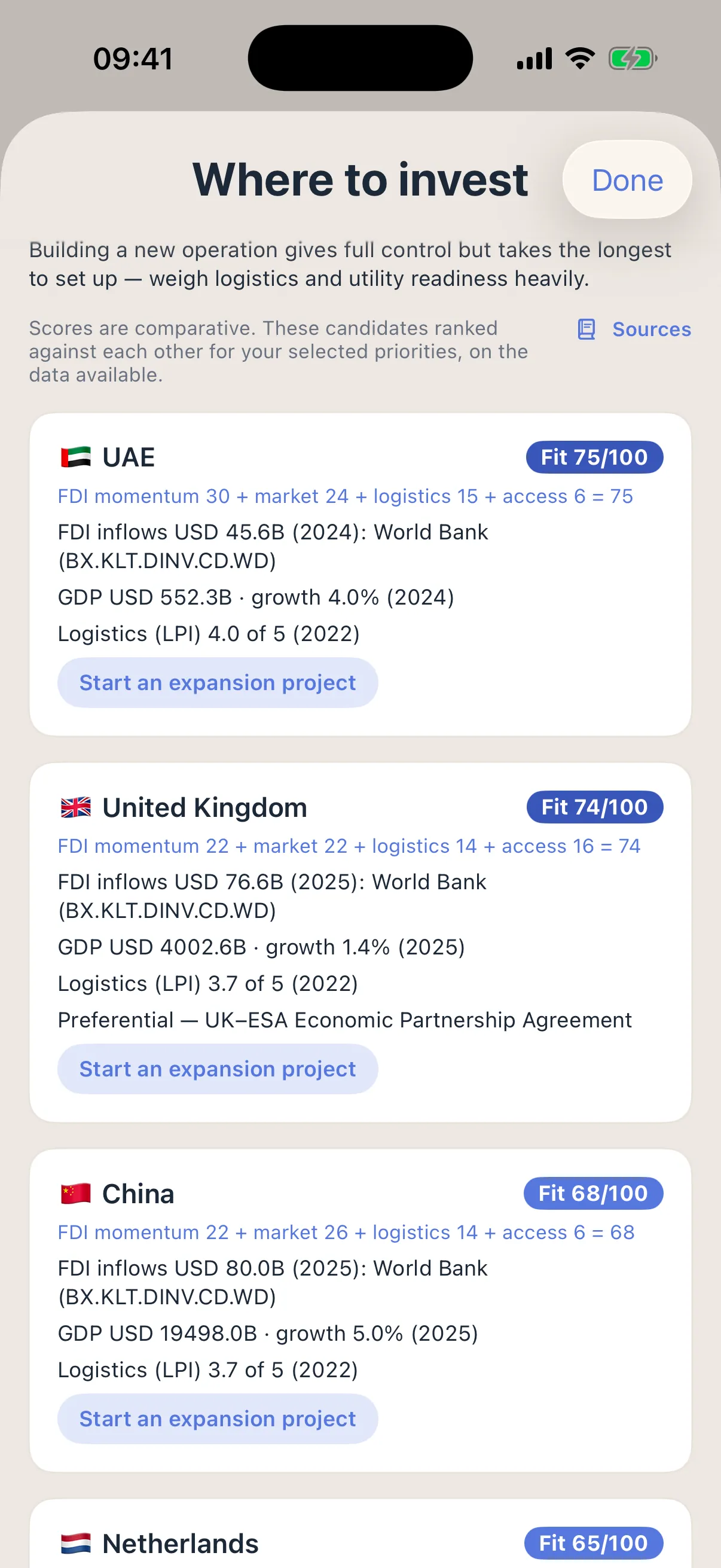
Where to invest, free on the web and iPhone, compares up to five countries for an acquisition, weighted by what matters to you, and gives each a location fit out of 100 with every figure’s source and year. The scores compare the countries you chose; they do not grade a country. Start an expansion project from a result, then choose Acquisition (M&A) as the route: the web lists it, and on iPhone the route advisor or Meridian’s Set entry method card sets it.
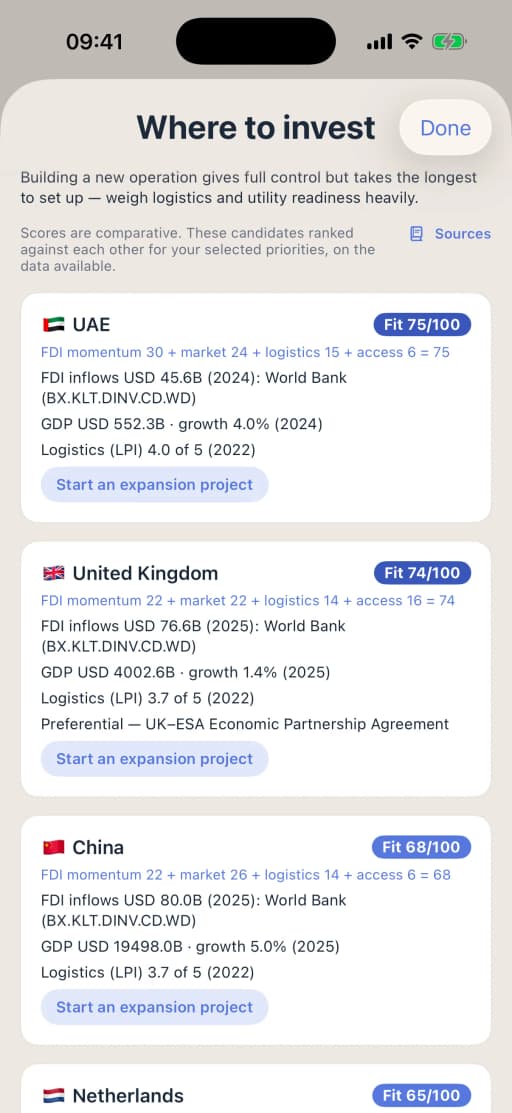
Where to invest on iPhone, comparing countries. Connect
Step 2: Build a list of targets and approach them
Ask your advisors and your bank, industry associations, investment promotion agencies, chambers, and your own suppliers and customers which companies might sell. Keep several targets in play, because talking to only one weakens your position, and sign a confidentiality agreement before any information changes hands.
What this step produces
- A long list and a shortlist of targets
- Confidentiality agreements
Common mistake: Approaching only one target, which weakens your negotiating position.
With Promote:Global
On the project, Search for possible partners looks on the open web for whoever you describe, such as a company of a given size in your sector and country, ranked by fit, for 1 AI action; each result is a lead to check. Investment promotion agencies can publish investment opportunities on Promote:Global, and every signed-in company can browse the open ones, with those matching its markets and sectors first, and express interest. Your chamber or trade agency can also introduce you, if the other side accepts.
Prepare
Step 3: Value the target and choose a share or asset deal
Private companies are usually valued in three ways: by the market (multiples of comparable companies), by income (discounted future cash flows) and by adjusted net assets, all three described in the IFRS Foundation’s educational material on unquoted shares1. Adjust for country risk, currency and the premium for control.
Choose the structure at the same time, because it changes the price. In a share deal, the company’s assets, liabilities, contracts, employees and permits stay with it, though change-of-control clauses can give counterparties rights. In an asset deal you choose the assets and liabilities, but contracts need the counterparty’s consent, and in most European countries employees transfer by law with the business. A 2010 guide to Swiss practice notes that share deals are the usual choice, that buyers pick an asset deal to leave unknown liabilities behind, that the tax treatment differs so an asset deal can cost more, and that permits granted to the company may not move with its assets2.
Put the indicative price, the intended structure, exclusivity and the key conditions in a letter of intent or term sheet.
What this step produces
- A valuation range
- A structure note with tax advice
- A letter of intent or term sheet
Common mistake: Using home-market multiples without adjusting for the target’s country.
You do this step yourself
Promote:Global does not value companies or give tax advice; your accounting and deal advisors do. Keep their range and the term sheet as notes on the project, which Meridian reads when you ask about it.
Connect
Step 4: Run due diligence
Cover the target’s finances, legal position, tax, employment, commercial position, information technology and data, environmental exposure, and anti-corruption and responsible-business risks. The OECD’s due diligence guidance for responsible business conduct sets out how to identify and act on risks to workers, human rights, the environment, bribery, consumers and governance, in a company’s own operations and in its business relationships8.
Use local advisors rather than relying on data the seller prepared, and carry each finding into the price, the agreement or the integration plan.
What this step produces
- Due-diligence reports with red flags, price adjustments and conditions
Common mistake: Relying on seller-prepared data without local advisors.
You do this step yourself
Due diligence is yours, done by the accountants and lawyers you hire; Promote:Global checks no firm. Run financial, legal & tax due diligence carries Find an advisor for this market, to help you find advisory firms with experience of the market.
Prepare
Step 5: Check foreign-investment screening and merger control early
Screening is now widespread: in a March 2024 note, the OECD reported that it had become the most common tool among the economies in its investment roundtable, usually through mechanisms covering every sector, though most transactions are cleared3. In the US, CFIUS reviews certain foreign investments in US businesses for national security, through a short declaration or a full notice9,10. The UK’s National Security and Investment Act, in force since January 2022, makes notification mandatory for qualifying acquisitions in 17 sensitive areas and lets the government call in others7. In the European Union, a revised screening regulation was adopted in 2026 and applies 18 months after it enters into force; it makes screening mandatory in every member state for a minimum list of sectors11,12.
Merger control is separate. Deals with an EU dimension, for example combined worldwide turnover above 5 billion euros and EU turnover above 250 million euros for each of at least two parties, must be notified and cannot close before clearance4. Many other countries have their own thresholds and waiting periods. Put the answers, with any sector regulator and employee consultation, in one timetable: it sets the earliest closing date and the long-stop date you will negotiate.
What this step produces
- A filing matrix and timetable
Common mistake: Leaving the filing analysis until after signing, when the timetable can no longer shape the agreement.
With Promote:Global
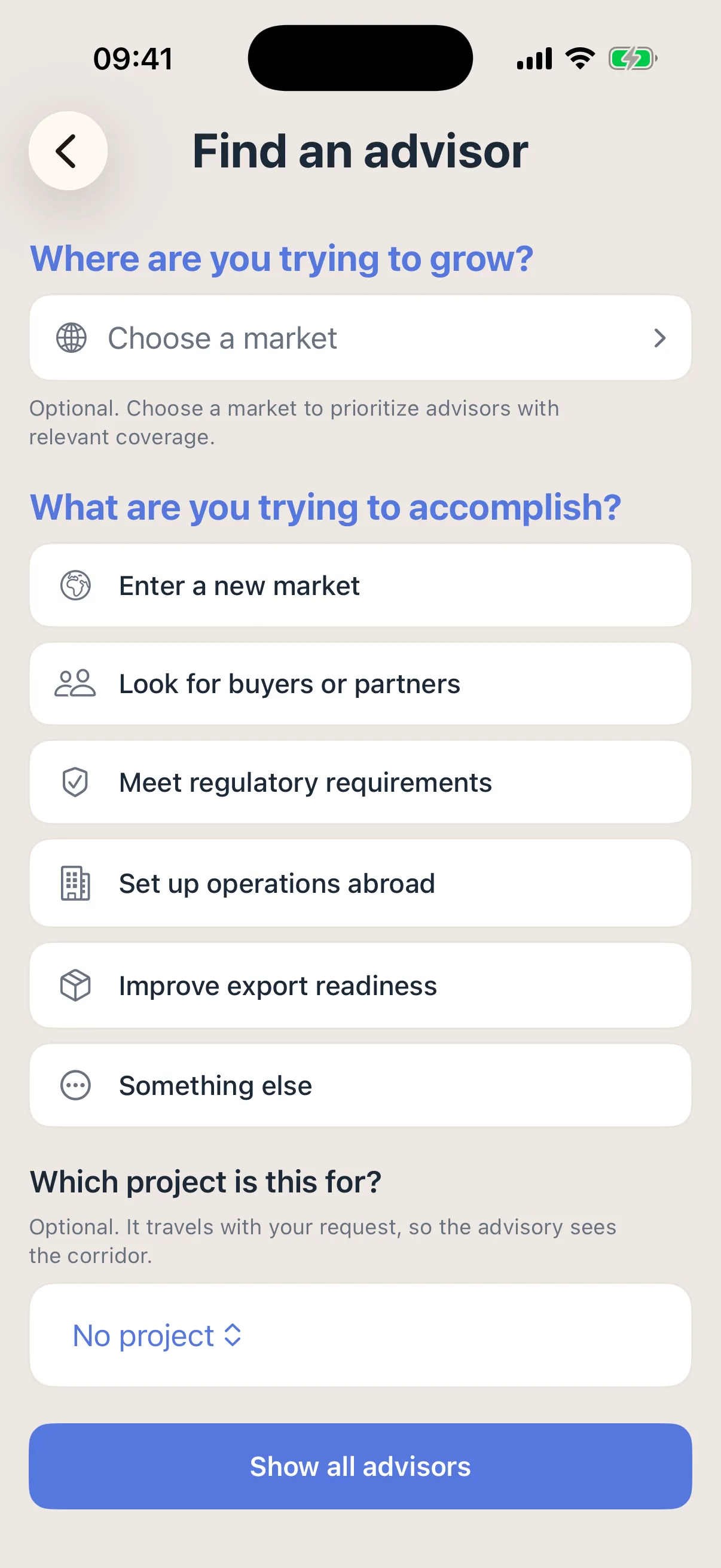
Check foreign-investment & competition approvals carries Find an advisor for this market. Promote:Global files nothing and gives no legal advice: the filing analysis comes from your counsel.
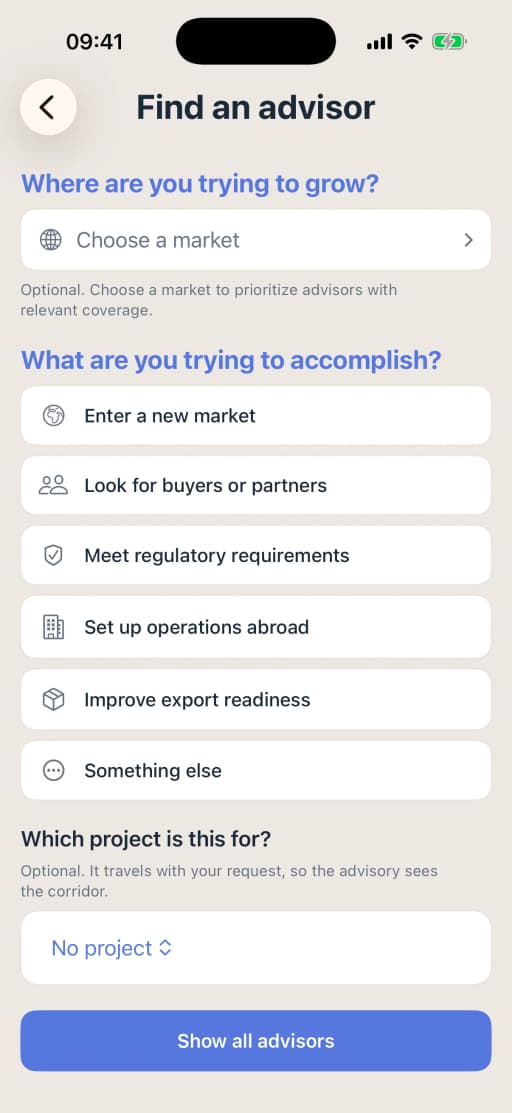
Finding an advisor for a market on iPhone. Prepare
Step 6: Plan the integration before you sign
Plan the first 100 days during due diligence, not after closing. A 100-day plan published by the accounting bodies AICPA and CIMA recommends carrying the risks and opportunities found in diligence into the plan, settling the organization early, forming cross-functional teams under one project manager, involving top performers, and tracking a few measures tied to why you bought the company5.
Decide who must stay, and agree retention terms with the people who hold the customer relationships so they are in place by closing. The plan is carried out only after clearance and closing.
What this step produces
- An integration plan with its lead, owners and measures
- A communication plan
- Retention terms for key staff
Common mistake: Leaving integration until after closing, so the first weeks go on planning instead of acting.
You do this step yourself
The plan’s Plan the first 100 days of integration step comes after Sign & complete the purchase, so add this planning as its own step before signing with Add a step, and keep the plan as notes on the project, which Meridian reads when you ask about it. Promote:Global does not run integrations.
Prepare
Step 7: Negotiate and sign the purchase agreement
Confirm the price and the structure in the light of the diligence. The share or asset purchase agreement then sets the price mechanics (completion accounts or a locked box), the seller’s warranties, specific indemnities for known risks, the conditions such as approvals and key consents, what each side may do between signing and closing, and the limits on claims. Make each required approval a condition, since a deal that needs clearance cannot close without it4, and set a long-stop date by which the conditions must be met.
A buy-side warranty and indemnity policy lets you claim against an insurer, rather than the seller, if a warranty proves untrue, which can reduce the money held back from the seller6.
What this step produces
- Share or asset purchase agreement, signed
- The seller’s disclosure letter
- A warranty and indemnity policy, if used
Common mistake: Accepting broad disclosure against the warranties, which strips the value from them.
With Promote:Global
Agree the price & the deal structure carries Find an advisor for this market, which opens advisory firms with experience of the market; they see what you share with them for that work. Your lawyers draft the agreement: Promote:Global does not draft or review contracts or arrange insurance.
Prepare
Step 8: Meet the conditions
Between signing and closing, make the screening and merger-control filings, answer the authorities’ questions, collect the third-party consents the agreement lists, and run any employee consultation the law requires. Track each condition against the long-stop date. Keep the two companies apart until clearance: running the target as your own before then, known as gun-jumping, breaches the standstill4.
What this step produces
- Filings and clearance decisions
- Third-party consents
Common mistake: Letting the long-stop date approach with a consent nobody has asked for yet.
You do this step yourself
Your counsel makes the filings and collects the consents; Promote:Global files nothing on your behalf. The plan holds signing and completing in one step, Sign & complete the purchase, so add this one before it with Add a step.
Prepare
Step 9: Close the purchase
At closing, transfer the money and the shares or assets, appoint directors, and update the registers, including the register of beneficial owners, along with bank mandates and signatories. Local formalities, such as notarization or registry filings, can be what makes the transfer effective, so list them with local counsel before the closing date.
What this step produces
- The closing set: transfers, resignations, board minutes, proof of payment
Common mistake: Missing a local formality that makes the transfer effective.
With Promote:Global
Sign & complete the purchase carries Find an advisor for this market; tick it off at closing. Find service providers lists banking, legal and corporate, and accounting and tax firms that list themselves. Promote:Global registers nothing on your behalf.
Grow
Step 10: Run the first 100 days
From day one, explain the reasons for the deal consistently to staff, customers, suppliers and unions, and bring key people together in person, as the AICPA and CIMA plan recommends5. Look after the people and the customer relationships before the systems, and report the few measures the plan set.
What this step produces
- Integration progress reports
Common mistake: Fixing systems first while losing the people who hold the customers.
With Promote:Global
The plan ends with Plan the first 100 days of integration, which here stands for carrying out the plan you made before signing, and Set a compliance & reporting cadence. On the project, Documents and compliance tracks certificates and documents with their status and expiry, and an expired one blocks the project until it is renewed. The Revenue tracker adds up the revenue you log, by market and by project.
Your plan in Promote:Global
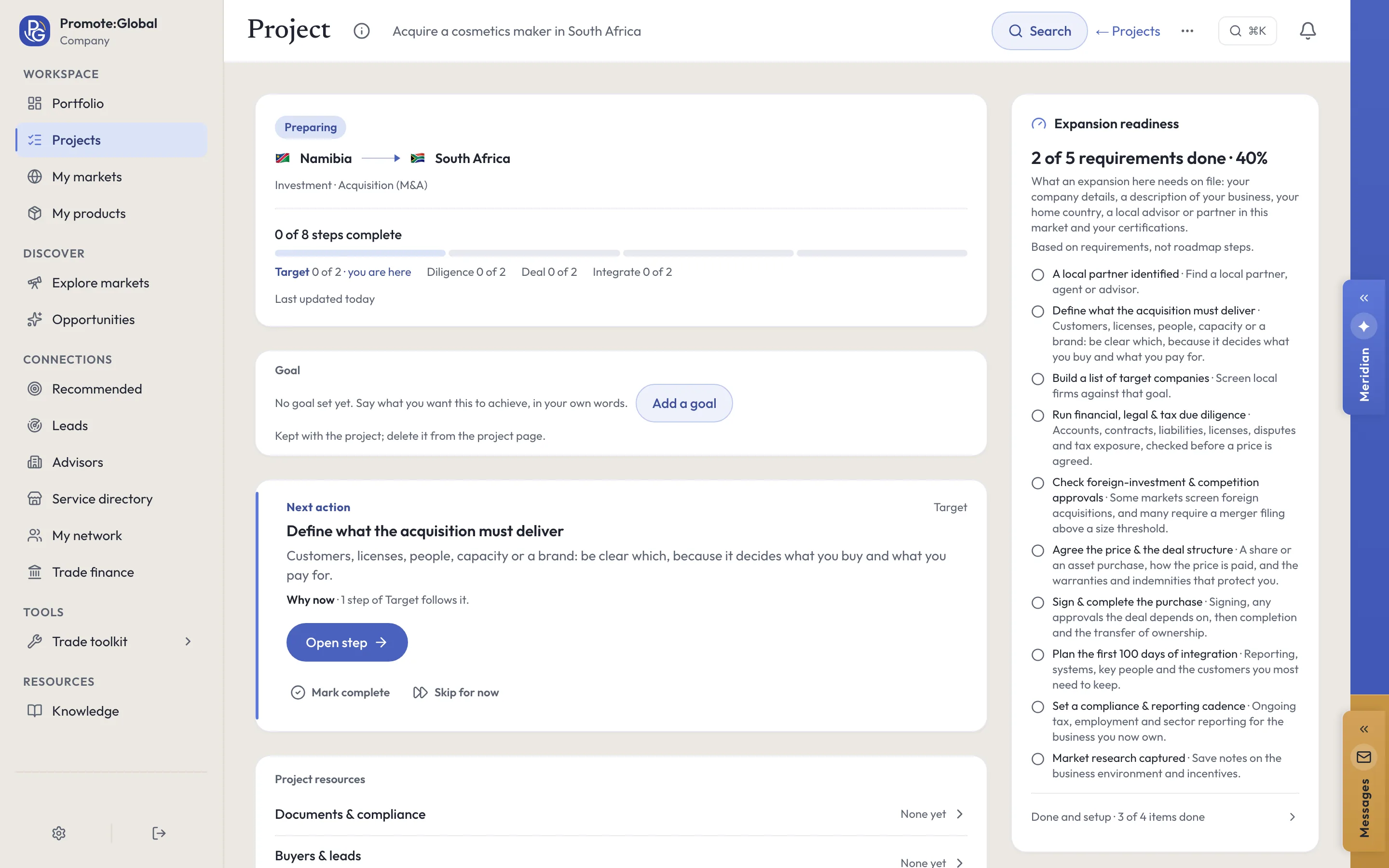
What an acquisition project looks like.
Create a project, choose “Acquisition (M&A)” under “How are you entering?”, and Promote:Global writes this plan for your product and market. The web lists the route; on iPhone, the route advisor or Meridian sets it. You tick steps off, skip one for now or add your own.
Target
- Define what the acquisition must deliver
- Build a list of target companies
Diligence
- Run financial, legal & tax due diligenceButton: Find an advisor for this market
- Check foreign-investment & competition approvalsButton: Find an advisor for this market
Deal
- Agree the price & the deal structureButton: Find an advisor for this market
- Sign & complete the purchaseButton: Find an advisor for this market
Integrate
- Plan the first 100 days of integration
- Set a compliance & reporting cadence
The plan is the route’s own checklist, with no customs steps by default. Where the work moves goods across a border, such as equipment, ingredients, samples or branded supplies, add those steps yourself. You can add, reorder and skip steps. In your own project, each step names your product and your countries. Building the plan uses no AI action.
On a project, Search for possible partners looks on the open web for whoever you describe, ranked by fit, for 1 AI action. A result is a lead to check before you contact anyone, not a confirmed partner.
Make the plan fit this route
The plan for this route is its own checklist, from “Define what the acquisition must deliver” to “Set a compliance & reporting cadence”. It holds signing and closing in one step and plans the integration after it. Add these four, tick “Sign & complete the purchase” off at closing, and use “Plan the first 100 days of integration” to carry out the plan you made before signing.
- Value the target and agree a letter of intent (after “Build a list of target companies”, before “Run financial, legal & tax due diligence”)
- Name the integration lead and plan the first 100 days (after “Check foreign-investment & competition approvals”, before “Agree the price & the deal structure”)
- Sign the purchase agreement (after “Agree the price & the deal structure”)
- Meet the conditions: clearances and consents (next, before “Sign & complete the purchase”)
On the project, type a step into Add a step under the roadmap, or ask Meridian to propose them: a step Meridian proposes is added only when you accept its card.
Meridian
Meridian, on your acquisition project.
Meridian, the built-in AI assistant on the web and on iPhone, reads the project you have open: its route, its countries, the steps still open and your notes. It answers questions about them, and it proposes changes as cards. Nothing changes on the project until you accept a card. Ask it to search for possible partners and it runs the project’s search in the conversation, looking on the open web for whoever you describe, for 1 AI action; every result is a lead to check.
Ask
- What’s the next step on this project?
- What’s blocking this project?
- What should our due diligence cover?
Do
Add a step — to this plan, as a card you accept
Save a note — to the project
Set entry method — one of the eighteen routes, with its reason, if another fits you better
Every plan carries a monthly allowance of AI actions, and each question uses 1. Building the plan uses none, and neither do Where to invest and First hire. Meridian is AI. Verify before acting.
Documents
The paperwork.
- Confidentiality agreement and letter of intent
- Signed before information is shared; the letter sets the indicative price, the intended structure, exclusivity and the key conditions.
- Valuation and due-diligence reports
- Financial, legal, tax, employment, environmental and responsible-business findings, with red flags and price adjustments1,8.
- Integration plan
- The first 100 days, with a lead, owners, measures and a communication plan, written before signing5.
- Share or asset purchase agreement
- Price mechanics, warranties, specific indemnities, conditions, a long-stop date and limits on claims, with the seller’s disclosure letter.
- Warranty and indemnity policy
- If you use one: what it covers and what it excludes6.
- Screening filings and clearances
- Such as a CFIUS filing in the US, a notification under the UK’s National Security and Investment Act, or a member state’s screening in the EU7,10.
- Merger-control filing and clearance
- Where turnover thresholds are met, before the deal closes4.
- Employee transfer and consultation documents
- Where the law moves employees with the business, as it often does in an asset deal2.
Costs and timelines
What to budget for.
Get quotes for
- Valuation and deal advice
- Moves with the target’s size, the number of countries and how many valuation methods are run1.
- Due diligence
- Financial, legal, tax, employment, information technology and data, environmental and responsible-business work; moves with the scope and the target’s countries8.
- Screening and merger-control filings
- Counsel’s analysis and each filing; moves with the number of regimes the deal falls under. A CFIUS notice may carry a filing fee10.
- The purchase agreement
- Moves with the structure: an asset deal needs the counterparty’s consent for each contract it moves2.
- Warranty and indemnity insurance
- If used, the premium moves with the policy limit, the retention and the exclusions, and differs by market and year6.
- Integration
- Retention terms for key people, the integration team and any systems work; moves with the plan5.
- Closing formalities
- Notary, registry and translation costs, where local law makes them part of the transfer.
What sets the timing
- Finding a target and agreeing a letter of intent; the sources consulted give no typical timeline.
- Due diligence, which moves with its scope and the target’s countries.
- Screening: CFIUS assesses a declaration in 30 days and reviews a notice in 45, with a possible further 45-day investigation10; under the UK’s National Security and Investment Act, the review runs from when a notification is accepted7.
- Merger control in the EU: a first-phase review takes 25 working days (35 with commitments), an in-depth second phase 90 working days, with possible extensions4.
- The long-stop date in the agreement, set from the slowest approval or consent.
Ask for each quote in writing, for your product, market and volumes. Prices and timings differ by country, provider and year.
Mistakes and best practices
What goes wrong, and what works.
Common mistakes
- Treating warranty and indemnity insurance as a substitute for due diligence: insurers exclude known risks and areas where the diligence was narrow6.
- Leaving the cost of the integration, and of keeping the key people, out of the price you offer.
Best practices
- Appoint local legal, tax and accounting advisors before you sign a term sheet.
- Send every red flag from the diligence to one of three places: the price, a specific indemnity or condition, or the integration plan.
- Keep one closing checklist across your counsel in each country, with every filing, consent and local formality set against the long-stop date.
Questions
Questions people ask.
What is the difference between a share deal and an asset deal?
In a share deal you buy the company with everything in it, and its contracts, employees and permits generally stay with it. In an asset deal you buy chosen assets and liabilities, which needs counterparties’ consent and often moves employees by law2.
Do I need government approval to buy a company abroad?
Often, for two separate reasons: merger control where turnover thresholds are met, and foreign-investment screening in sensitive sectors. Most screened cases are cleared, but many regimes require clearance before closing3,4.
What is the difference between signing and closing?
Signing commits buyer and seller to the purchase agreement on its conditions. Closing comes once the conditions, such as clearances and consents, are met, when the money and the shares or assets change hands. A deal that must be notified cannot close before clearance4.
Sources
Where this guide comes from.
- [1]Measuring the fair value of unquoted equity instruments (IFRS 13 education material) · IFRS Foundation, 2012, updated 2013
- [2]Negotiated M&A guide, Switzerland chapter · Schellenberg Wittmer, law firm, for the International Bar Association, 2010
- [3]Managing security implications of international investment: policy developments in a changing world (research note) · OECD, 2024
- [4]Merger procedures · European Commission, Directorate-General for Competition
- [5]Crafting a 100-day M&A integration road map · FM magazine, AICPA & CIMA, 2020
- [6]Introduction to warranty and indemnity insurance in M&A transactions · Lander & Rogers, law firm, 2022
- [7]National Security and Investment Act 2021 · UK Cabinet Office, Investment Security Unit, on GOV.UK
- [8]OECD Due Diligence Guidance for Responsible Business Conduct · OECD, via the Dutch National Contact Point, 2018
- [9]Committee on Foreign Investment in the United States · U.S. Department of the Treasury
- [10]CFIUS filing guidance · U.S. Department of the Treasury
- [11]Revision of the FDI Screening Regulation (Legislative Train Schedule) · European Parliament, 2026
- [12]Agreement to protect EU strategic sectors from risky foreign investments · European Parliament, 2025
Reviewed October 26, 2026. This guide is general information about how companies do this, written in our own words from the sources above; it is not legal, tax or financial advice. Rules differ by country and change, so check them with the authority or an advisor before you act. What it says Promote:Global does is what the product does today. The screens on this page come from our demo workspace, and the companies in them are invented.
Read next
Related guides.
- How to form an international joint venture
Joint venture · Investment / FDI
- How to set up a subsidiary abroad
Wholly-owned subsidiary · Investment / FDI
- How to make a greenfield investment abroad
Greenfield investment · Investment / FDI
All eighteen guides Promote:Global for international expansion Plans and prices
Start your acquisition project.
Sign up, add what you sell, then create a project and choose “Acquisition (M&A)” under “How are you entering?”. The plan above is written for your product and market.
Start this projectFree to start. No credit card needed. See plans and prices