How to set up a subsidiary abroad
Form a company of your own in a new country: legal form, directors, parent documents, capital, registration, tax and filings.
For a company that will sign local contracts, hire staff, hold stock or premises, or invoice in local currency in a new country, and plans to stay for several years.
On this page: In short
In short
In short
To set up a subsidiary abroad, decide what the local company must do, check the rules for foreign owners with the country’s investment promotion agency, choose the legal form, the directors and the address, and prepare your parent company’s documents1,2. Then pay in any capital the law wants before filing, register the company, open its bank account, register for tax and calendar the filings that recur every year2. A subsidiary is a separate local company your company owns, so its debts are its own, unlike a branch, where the parent answers for everything3,4.
The route in Promote:Global
Wholly-owned subsidiary · Investment / FDI
Commitment
Control
Risk
Rated 1 to 5, as the iPhone app rates every route when you choose one. The ratings are general, for the route itself: your own commitment, control and risk depend on your market, your product and your partners.
When it fits
Is a wholly-owned subsidiary the right route?
A good fit when
- You will sign contracts, employ people, hold stock or lease premises in the country, and want the parent’s assets kept apart from local liabilities3,4.
- Customers, banks or public buyers in the market expect to deal with a locally registered company.
- You expect to stay several years, long enough to justify annual accounts, tax returns and the duties of a director.
A poor fit when
- You only want to test demand. A distributor, an employer of record or a representative office costs less to start, though a representative office usually may not trade5,6.
- Your sector is closed to foreign owners or needs a local partner: Kenya, for example, limits foreign ownership of agricultural land and some professional services firms7.
- The running costs of directors, an address, an auditor and filings would outweigh the revenue the company can earn there.
The people involved
Who’s involved and how they work together
- Your company to Subsidiary: Share capital and know-how
- Subsidiary to Local market: Contracts, invoices, wages
- Local market to Subsidiary: Revenue, in local currency
- Subsidiary to Your company: Dividends, intercompany fees
Step by step
How to set up a subsidiary abroad, in 10 steps.
Each step says how companies do it, with sources, then what Promote:Global does there, or that the step is yours to do.
Discover
Step 1: Decide what the company must do, and where
Write down what the local company will do (sell, hire, hold stock, sign contracts, manufacture), how many people it needs and how long you plan to stay. That list decides the structure, and whether you need premises at all: a company that only signs contracts and invoices may need no more than a registered address at first.
Compare the shortlisted countries on how easy it is to set up and run a company there. The World Bank’s B-READY project measures, economy by economy, the rules, the public services and the time and cost of starting a business, for domestic and foreign-owned firms9.
What this step produces
- A one-page purpose memo
- A shortlist of two or three countries
Common mistake: Choosing the country on its headline tax rate alone, before writing down what the company will do there.
With Promote:Global
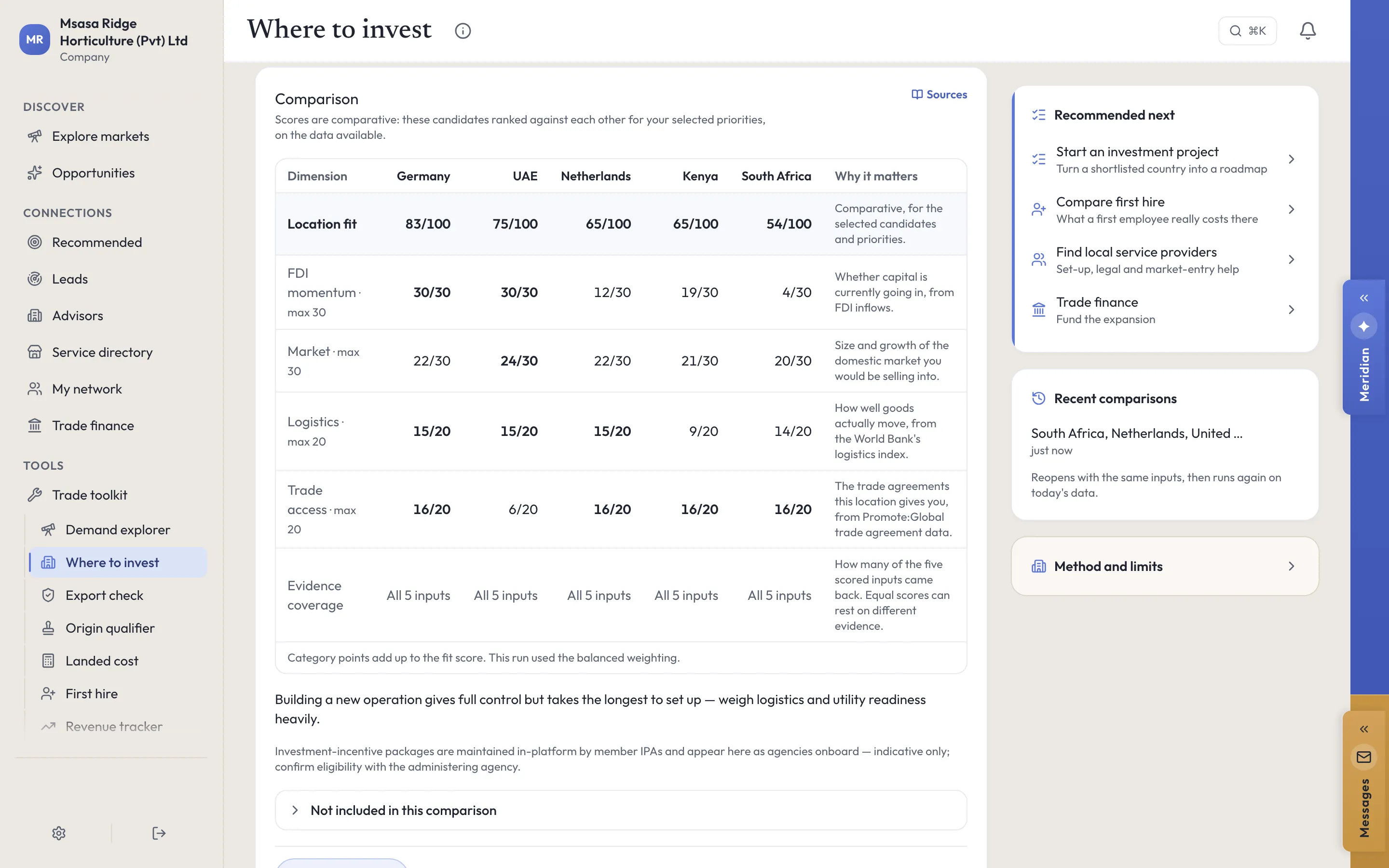
Where to invest compares up to five countries for setting up, weighted by what matters to you, and gives each a location fit out of 100 from investment momentum, market, logistics and trade access, every figure with its source and year. The scores compare the candidates; they do not grade a country. A market’s page adds the investment climate: foreign investment inflows, World Bank governance indicators and B-READY. Not sure a company of your own is the right step yet? The iPhone’s route advisor asks four questions and ranks up to three routes.
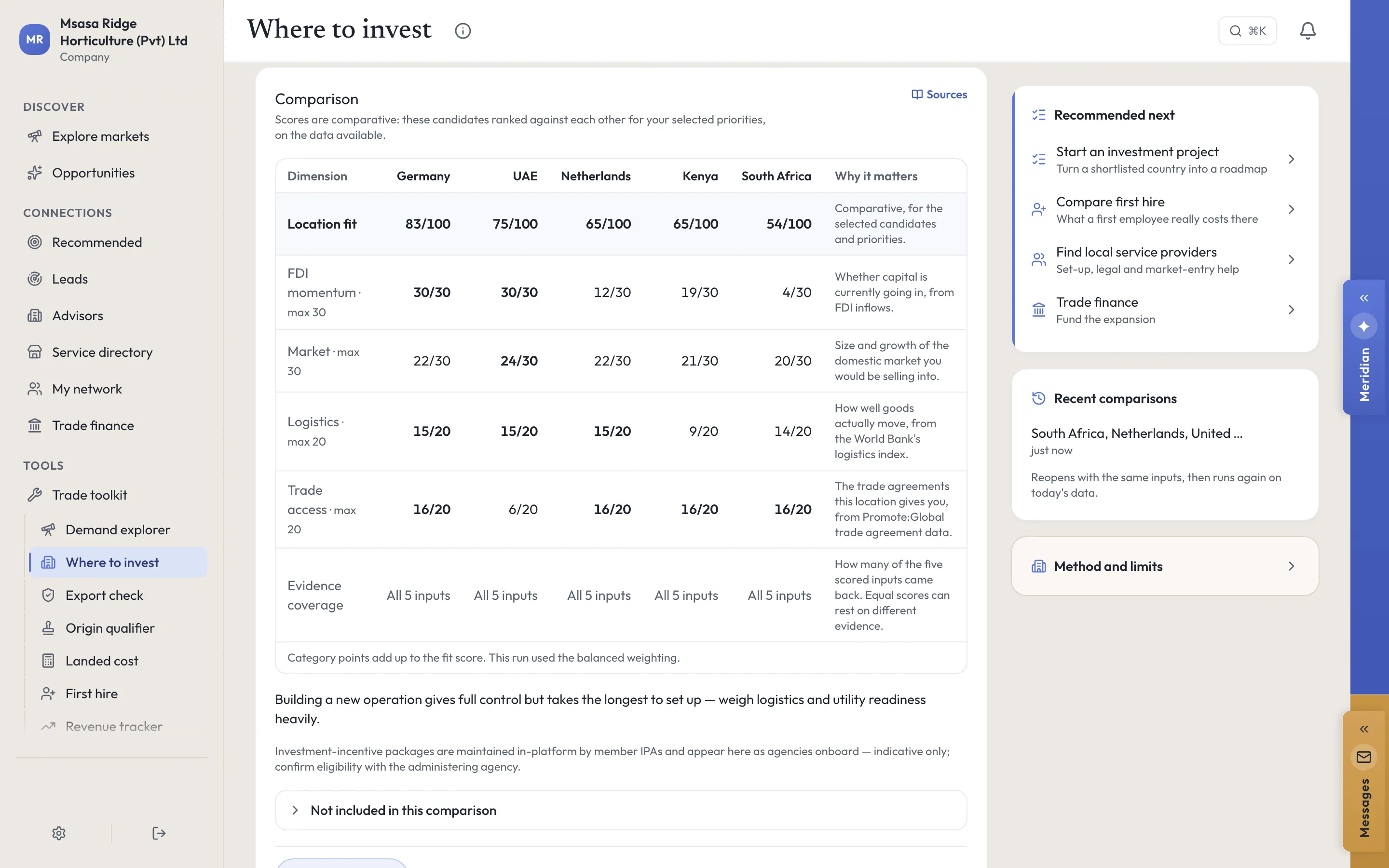
Where to invest on the web, comparing five countries. Click or tap to see the whole screen. Prepare
Step 2: Choose a subsidiary, a branch or a representative office
A subsidiary is a new local company, with its own legal personality, whose shares your company holds. A branch is your company itself, registered to operate in the country: it has no separate personality, so the parent answers for its debts and acts, and its results usually flow into the parent’s own tax return, where a subsidiary files its own3,4.
A representative office is lighter still, and in many countries it may only do market research and liaison work, not sign contracts or earn income, as Singapore and the Netherlands both describe it5,6. The words mean different things in different countries, so compare the options against what the operation will actually do, not against a template6.
What this step produces
- A structure memo with the reasons for the choice
Common mistake: Choosing a branch to save setup work, then finding the parent carries the liability and a taxable presence anyway3,4.
You do this step yourself
This choice is yours, with a lawyer or accountant in the country. Promote:Global gives no legal or tax advice, and its routes do not include a branch or a representative office: the plan it writes for this route is for a company of your own.
Connect
Step 3: Check the entry rules with the investment promotion agency
Find out whether your sector needs a license, an approval for foreign investment or a minimum local share. Lists differ by country: a U.S. government guide to Belgium says no prior authorization is needed except in a few sectors such as banking, insurance, pharmaceuticals and broadcasting3, while Kenya limits foreign ownership of agricultural land and of some professional services firms7.
Ask the investment promotion agency, or the country’s one-stop shop, before you pay anyone to register; UNCTAD recommends that governments give investors a single enquiry point and a lead agency1. Ask about incentives only if the company will invest in premises, equipment or jobs on a scale that could qualify.
What this step produces
- A note on restrictions and approvals, from counsel or the agency
- A checklist of local requirements
- A named contact at the agency
Common mistake: Registering first and asking later, then redoing documents the registry rejects.
With Promote:Global
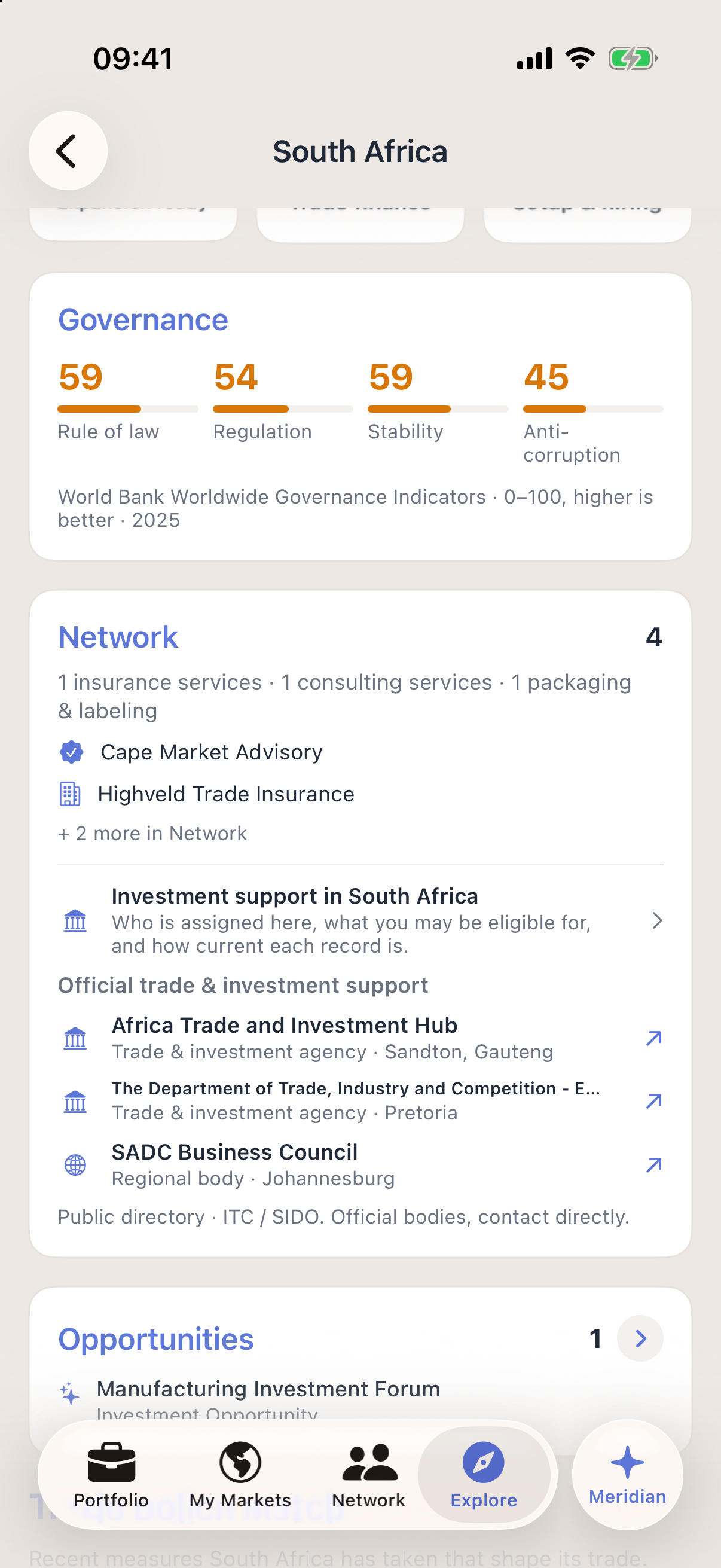
A market’s page lists the official trade and investment bodies for the country, from a public directory, for you to contact directly. Investment promotion agencies can also publish investment opportunities on Promote:Global, which every signed-in company can browse, those matching its markets and sectors first, and express interest in. The plan’s Engage the investment promotion agency step carries Find an advisor for this market. Promote:Global does not hold sector ownership limits or incentive packages: ask the agency what applies to you, and keep the answer as a note on the project, which Meridian reads when you ask about it.
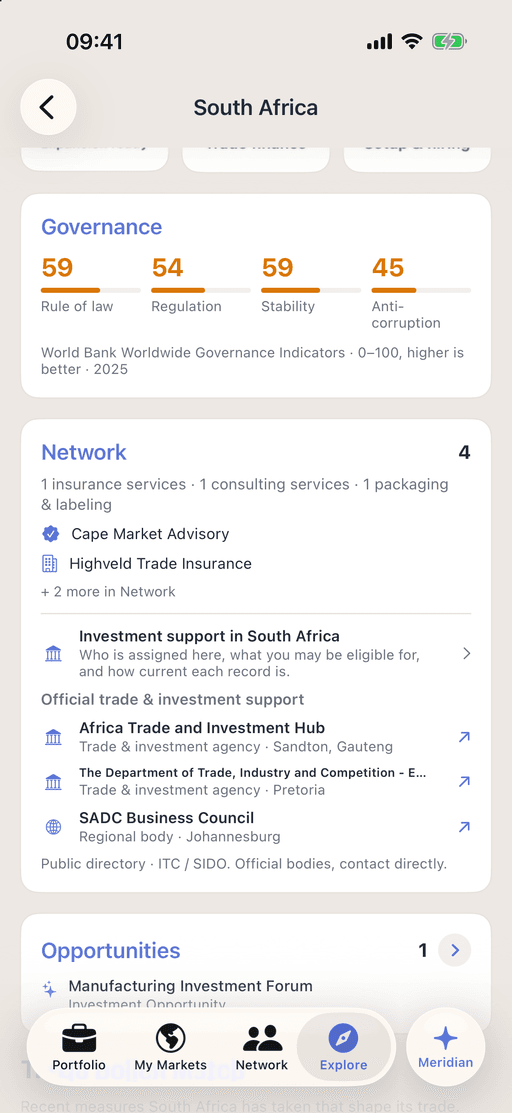
The official trade and investment bodies listed on a market’s page. Prepare
Step 4: Choose the legal form, the directors and the address
Most foreign owners choose the country’s private limited company, such as Germany’s GmbH. Some forms carry a minimum capital: a standard GmbH needs 25,000 euros of share capital, at least 12,500 of it paid in when it is registered2.
Rules on directors and addresses vary. Germany treats the nationality and residence of shareholders and managing directors as irrelevant, but wants a German business address2. Singapore sets local residency requirements for the people who register and run a company there, and lists which pass holders meet them10. If you appoint a local nominee director to meet such a rule, understand the liability that person takes on, and the control you give up.
What this step produces
- Draft articles of association
- A board plan
- A registered address
Common mistake: Discovering a residency rule for directors or the company secretary after the papers are drafted.
With Promote:Global
The plan’s Choose the entity type step carries Find an advisor for this market, which opens advisory firms with experience of the market. Find service providers lists firms under legal and corporate, and under domiciliation for a registered address. Firms list themselves, Promote:Global does not check them, and whether one is listed for your market varies.
Prepare
Step 5: Prepare the parent company’s documents
Registries usually want an extract from your home commercial register, your constitutional documents, a board resolution approving the subsidiary and proof of who may sign for the parent, such as a power of attorney, often notarized, apostilled and translated2. Ask the registry or your notary for the exact list and form before you start, and prepare them in one round.
What this step produces
- A commercial register extract
- A board resolution and a power of attorney
- Notarized, apostilled and translated copies
Common mistake: Sending parent documents unlegalized or untranslated, so the registry rejects them2.
You do this step yourself
A notary, lawyer or corporate service provider prepares these with you; Promote:Global does not legalize documents. Add this step before Register the entity with Add a step.
Prepare
Step 6: Pay in the capital and register the company
Check which comes first, the capital or the filing. In some countries the share capital must be in the company’s account before the registration is filed: in Germany it is paid in before the notary, who drafts the articles, files them electronically2. Elsewhere the account is opened after registration. In Singapore a foreign owner registers through a corporate service provider5.
Until it is registered, the company may not protect you: in Germany it has limited liability only once registered, so acting for it before then can make you personally liable2. Where the law keeps a register of beneficial owners, as Germany’s transparency register does, the owners are entered in it2.
What this step produces
- Evidence of the capital paid in, where it is due first
- Certificate of incorporation and registry number
- Beneficial-owner entry, where required
Common mistake: Signing contracts or leases for the company before it is registered2.
You do this step yourself
Promote:Global does not register companies or legalize documents: a notary, lawyer or corporate service provider does that with you. The plan’s Register the entity step carries Find an advisor for this market, and you tick it when the certificate is in hand.
Prepare
Step 7: Open the bank account and register for tax
Where the account was not needed for the registration, open it now. Banks usually ask for the registration documents, the beneficial owners, the directors’ identity and a business plan2. Record the money you put in as share capital or as a documented loan, never as informal transfers.
Then register for corporate income tax, VAT or sales tax where it applies, payroll and social security, and any trade or sector license. In Germany the local trade office must be told before operations start2.
What this step produces
- Bank account and capital contribution evidence
- Tax, VAT and payroll registrations
- Trade or sector licenses
Common mistake: Hiring staff before the company is registered for payroll.
With Promote:Global
The plan’s Set up banking & tax registration step carries Find service providers, where firms list themselves under banking, and under accounting and tax. A request to a firm carries your company’s contact card, shown to you before you send it, and the firm answers in Messages.
Prepare
Step 8: Price intercompany dealings, and check permanent establishment
Everything the parent and the subsidiary charge each other, for goods, services, brands or loans, should follow the arm’s length principle in the OECD Transfer Pricing Guidelines: priced as unrelated companies would price it, set out in written intercompany agreements and documented8.
Check separately whether the parent still has a taxable presence of its own. Under Article 5 of the OECD Model Tax Convention, a fixed place of business or a person who habitually concludes contracts for the parent can create a permanent establishment, and in November 2025 the OECD updated its commentary on when a home office counts as a place of business11.
What this step produces
- Intercompany agreements
- A transfer pricing file
- A permanent-establishment memo
Common mistake: Invoicing the subsidiary for months with no written agreement, which makes later adjustments hard to defend8.
You do this step yourself
Promote:Global gives no tax advice and drafts no agreements. Your tax advisor sets the prices and writes the memo; keep a note of the decision on the project.
Grow
Step 9: Hire the first people
Use employment contracts written for local law, not your home template, and register as an employer before anyone starts. Decide early who may sign for whom: the subsidiary is taxed on its own profits, but if its staff habitually conclude contracts in the parent’s name, the parent can have a permanent establishment in the country as well11.
What this step produces
- Job descriptions
- Local employment contracts
- A signing-authority list
Common mistake: Letting the subsidiary’s sales lead sign deals in the parent’s name.
With Promote:Global
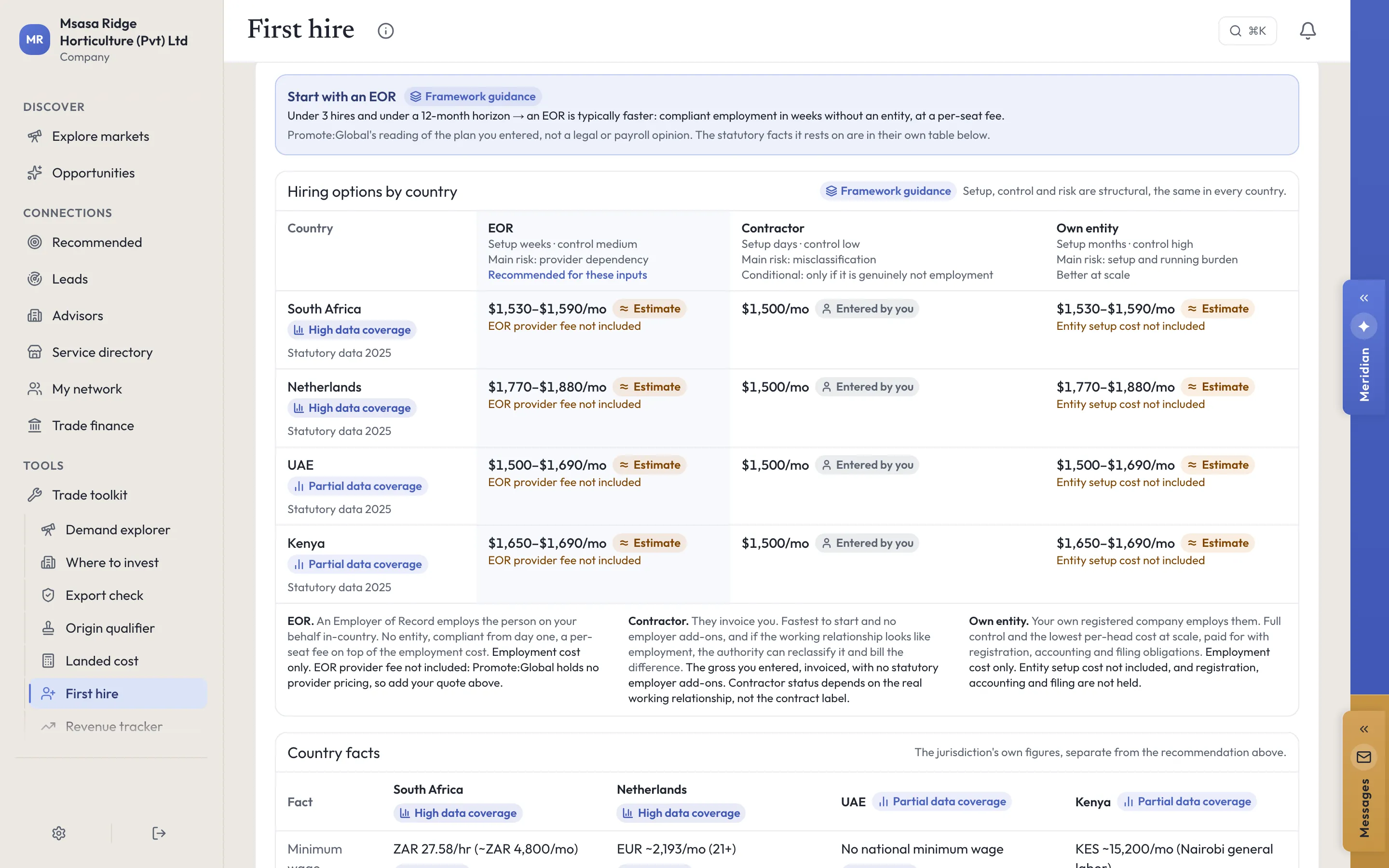
First hire compares hiring through an employer of record, as a contractor or through your own company, in up to four countries: the minimum wage with its year, an estimated employer cost, notice and leave rules, and a recommendation. It is free, says where it has no data, and is orientation, not payroll or legal advice. The plan’s Hire the local team step carries Find service providers, with recruitment and HR, and payroll and benefits. Promote:Global does not recruit or run payroll.
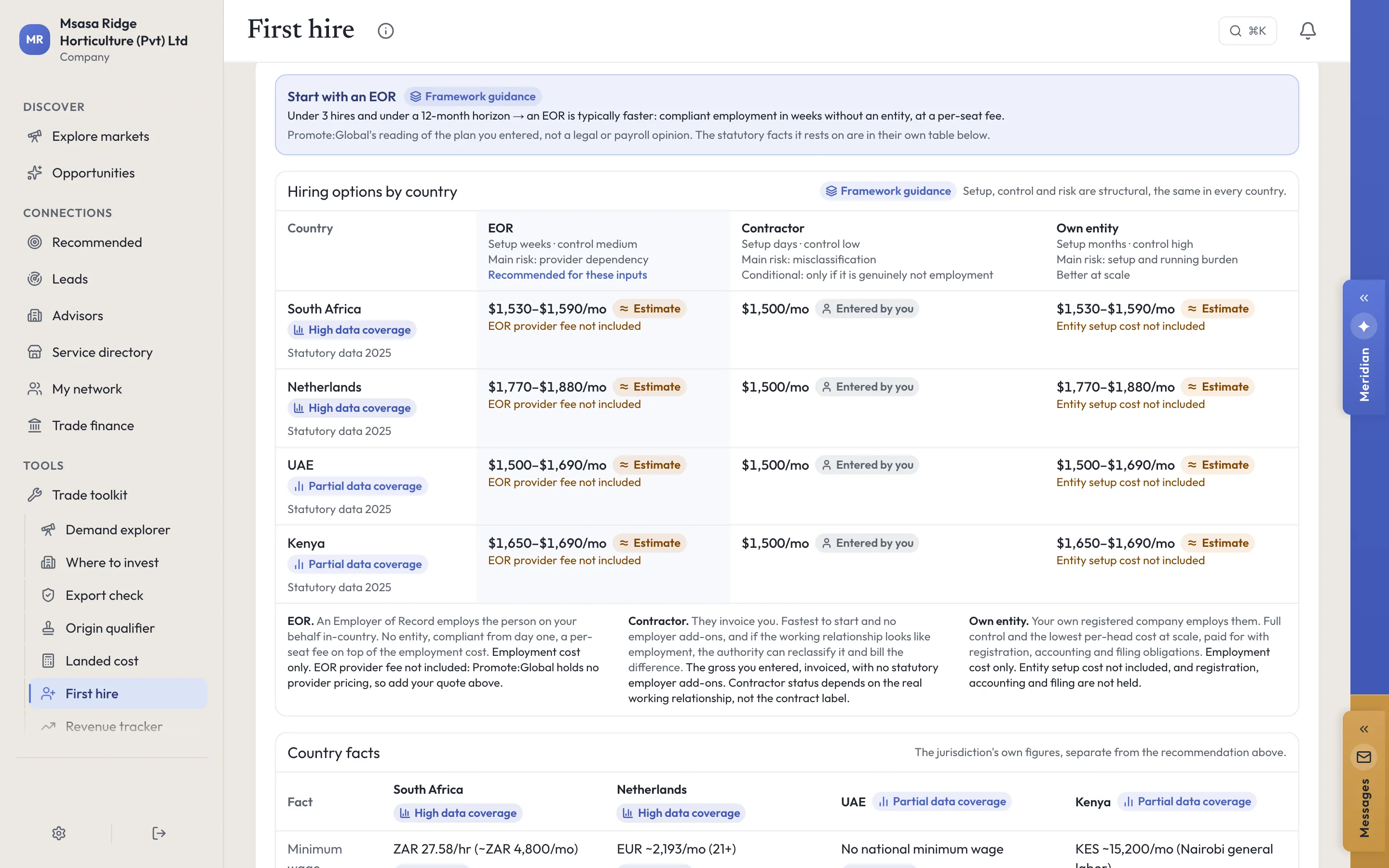
First hire on the web, comparing an employer of record, a contractor and your own company. Click or tap to see the whole screen. Grow
Step 10: Calendar the filings that recur every year
Put every recurring duty in one calendar: the registered address, annual accounts, tax returns, any audit, director filings, and the parent’s own filings about the subsidiary. Then go back to the investment promotion agency, whose aftercare can help with permits, problems and expansion once you operate12.
What this step produces
- A compliance calendar
- A six-month review
Common mistake: Treating registration as the finish line and letting the registered address or a filing lapse.
With Promote:Global
The plan ends with Set a compliance & reporting cadence. On the project you can keep certificates and documents with their status and expiry date, and an expired one blocks the project until it is renewed. Promote:Global files no accounts or returns: your accountant does.
Your plan in Promote:Global
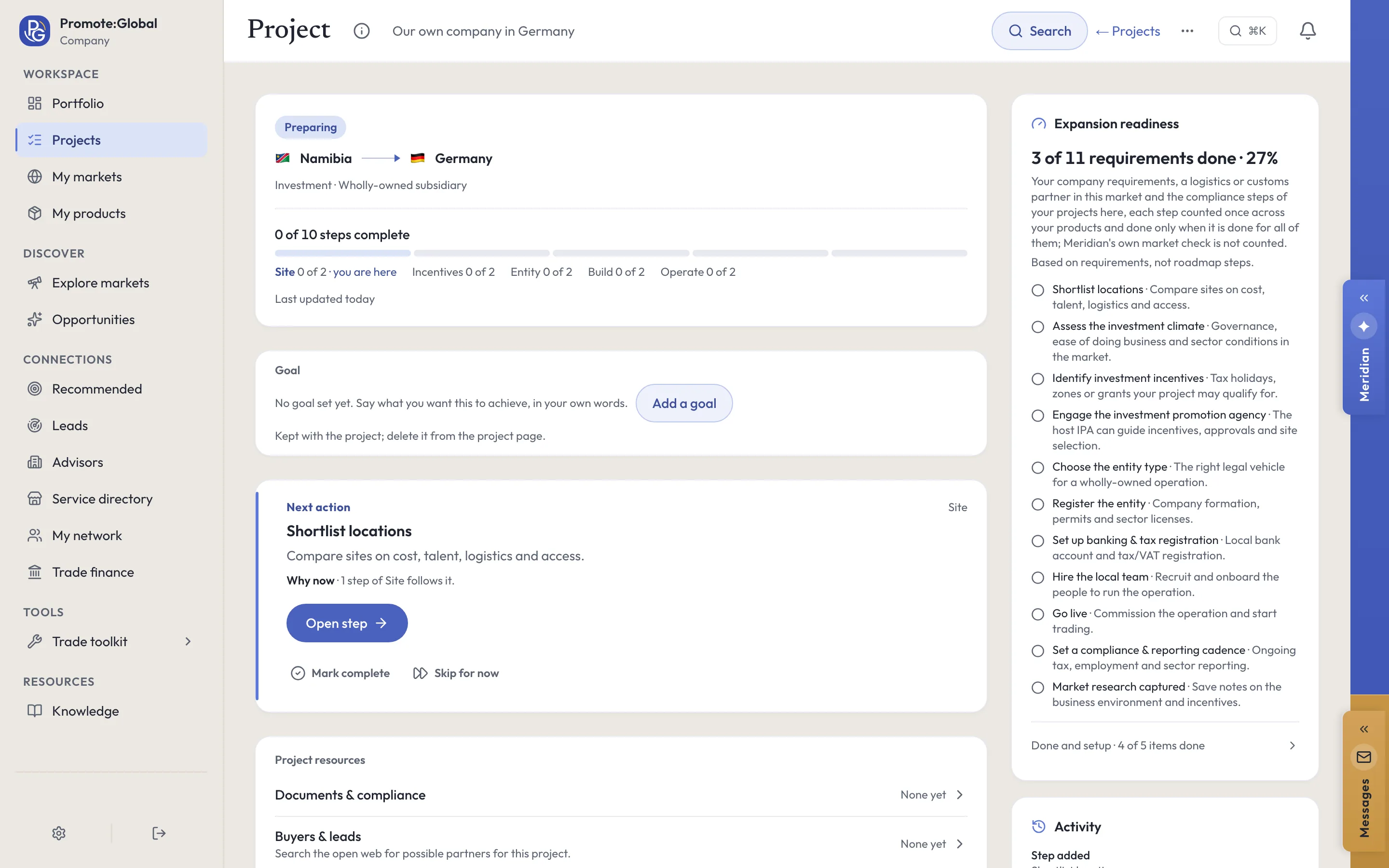
What a wholly-owned subsidiary project looks like.
Create a project, choose “Wholly-owned subsidiary” under “How are you entering?”, and Promote:Global writes this plan for your product and market. The web lists the route; on iPhone, the route advisor or Meridian sets it. You tick steps off, skip one for now or add your own.
Site
- Shortlist locations
- Assess the investment climate
Incentives
- Identify investment incentivesButton: Find an advisor for this market
- Engage the investment promotion agencyButton: Find an advisor for this market
Entity
- Choose the entity typeButton: Find an advisor for this market
- Register the entityButton: Find an advisor for this market
Build
- Set up banking & tax registrationButton: Find service providers
- Hire the local teamButton: Find service providers
Operate
- Go live
- Set a compliance & reporting cadence
The plan is the route’s own checklist, with no customs steps by default. Where the work moves goods across a border, such as equipment, ingredients, samples or branded supplies, add those steps yourself. You can add, reorder and skip steps. In your own project, each step names your product and your countries. Building the plan uses no AI action.
On a project, Search for possible partners looks on the open web for corporate-services firms: company formation, legal, tax, or for whoever you describe, ranked by fit, for 1 AI action. A result is a lead to check before you contact anyone, not a confirmed partner.
Make the plan fit this route
For this route Promote:Global writes the greenfield checklist, which is built for a new operation with a site. For a company of your own, use Skip for now on “Shortlist locations” if the country is settled, and on “Identify investment incentives” unless the company will invest in premises, equipment or jobs; then add these five around the entity steps.
- Choose between a subsidiary, a branch and a representative office (after “Assess the investment climate”)
- Appoint the directors and secure a registered address (after “Choose the entity type”)
- Prepare the parent company’s documents: legalized and translated (next, before “Register the entity”)
- Pay in the share capital, where it is due before the filing (just before “Register the entity”, where the law requires it)
- Sign intercompany agreements and set transfer pricing (after “Set up banking & tax registration”)
On the project, type a step into Add a step under the roadmap, or ask Meridian to propose them: a step Meridian proposes is added only when you accept its card.
Meridian
Meridian, on your wholly-owned subsidiary project.
Meridian, the built-in AI assistant on the web and on iPhone, reads the project you have open: its route, its countries, the steps still open and your notes. It answers questions about them, and it proposes changes as cards. Nothing changes on the project until you accept a card. Ask it to search for possible partners and it runs the project’s search in the conversation, looking on the open web for corporate-services firms (company formation, legal, tax), for 1 AI action; every result is a lead to check.
Ask
- What’s the next step on this project?
- What’s blocking this project?
- What do we need before we register the company?
Do
Add a step — to this plan, as a card you accept
Save a note — to the project
Set entry method — one of the eighteen routes, with its reason, if another fits you better
Every plan carries a monthly allowance of AI actions, and each question uses 1. Building the plan uses none, and neither do Where to invest and First hire. Meridian is AI. Verify before acting.

Documents
The paperwork.
- Articles of association
- The subsidiary’s constitution: its name, purpose, share capital and how its directors are appointed.
- Parent company documents
- Commercial register extract, constitutional documents, a board resolution and a power of attorney, usually notarized, apostilled and translated2.
- Director appointments and registered address
- The resolution appointing the directors, and the agreement for the local address, where a rule requires one2,10.
- Capital evidence
- Proof the share capital was paid in, before the filing where the law asks for it, as in Germany2.
- Certificate of incorporation
- With the registry number and, where required, the beneficial-owner entry, as in Germany’s transparency register2.
- Tax, VAT and payroll registrations
- Plus any trade or sector license the activity needs2.
- Intercompany agreements
- For goods, services, brands and loans between parent and subsidiary, with the transfer pricing file behind them8.
- Compliance calendar
- Accounts, returns, any audit and director filings, for the subsidiary and for the parent.
Costs and timelines
What to budget for.
Get quotes for
- Share capital
- Not a fee but cash the company must hold, set by the legal form: a standard German GmbH needs 25,000 euros, at least 12,500 of it paid in at registration2.
- Notary, lawyer or corporate service provider
- Moves with the country’s route to registration: a notary in Germany2, a corporate service provider for a foreign owner in Singapore5.
- Legalizing and translating the parent’s documents
- Moves with the number of documents, the languages and the form of legalization the registry asks for.
- Registered address and a local director or secretary
- Only where a rule requires them; moves with the residency rules for the people who run the company2,10.
- Accounting, tax registration and transfer pricing
- Moves with how much the parent and the subsidiary trade with each other, since each kind of dealing needs a written agreement and a file8.
- The yearly running costs
- Accounts, tax returns, any audit and director filings; they recur every year and move with the country and the company’s size.
What sets the timing
- The entry rules for your sector: an approval or a license, where one is needed, comes before registration3,7.
- Legalizing and translating the parent’s documents.
- The capital: where it must be paid in before the filing, opening the account sets the date2.
- Registration itself: an undated U.S. government guide to Belgium gives about six weeks3, and B-READY measures the time and cost for foreign-owned firms economy by economy9.
- Tax and payroll registration before anyone is hired, and in Germany notice to the trade office before operations start2.
Ask for each quote in writing, for your product, market and volumes. Prices and timings differ by country, provider and year.
Mistakes and best practices
What goes wrong, and what works.
Common mistakes
- Using the parent’s own contract and invoice templates in the subsidiary, so its documents name the wrong company.
- Leaving one person as the only signatory on the subsidiary’s bank account, so payments stop when that person is away or leaves.
Best practices
- Name the person in the parent who owns each of the subsidiary’s filings, so the calendar survives a change of staff.
- Review the structure after the first year: if the company never hires or holds stock, ask your advisor whether a lighter form would cost less to keep.
Questions
Questions people ask.
What is the difference between a subsidiary and a branch?
A subsidiary is a separate local company, and its liability is limited to its own assets. A branch is part of the foreign company, so the parent is liable for its debts and acts3,4.
Do I need a local director to open a subsidiary abroad?
It depends on the country. Germany treats the residence of managing directors as irrelevant but wants a German business address2; Singapore sets local residency requirements10.
Can a representative office sell products?
Usually not. Singapore and the Netherlands both describe representative offices as limited to research and liaison, unable to trade or earn income5,6.
How long does it take to register a foreign-owned company?
From days to months. A U.S. government guide to Belgium gives about six weeks3. The World Bank’s B-READY measures the time and cost of registering foreign firms in each economy it covers9.
Does a subsidiary remove permanent establishment risk?
It reduces it but does not remove it: if people habitually conclude contracts for the parent in the country, or the parent has a fixed place of business there, the parent can still have a permanent establishment11.
Sources
Where this guide comes from.
- [1]Global action menu for investment facilitation · UNCTAD, 2016
- [2]Setting up a GmbH · Germany Trade & Invest
- [3]Belgium Country Commercial Guide: distribution and sales channels · U.S. International Trade Administration
- [4]Subsidiary or branch office · Guichet.lu, Government of Luxembourg
- [5]Ways to set up foreign businesses in Singapore · Accounting and Corporate Regulatory Authority, Singapore
- [6]Foreign business structures in the Netherlands · Business.gov.nl, Government of the Netherlands
- [7]Kenya Investment Climate Statement · U.S. International Trade Administration, 2024
- [8]OECD Transfer Pricing Guidelines for Multinational Enterprises and Tax Administrations · OECD, 2022
- [9]Business Ready (B-READY) methodology · World Bank Group
- [10]Requirements for local residency: foreigners registering a business · Accounting and Corporate Regulatory Authority, Singapore
- [11]The 2025 Update to the OECD Model Tax Convention · OECD, 2025
- [12]Investment Brief No. 2: Aftercare · UNCTAD, 2008
Reviewed October 26, 2026. This guide is general information about how companies do this, written in our own words from the sources above; it is not legal, tax or financial advice. Rules differ by country and change, so check them with the authority or an advisor before you act. What it says Promote:Global does is what the product does today. The screens on this page come from our demo workspace, and the companies in them are invented.
Read next
Related guides.
- How to make a greenfield investment abroad
Greenfield investment · Investment / FDI
- How to hire abroad without an entity
Local hire via EOR · People-led
- How to acquire a company abroad
Acquisition (M&A) · Investment / FDI
- How to form an international joint venture
Joint venture · Investment / FDI
All eighteen guides Promote:Global for international expansion Plans and prices
Start your wholly-owned subsidiary project.
Sign up, add what you sell, then create a project and choose “Wholly-owned subsidiary” under “How are you entering?”. The plan above is written for your product and market.
Start this projectFree to start. No credit card needed. See plans and prices