How to make a greenfield investment abroad
Build your own plant, warehouse or center from the ground up: site, permits, utilities, construction and commissioning.
For a company that needs its own plant, warehouse or service center built in a new country, has proven demand there, and can wait through site search, permits, construction and commissioning.
On this page: In short
In short
In short
To make a greenfield investment, define what the new operation needs, narrow countries and sites with public data, bring in the investment promotion agency early and confirm whether investment screening applies1,2,3,4. Then check the site, form the local company, secure the land and the permits, connect the utilities, build, hire and commission in phases1,2. You get full control and no inherited liabilities, in exchange for the longest lead time and the whole construction and permit risk.
The route in Promote:Global
Greenfield investment · Investment / FDI
Commitment
Control
Risk
Rated 1 to 5, as the iPhone app rates every route when you choose one. The ratings are general, for the route itself: your own commitment, control and risk depend on your market, your product and your partners.
When it fits
Is greenfield investment the right route?
A good fit when
- You need purpose-built capacity, such as a plant, a cold chain or a logistics facility, that no existing business in the market offers.
- Demand is proven and large enough to justify fixed assets, and the reasons are lasting ones: access to customers, shorter logistics or skilled engineers1.
- You want your own standards, technology and culture, with no inherited staff or liabilities.
A poor fit when
- You are still testing the market, or need only a legal presence and rented space: a distributor first, or a subsidiary with no build, commits far less.
- The country screens new foreign facilities or restricts your sector: Canada, Australia and New Zealand are among the few that extend screening to greenfield projects4.
- The numbers only work with incentives. Government guidance says incentives should not lead the location decision5.
The people involved
Who’s involved and how they work together
- Your company to New operation: Capital, equipment, know-how
- New operation to Host country: Jobs, taxes, reports
- Host country to New operation: Permits, land, incentives
- New operation to Your company: Output and profits
Step by step
How to make a greenfield investment abroad, in 10 steps.
Each step says how companies do it, with sources, then what Promote:Global does there, or that the step is yours to do.
Discover
Step 1: Define the project and form the team
Write down what the operation is for (a warehouse, a plant, a service center), its headcount, and its needs for power, water, land and transport. U.S. government guidance on site selection suggests a team drawn from human resources, real estate, operations, supply chain, finance, legal and tax, with outside experts to fill the gaps, and one person who owns the project1.
Rank the criteria before you look at any place: for a distribution facility logistics usually decides, for a plant the availability and cost of labor1.
What this step produces
- A project brief
- Ranked site criteria
Common mistake: Starting the site search before agreeing which factor matters most1.
You do this step yourself
The brief and the team are yours. Promote:Global’s plan for this route starts at Shortlist locations, and Add a step puts your own steps, such as the brief, on the project.
Discover
Step 2: Narrow countries and regions with data
Eliminate in stages, from country to region to site, with free public data first, then compare the shortlisted locations on workforce, logistics, real estate, the business and tax climate, and utilities1. The World Bank’s B-READY benchmarks business entry, business location (land, building permits and environmental licenses), utility services, labor and taxation, economy by economy2,7.
What this step produces
- A shortlist of two to four locations
Common mistake: Choosing on headline wages or the tax rate alone.
With Promote:Global
Where to invest compares up to five countries for a new operation, weighted by what matters to you, and gives each a location fit out of 100 from investment momentum, market, logistics and trade access, every figure with its source and year. The scores compare the candidates; they do not grade a country. A market’s page adds foreign investment inflows, World Bank governance indicators and B-READY. Where to invest is free.
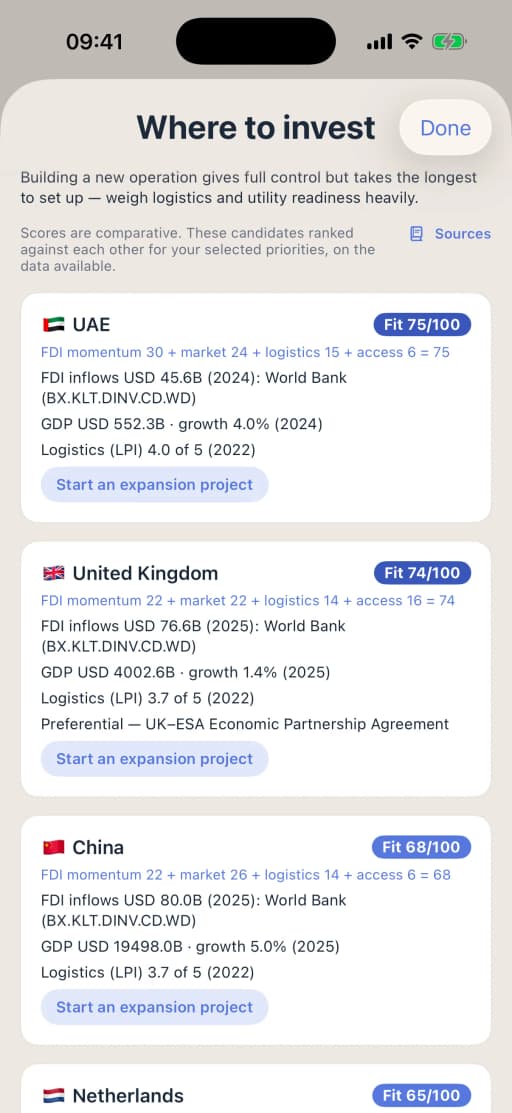
Where to invest on iPhone, each country with its sources. Connect
Step 3: Work with the investment promotion agency on sites and incentives
The national or regional investment promotion agency can supply data, show prepared sites and zones, explain the permits and connect you with whoever grants incentives. UNCTAD separates promotion, marketing a location, from facilitation, making it easier to set up and run there, and recommends a single window for investor enquiries3. Ask for one named contact and a written permit roadmap.
Incentives take forms such as tax credits, grants, help with infrastructure and training funds. They are usually tied to commitments on jobs and investment, and negotiated once you have a shortlist5; let them break a tie, not lead the choice. In the United States, many are granted only if the project would not happen without them, so announcing it before the agreement is signed can cost you the incentive1. Check whether the country you choose has a similar rule.
Special economic zones offer tax breaks and simpler procedures, but UNCTAD noted that many failed to attract the investors they expected, so check a zone’s occupancy, services and record before you commit6.
What this step produces
- A named contact
- A permit roadmap
- An incentive term sheet or a zone offer, with its commitments
Common mistake: Counting an incentive as certain in the business case before it is signed5.
With Promote:Global
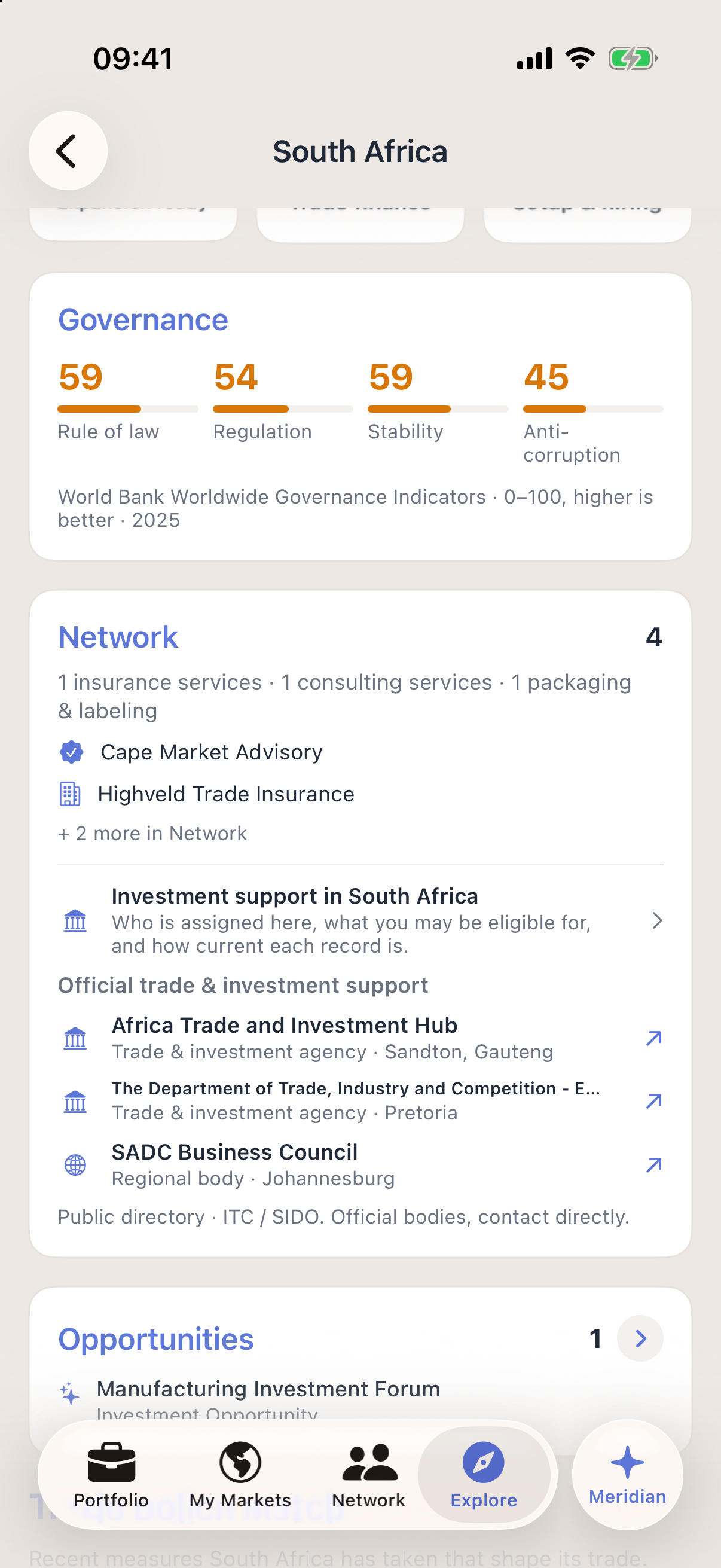
A market’s page lists the official trade and investment bodies for the country, from a public directory, for you to contact directly. Investment promotion agencies can also publish investment opportunities on Promote:Global, which every signed-in company can browse, those matching its markets and sectors first, and express interest in. The plan’s Identify investment incentives and Engage the investment promotion agency steps carry Find an advisor for this market. Promote:Global does not model incentive packages and holds no record of zones: ask the agency what applies.
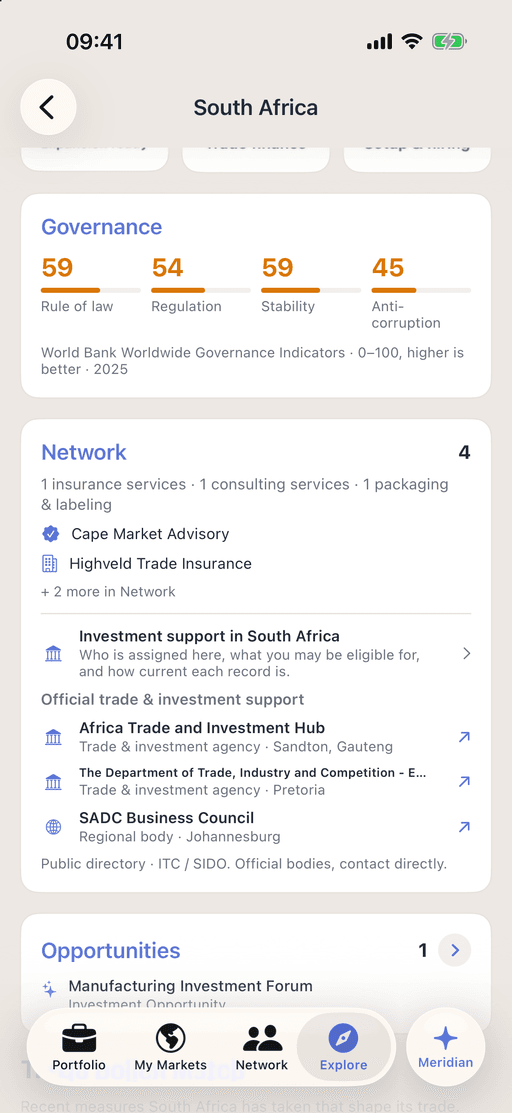
The official trade and investment bodies listed on a market’s page. Prepare
Step 4: Check investment screening and ownership rules
Many governments now review foreign investments for national security. An OECD research note of March 2024 found screening the most common such tool among the economies it follows, mostly through mechanisms that cover every sector4. Most screening targets acquisitions, but Canada, Australia and New Zealand, among others, also cover greenfield projects4.
Ask also whether your sector limits foreign ownership, and get written confirmation of whether you need to file before you spend on land or design.
What this step produces
- A screening filing, or written confirmation that none is needed
Common mistake: Assuming a new facility is exempt because nothing is being bought4.
You do this step yourself
Promote:Global does not hold screening regimes or sector ownership limits. Ask the agency or local counsel, and keep the answer as a note on the project, where Meridian reads it when you ask about the project.
Prepare
Step 5: Choose the site and check it
Compare the shortlisted sites in one cash-flow model that includes construction, connecting utilities, the workforce and any incentives1. Then check the one you prefer: title, zoning and permitted use, utility capacity and how long a connection takes, environmental condition, and access. B-READY’s business-location topic measures the time and cost of transferring property, getting building permits and environmental clearance in each economy it covers2.
Agree the terms with the owner, to be signed by the local company once it exists.
What this step produces
- Title and zoning checks
- Utility capacity letters
- Agreed terms for the land
Common mistake: Committing to a site before confirming how much power and water it can get, and how long the connection takes1.
With Promote:Global
On the project, Search for possible partners looks on the open web for corporate-services firms for company formation, legal, tax and site selection, ranked by fit, for 1 AI action. Each result says where it was found and is a lead to check before you make contact. Find service providers lists firms under property and parks, free trade zones and construction. Firms list themselves, and Promote:Global does not check them.
Prepare
Step 6: Form the local company
Most greenfield projects run through a local subsidiary, which signs the land deal, the construction contracts and the employment contracts, so form it, open its bank account and register it for tax before any of those are signed. B-READY’s business-entry topic shows what registering a foreign-owned firm involves in each economy it covers7.
This is one step of a greenfield project. A company that needs only a legal presence, with no site to build, follows our guide to setting up a subsidiary abroad instead.
What this step produces
- Certificate of incorporation
- Tax, VAT and payroll registrations
- Bank account
Common mistake: Signing for the land or the works before the company that will hold them exists.
With Promote:Global
The plan’s Choose the entity type and Register the entity steps carry Find an advisor for this market, and Set up banking & tax registration carries Find service providers, with legal and corporate, accounting and tax, and banking firms. Promote:Global does not register companies.
Prepare
Step 7: Secure the land and obtain the permits
Sign the lease or the purchase in the company’s name, then apply for the building or construction permit, the environmental license or impact assessment where one is required, any industrial or sector license, and the fire and safety certificates; B-READY measures the time and cost of several of these by economy2. Keep one tracker for every permit: who issues it, what it needs, and what waits on it.
What this step produces
- Land lease or title
- Building and environmental permits
- Sector licenses
Common mistake: Relying on one contractor’s promise about how long the permits will take.
You do this step yourself
Permits are yours, with your architect, engineer and counsel; Promote:Global applies for no permits. Add each permit to the project as a step, and keep the certificates there with their expiry dates.
Prepare
Step 8: Connect the utilities and build
Apply for the power, water and telecommunications connections as soon as the land is secured; B-READY’s utility services topic covers them by economy2. Hire a local architect, engineer and contractor, and fix the scope, the schedule and the payment milestones in the construction contract.
Imported machinery is a shipment of its own: it can need a customs registration and import documents2, so settle the duty, the documents and the delivery date with a customs broker before it ships.
What this step produces
- Utility connection agreements
- Construction contract
- Import documents for the equipment
Common mistake: Ordering equipment before the building permit and the site’s utility capacity are confirmed.
You do this step yourself
Design, construction and the import of equipment are yours, with your contractor and a customs broker; Promote:Global drafts no contracts and files no customs declarations. Find service providers lists firms under construction, logistics and freight, and customs and compliance; whether one is listed for your market varies.
Grow
Step 9: Hire and train the team
Build a staffing plan for availability, skills and cost from local employment data and what the agency knows about technical graduates1. Write contracts that meet local labor law, which B-READY covers under its labor topic7, and phase hiring so headcount rises with the operation, not ahead of it.
What this step produces
- Job descriptions
- Local employment contracts
- A training plan
Common mistake: Copying home-country contracts that do not meet local labor rules.
With Promote:Global
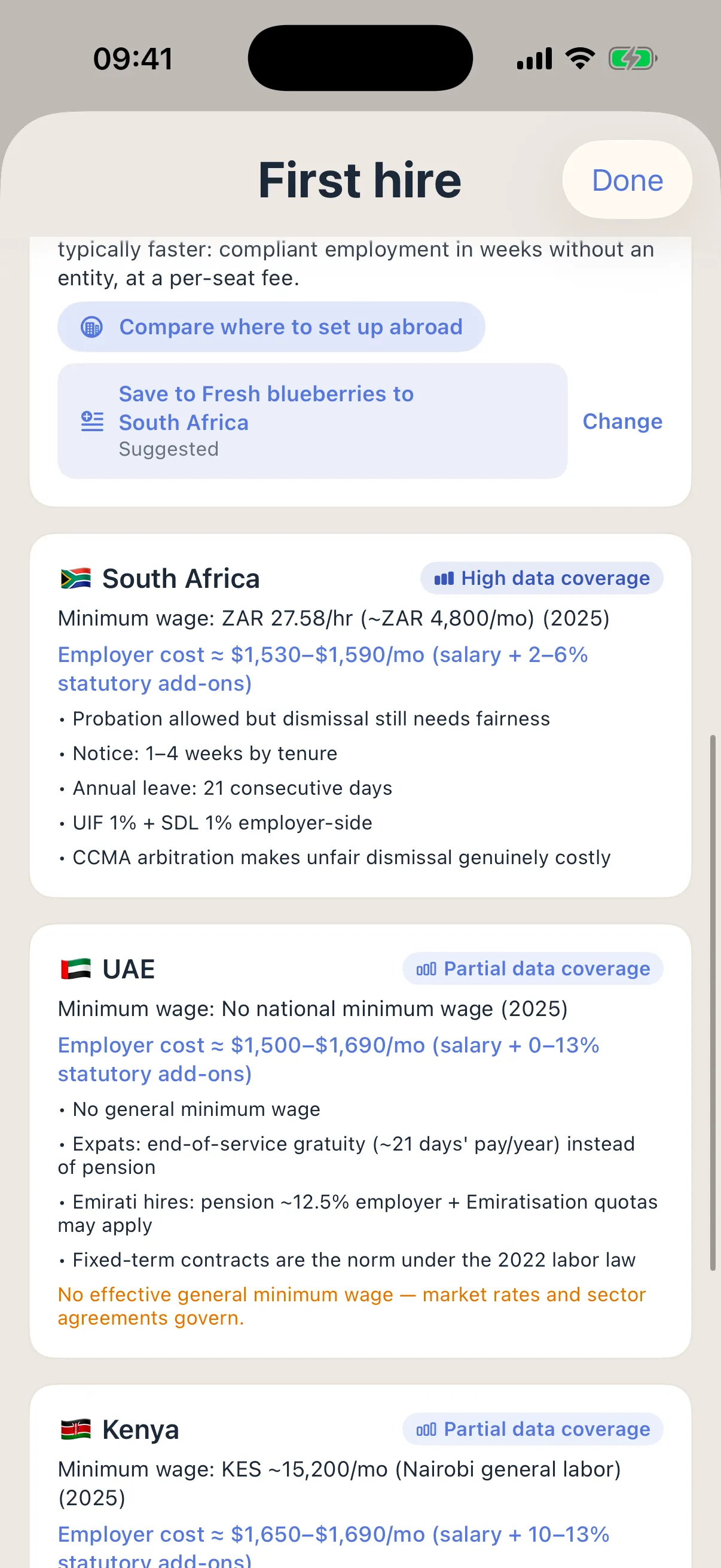
First hire compares hiring through an employer of record, as a contractor or through your own company, in up to four countries: the minimum wage with its year, an estimated employer cost, notice and leave rules, and a recommendation. It is free and is orientation, not payroll or legal advice. The plan’s Hire the local team step carries Find service providers, with recruitment and HR, and payroll and benefits. Promote:Global does not recruit.
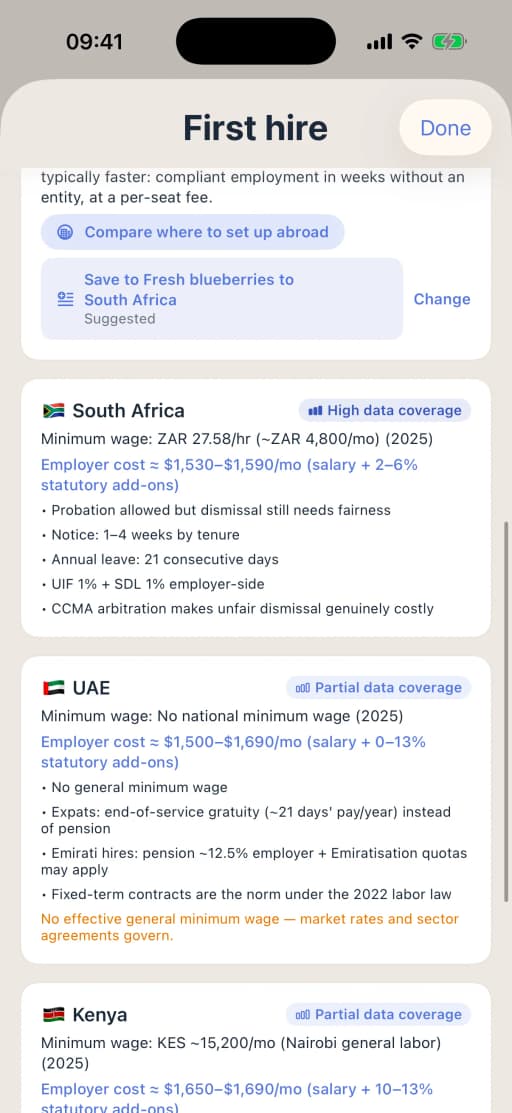
First hire on iPhone, country by country. Grow
Step 10: Commission in phases, then use aftercare
Commission the facility in phases: test the equipment and the connections, obtain the occupancy or operating certificate2, then raise output as the team is trained. Then keep meeting the agency. UNCTAD’s 2008 work on aftercare found that agencies see investors already in the country as a source of repeat investment, and help them with permits, suppliers and expansion8.
What this step produces
- Commissioning records
- Occupancy or operating certificate
- A review meeting with the agency
Common mistake: Treating the agency relationship as finished at the opening8.
With Promote:Global
The plan ends with Go live and Set a compliance & reporting cadence. Operating licenses and certificates can sit on the project with their expiry dates, and an expired one blocks the project until it is renewed. The Revenue tracker adds up the revenue you log by market and by project, against each market’s goal.
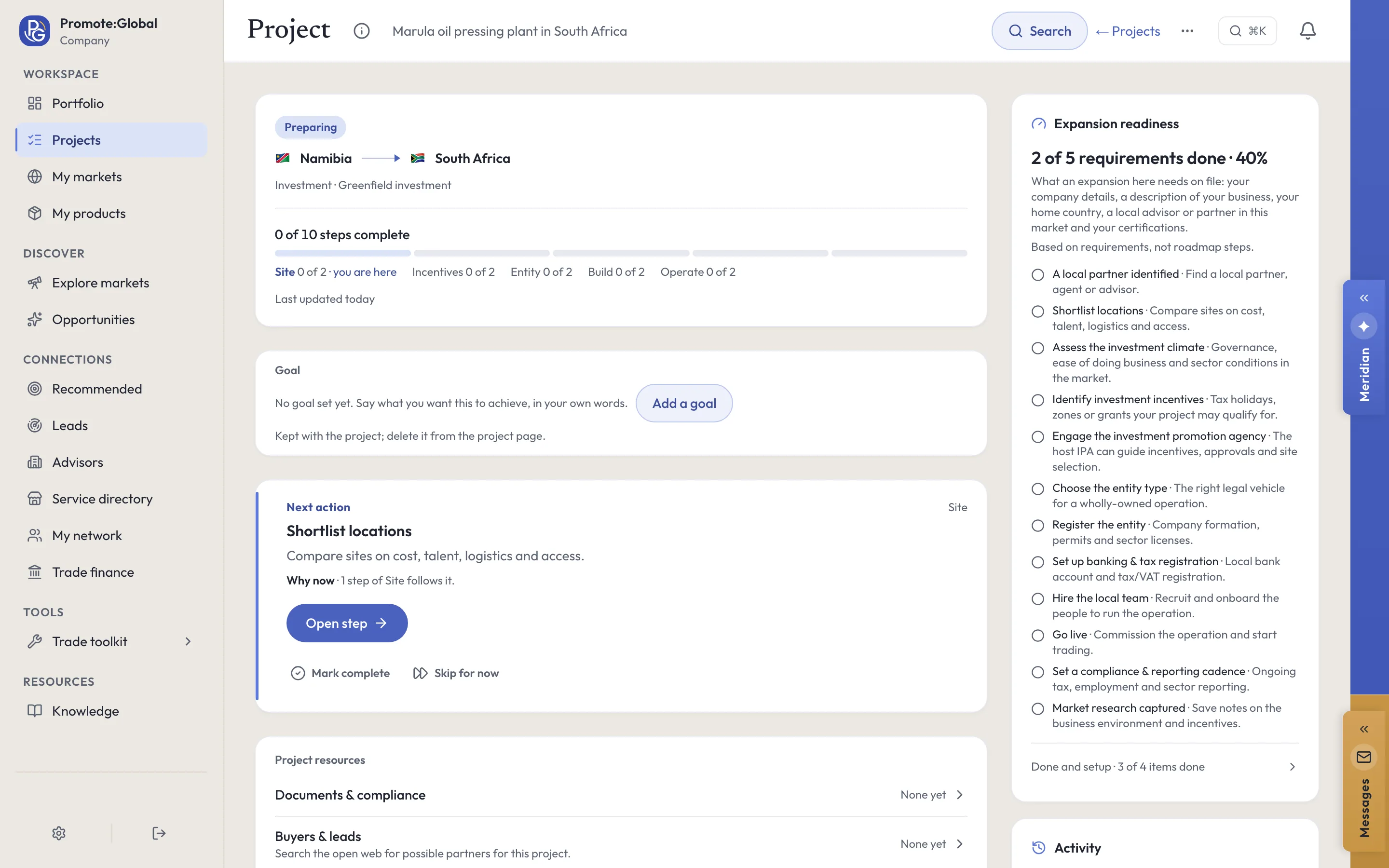
Your plan in Promote:Global
What a greenfield investment project looks like.
Create a project, choose “Greenfield investment” under “How are you entering?”, and Promote:Global writes this plan for your product and market. The route is in the list on the web and on iPhone. You tick steps off, skip one for now or add your own.
Site
- Shortlist locations
- Assess the investment climate
Incentives
- Identify investment incentivesButton: Find an advisor for this market
- Engage the investment promotion agencyButton: Find an advisor for this market
Entity
- Choose the entity typeButton: Find an advisor for this market
- Register the entityButton: Find an advisor for this market
Build
- Set up banking & tax registrationButton: Find service providers
- Hire the local teamButton: Find service providers
Operate
- Go live
- Set a compliance & reporting cadence
The plan is the route’s own checklist, with no customs steps by default. Where the work moves goods across a border, such as equipment, ingredients, samples or branded supplies, add those steps yourself. You can add, reorder and skip steps. In your own project, each step names your product and your countries. Building the plan uses no AI action.
On a project, Search for possible partners looks on the open web for corporate-services firms: company formation, legal, tax, site selection, or for whoever you describe, ranked by fit, for 1 AI action. A result is a lead to check before you contact anyone, not a confirmed partner.
Make the plan fit this route
The plan for this route runs from “Shortlist locations” to “Go live”, and its Build phase holds banking, tax and hiring but not the build itself. Add these six so the screening check, the site checks, the permits, the utilities, the construction and the commissioning sit where the work happens.
- Write the project brief and rank the site criteria (before “Shortlist locations”)
- Confirm whether investment screening applies (after “Engage the investment promotion agency”)
- Check the site: title, zoning, utility capacity, environment (next, before “Choose the entity type”)
- Secure the land and obtain the permits (after “Set up banking & tax registration”)
- Connect the utilities and build (next, before “Hire the local team”)
- Commission the facility in phases (after “Hire the local team”, before “Go live”)
On the project, type a step into Add a step under the roadmap, or ask Meridian to propose them: a step Meridian proposes is added only when you accept its card.
Meridian
Meridian, on your greenfield investment project.
Meridian, the built-in AI assistant on the web and on iPhone, reads the project you have open: its route, its countries, the steps still open and your notes. It answers questions about them, and it proposes changes as cards. Nothing changes on the project until you accept a card. Ask it to search for possible partners and it runs the project’s search in the conversation, looking on the open web for corporate-services firms (company formation, legal, tax, site selection), for 1 AI action; every result is a lead to check.
Ask
- What’s the next step on this project?
- What’s blocking this project?
- What should we compare between locations?
Do
Add a step — to this plan, as a card you accept
Save a note — to the project
Set entry method — one of the eighteen routes, with its reason, if another fits you better
Every plan carries a monthly allowance of AI actions, and each question uses 1. Building the plan uses none, and neither do Where to invest and First hire. Meridian is AI. Verify before acting.
Documents
The paperwork.
- Project brief and site criteria
- What the operation needs, ranked, and the scoring of each location against it1.
- Investment or incentive agreement
- The incentive, with the jobs, capital and reporting commitments behind it and what happens if they are missed5.
- Screening filing or confirmation
- A filing where the country screens greenfield projects, or written confirmation that none is needed4.
- Land lease or title, and zoning
- Signed by the local company, after the title, zoning, utility and environmental checks1.
- Permits and licenses
- Building, environmental, sector, fire and safety, and the occupancy or operating certificate at the end2.
- Zone license
- Where the site is in a special economic zone or industrial park6.
- Utility, construction and equipment contracts
- Connections, the build’s scope, schedule and payment milestones, and the import documents for machinery.
- Company and employment records
- Incorporation, tax and payroll registrations, and local employment contracts.
Costs and timelines
What to budget for.
Get quotes for
- Land, bought or leased
- Moves with the location, the size, whether the site is in a zone or park, and the title and zoning checks. B-READY measures the time and cost of transferring property by economy2.
- Permits and environmental clearance
- The fees, and the consultants who prepare the applications; moves with the activity and the site. B-READY measures building permits and environmental clearance by economy2.
- Utility connections
- Power, water and telecommunications; moves with the capacity you need and how far the site is from the networks1,2.
- Design and construction
- Architect, engineer and contractor; moves with the scope, the schedule and the payment milestones you fix in the contract.
- Equipment and its import
- Moves with the machinery, the duty on it in the market and the customs broker’s work.
- The local company
- Registration, banking and tax set-up; B-READY’s business-entry topic shows what it involves for a foreign-owned firm, by economy7.
What sets the timing
- Investment screening: written confirmation of whether you must file, before you spend on land or design4.
- Incentives, if any: negotiated once you have a shortlist and, in the US, signed before the project is announced1,5.
- Forming the local company, which signs for the land, the works and the staff7.
- Land transfer and permits, which B-READY measures by economy: use the country’s own figures, not an average2.
- Utility connections and construction, then commissioning in phases.
Ask for each quote in writing, for your product, market and volumes. Prices and timings differ by country, provider and year.
Mistakes and best practices
What goes wrong, and what works.
Common mistakes
- Planning the project around the company registration, and only then finding how long the land, the permits and the utility connections take.
- Fixing an opening date before the permit and connection dates are known.
Best practices
- Phase construction so cash and commitments rise with proven demand.
- Read an incentive’s reporting and repayment terms before you sign: the jobs and investment it is tied to are commitments you report against5.
Questions
Questions people ask.
What is a greenfield investment?
A new operation you build from the ground up in another country, rather than buying an existing business. You choose the site, build, hire and run it yourself, which gives you control but takes the longest1,6.
What is the difference between a greenfield investment and setting up a subsidiary?
A subsidiary is the local company. A greenfield investment is the operation you build through it: the site, the permits, the utilities, the construction and the commissioning. Most greenfield projects run through a subsidiary, but a subsidiary needs no building.
Do I need an investment screening filing for a new factory?
Sometimes. The OECD notes that Canada, Australia and New Zealand include greenfield investments in their screening, while most regimes focus on acquisitions4.
Are special economic zones worth it?
They can offer tax breaks and simpler procedures, but many failed to attract the investors expected, so compare their services, occupancy and record first6.
Sources
Where this guide comes from.
- [1]Site selection in the United States (SelectUSA investor guide) · U.S. International Trade Administration, 2022
- [2]B-READY 2024 publications · World Bank Group, 2024
- [3]Global action menu for investment facilitation · UNCTAD, 2016
- [4]Managing security implications of international investment: policy developments in a changing world · OECD, 2024
- [5]Economic development incentives (SelectUSA investor guide, chapter 11) · U.S. International Trade Administration, 2025
- [6]Global competition for investment prompts surge in special economic zones (World Investment Report 2019) · UNCTAD, 2019
- [7]Business Ready (B-READY) · World Bank Group
- [8]Investment Brief No. 2: Aftercare · UNCTAD, 2008
Reviewed October 26, 2026. This guide is general information about how companies do this, written in our own words from the sources above; it is not legal, tax or financial advice. Rules differ by country and change, so check them with the authority or an advisor before you act. What it says Promote:Global does is what the product does today. The screens on this page come from our demo workspace, and the companies in them are invented.
Read next
Related guides.
- How to set up a subsidiary abroad
Wholly-owned subsidiary · Investment / FDI
- How to acquire a company abroad
Acquisition (M&A) · Investment / FDI
- How to form an international joint venture
Joint venture · Investment / FDI
- How to hire abroad without an entity
Local hire via EOR · People-led
All eighteen guides Promote:Global for international expansion Plans and prices
Start your greenfield investment project.
Sign up, add what you sell, then create a project and choose “Greenfield investment” under “How are you entering?”. The plan above is written for your product and market.
Start this projectFree to start. No credit card needed. See plans and prices