How to form an international joint venture
Set up a business abroad with a local partner, sharing ownership, control, risk and profit in a company or under a contract.
For a company that wants a lasting business in another country with a local partner who brings licenses, customers, land or know-how, and is ready to share ownership, profits and control.
On this page: In short
In short
In short
To form an international joint venture, first check whether the country’s ownership rules make a local partner necessary for your activity1,2, then find and check a partner, work out which approvals each possible structure would need, and protect your IP before you share it3,4. Agree control, deadlock and exit before you sign, and do not put the venture into effect until any required clearance has been given4,5.
The route in Promote:Global
Joint venture · Investment / FDI
Commitment
Control
Risk
Rated 1 to 5, as the iPhone app rates every route when you choose one. The ratings are general, for the route itself: your own commitment, control and risk depend on your market, your product and your partners. Grows into: acquisition.
When it fits
Is a joint venture the right route?
A good fit when
- Local law requires or favors local participation in your sector; some markets still limit foreign ownership in restricted fields2.
- The partner brings licenses, distribution, land, customers or relationships that would take you years to build3.
- The project is large or risky and sharing capital and risk makes sense, as in construction and infrastructure6.
A poor fit when
- The law would let you own the business outright and you can run it alone; the UAE and China, for example, have removed or relaxed older partner requirements in many activities1,2.
- You cannot agree control, dividends and exit with the partner before you sign.
- Your core know-how is easy to copy and you cannot protect it in the market3.
The people involved
Who’s involved and how they work together
- Your company to Joint venture: Cash, technology, IP license
- Local partner to Joint venture: Licenses, land, market access
- Joint venture to Your company: Dividends, by your share
- Joint venture to Local partner: Dividends, by its share
Step by step
How to form an international joint venture, in 10 steps.
Each step says how companies do it, with sources, then what Promote:Global does there, or that the step is yours to do.
Discover
Step 1: Confirm that you need a joint venture
Check the country’s foreign-ownership rules for your exact activity before you look for a partner. The UAE lifted the general 49% cap on foreign ownership of mainland companies from 2021, but kept restrictions on listed activities such as security, telecommunications, banking and insurance, and lets the Cabinet name strategic activities that may carry limits1. China’s Foreign Investment Law took effect on 1 January 2020, replaced the three older foreign-enterprise laws and gives foreign investors national treatment outside a negative list; in restricted fields, the list’s conditions, such as a shareholding limit or a partner requirement, still apply2.
If the law lets you own the business outright, ask whether a partner still brings enough to be worth sharing control with.
What this step produces
- A note from local counsel on ownership rules for your sector
Common mistake: Relying on a rule from a few years ago instead of the current list for your activity.
With Promote:Global
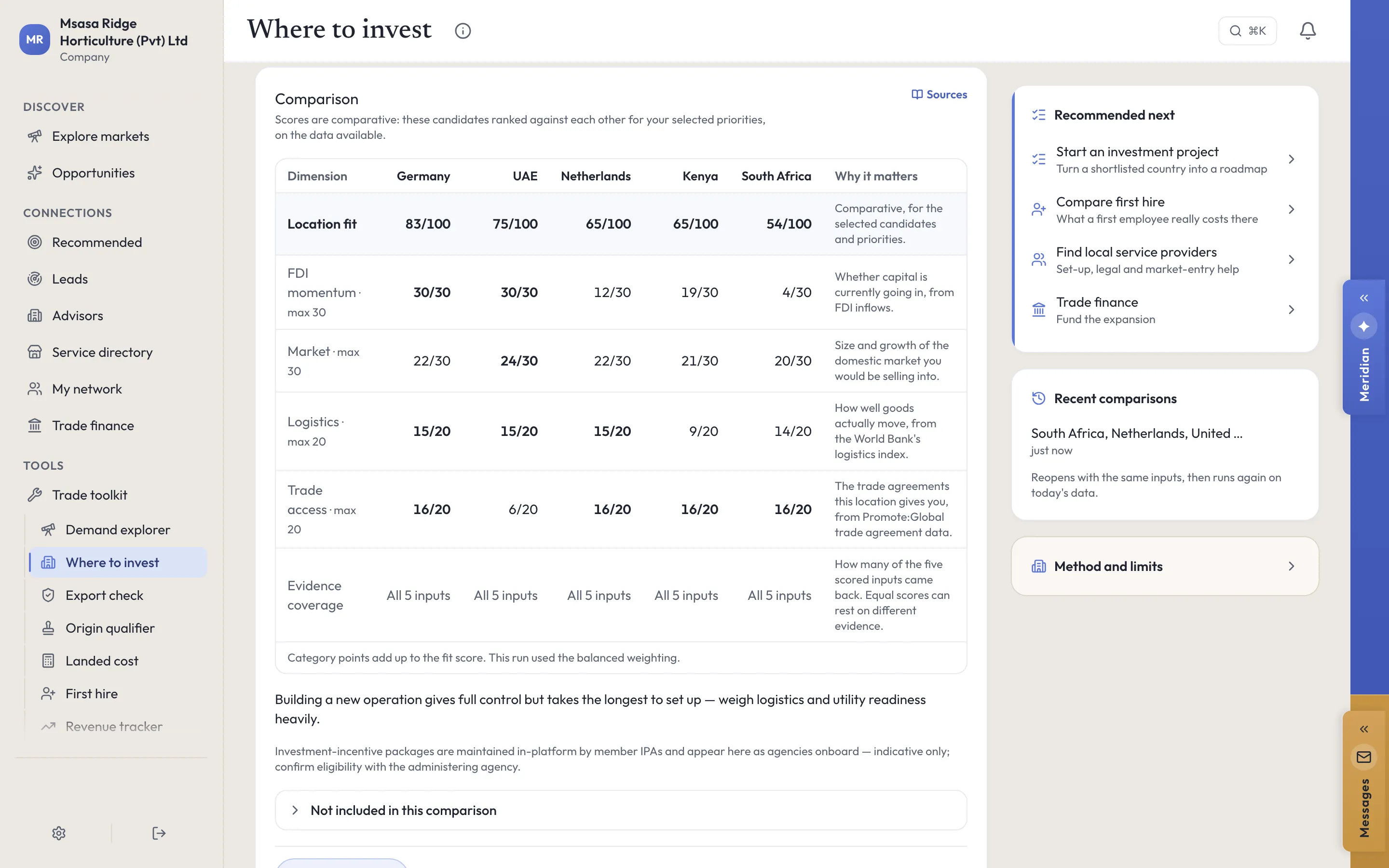
Where to invest, free on the web and iPhone, compares up to five countries for a joint venture, weighted by what matters to you, and gives each a location fit out of 100 from investment momentum, market, logistics and trade access, every figure with its source and year. The scores compare the countries you chose; they do not grade a country, and they do not check ownership rules. Each result has Start an expansion project.
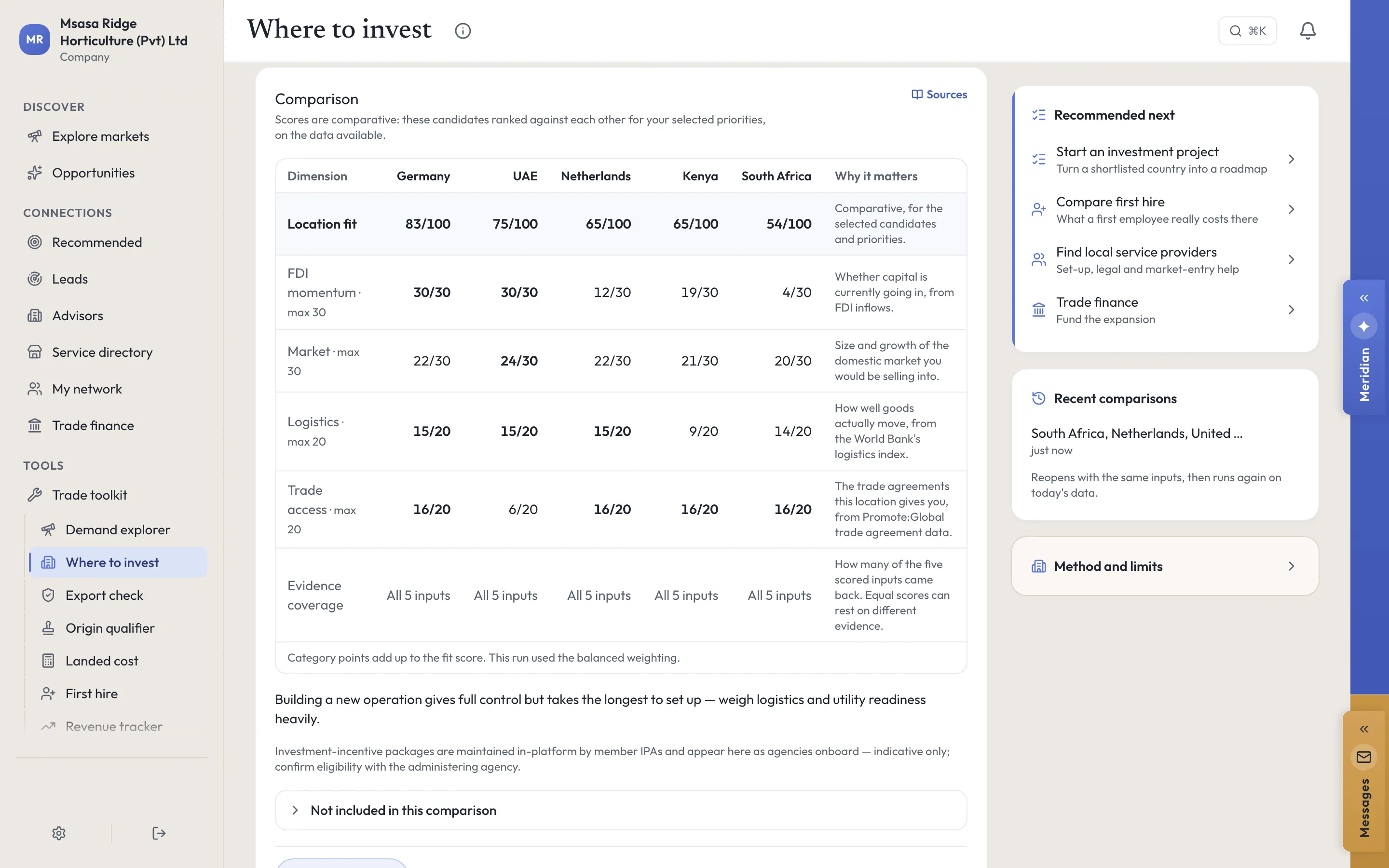
Where to invest on the web, comparing five countries. Click or tap to see the whole screen. Prepare
Step 2: Define the business case and what each side brings
Write down what you need a partner to bring, such as licenses, customers, land, people or market access, and what you will bring: cash, technology, a brand or know-how. Decide how you will propose to value each contribution. The value put on the partner’s local contribution, and on your IP, sets the ownership split, so the method should be agreed before the numbers.
What this step produces
- A business case
- The contributions you need, and how you propose to value them
Common mistake: Valuing the partner’s local contribution, and your own IP, only vaguely.
You do this step yourself
Promote:Global does not value businesses or contributions. Keep the business case as notes on the project, which Meridian reads when you ask about it.
Connect
Step 3: Search for a partner
Build the criteria first, then a list. The US trade agency’s guidance on China, for example, notes that a local partner is often critical, that checking one takes time, and that many partners have links to state-owned or large private groups, which affects both suitability and risk3. Look at established firms in your sector, at companies that already work with foreign partners, and at the projects investment promotion agencies put forward.
What this step produces
- Partner criteria
- A long list of possible partners
Common mistake: Choosing a partner on a personal introduction alone.
With Promote:Global
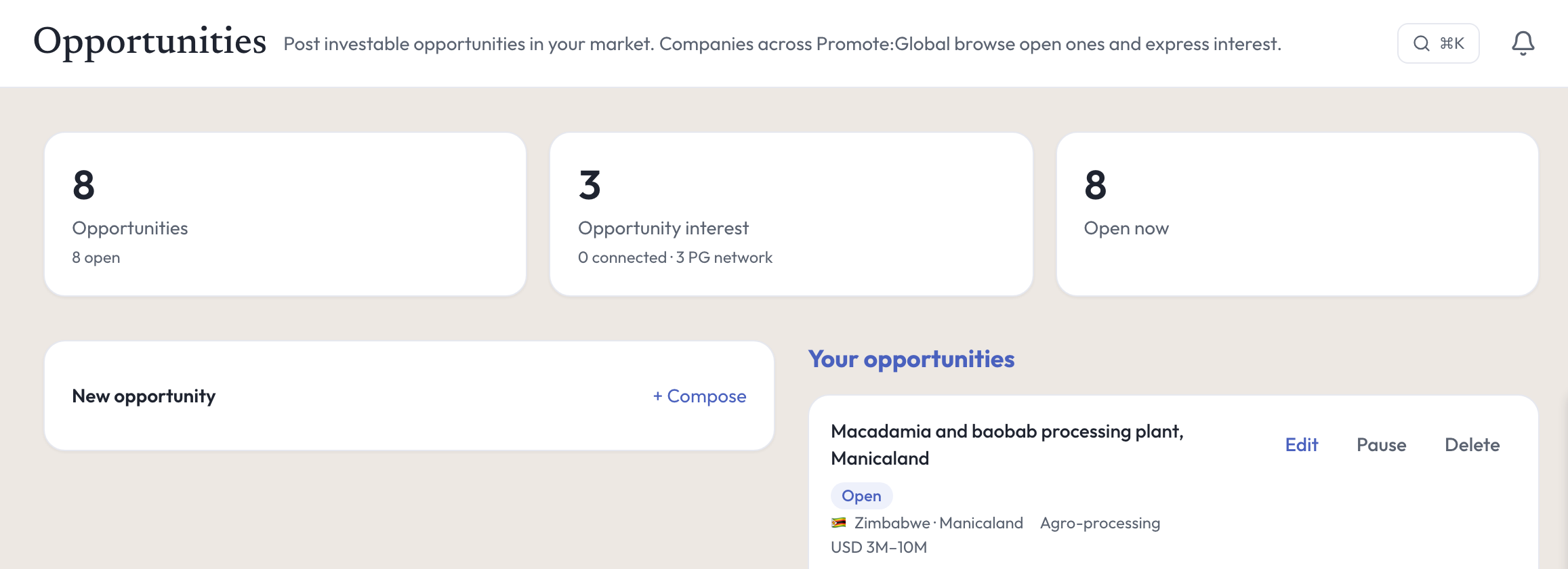
On the project, Search for possible partners looks on the open web for established companies in your sector open to a joint venture, or for whoever you describe, ranked by fit, for 1 AI action; each result is a lead to check. Investment promotion agencies can publish investment opportunities on Promote:Global, and every signed-in company can browse the open ones, with those matching its markets and sectors first, and express interest. Your chamber or trade agency can also introduce you, if the other side accepts.
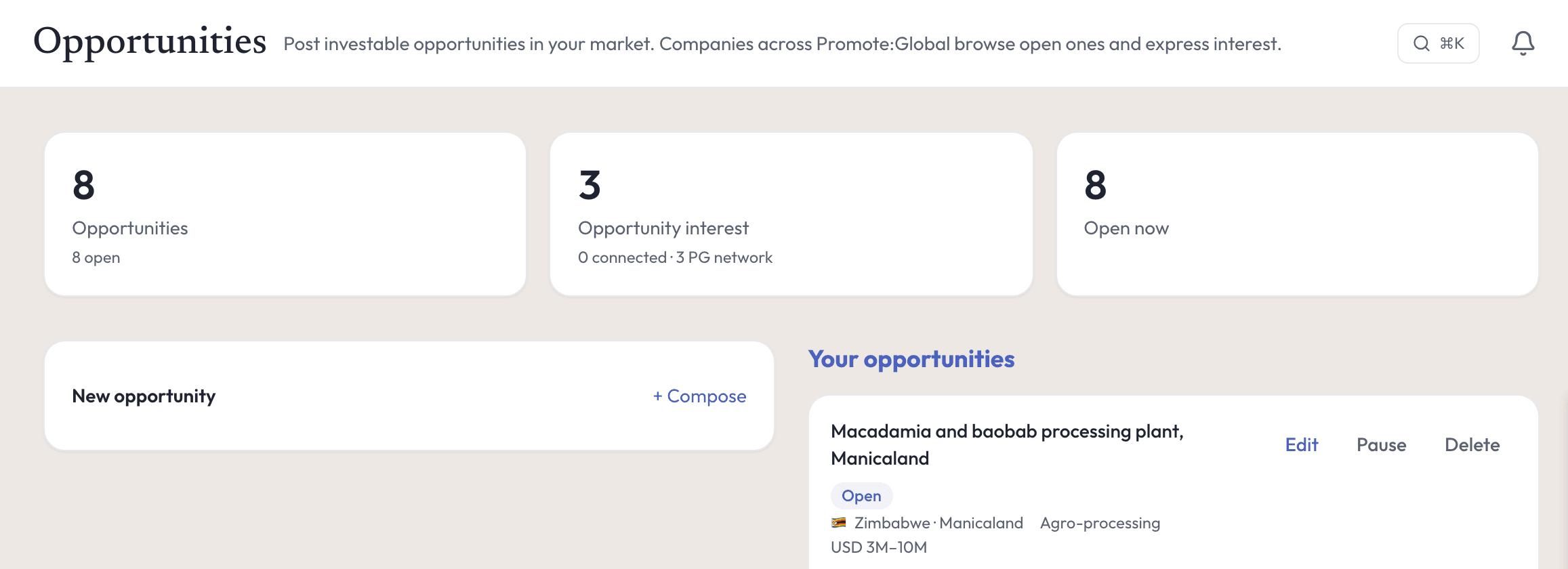
What an investment agency posts: opportunities for companies to browse. Click or tap to see the whole screen. Connect
Step 4: Check the partner deeply
Sign a nondisclosure agreement before either side shares confidential information. Then check the partner’s owners and beneficial owners, finances, litigation, licenses, other joint ventures and competing interests, regulatory standing, and exposure to bribery and sanctions, and speak to other foreign companies it has worked with. Ask who it is linked to: ties to the state or to a large group change what the partner can do and what it may want3.
What this step produces
- A nondisclosure agreement
- A due-diligence report on the partner
Common mistake: Skipping the beneficial-owner and government-links check.
You do this step yourself
Promote:Global does not check firms. Search results come from the open web, so commission the due diligence yourself, with local advisors.
Prepare
Step 5: Check which approvals each structure would need
Before you propose a structure, ask counsel which approvals each option would trigger, because the answer can change the structure. Creating a joint venture can be a reviewable merger. In the European Union it counts as a concentration only if it is full-function, meaning lasting and autonomous with its own management and resources, and jointly controlled; where turnover thresholds are met, it must be notified and cleared before it is put into effect4. The OECD recommends that mandatory regimes use clear thresholds and a waiting period before closing, in a recommendation revised in June 20255.
In the same pass, check whether foreign-investment screening applies to your stake, which licenses the venture’s activity needs and who will hold them, and any exchange controls on paying out dividends. The result is a list of filings for each structure and a timetable that sets the earliest closing date.
What this step produces
- A filing analysis for each structure and jurisdiction
- A timetable to closing
Common mistake: Settling the ownership split and control first, and only then finding which filings they trigger.
You do this step yourself
The filing analysis comes from your counsel: Promote:Global files nothing and gives no legal advice. Put the assessment on the project with Add a step, ahead of Agree the ownership split & control, and keep counsel’s answer as a note, which Meridian reads when you ask about the project.
Prepare
Step 6: Protect your IP before you share it
How you protect each right depends on its type. A patent protects only in the country or region where it was granted7, and a trademark is registered with each national or regional office, one by one or through WIPO’s Madrid System8, so file for the ones the venture will use there, in your own name. The US trade agency’s guidance on China advises registering trademarks and patents there before the partnership starts, and never letting the partner register them for you3. Know-how needs no registration: it is protected as a trade secret by keeping it confidential9, so share it under the nondisclosure agreement, and in stages.
Then license the IP to the joint venture rather than transferring it, so it comes back to you if the venture ends.
What this step produces
- Patent and trademark filings in your own name
- An IP license to the joint venture
Common mistake: Transferring IP to the joint venture company instead of licensing it.
You do this step yourself
Your IP attorney files the registrations; Promote:Global does not register IP.
Prepare
Step 7: Agree the structure and control
Agree the ownership split and the governance together, in a term sheet shaped by the approvals analysis: the value put on each contribution, the board’s make-up, the matters that need both partners’ consent, budgets, who appoints the managing director and the finance lead, information rights, dividend policy, how future capital calls are funded, dealings between the venture and each partner, and the scope of any non-compete.
What this step produces
- A term sheet with the ownership split and the governance
Common mistake: Fifty-fifty ownership with no list of matters that need both partners’ consent.
With Promote:Global
Agree the ownership split & control carries Find an advisor for this market, which opens advisory firms with experience of the market; they see what you share with them for that work. Promote:Global gives no legal advice and values no contributions.
Prepare
Step 8: Agree the deadlock and exit terms before you sign
Decide now what happens when the partners cannot agree. Practitioners describe a ladder: escalation to senior executives, then mediation or an independent tie-break, then a buy-sell mechanism in which one partner names a price and the other must either buy or sell at it. Draft these with care, because they can favor the partner with more money or better information, and local law may restrict them.
Cover the rest of the exit in the same round: first refusal on shares, rights to join a sale or to require one, change of control, limits on transfers, options to buy or sell, and what happens to IP, contracts and staff if the venture is dissolved. These terms belong in the agreement you sign, not in a later one.
What this step produces
- Deadlock and exit terms, in the agreement to be signed
Common mistake: Leaving exit until after signing, when the partners may no longer agree on anything.
You do this step yourself
You and your counsel write these terms; Promote:Global does not draft contracts. The plan’s Set exit & deadlock terms step comes after Sign the shareholders’ agreement, so add this step before signing, and tick that later one off once the signed agreement holds the terms.
Prepare
Step 9: Sign the agreements, get clearance, then close
For an equity joint venture, the terms go into a shareholders’ agreement and the company’s constitution, often with license, supply or management agreements beside them; for a contractual one, into the joint venture agreement. The ICC publishes model contracts, including one for construction and infrastructure projects that covers decision-making, the allocation of resources, risk and dispute resolution6.
Make the filings the approvals analysis found, and do not put the venture into effect until each clearance is given; where a regime is mandatory, the deal waits out the review4,5. Close once the approvals are in.
What this step produces
- Shareholders’ agreement and articles, or a joint venture agreement
- License, supply or management agreements
- Clearances and approvals
Common mistake: Putting the venture into effect before clearance, or assuming a small joint venture needs no filing.
With Promote:Global
Sign the shareholders’ agreement and Obtain competition clearance both carry Find an advisor for this market. Your lawyers draft the agreements and your counsel makes the filings: Promote:Global drafts no contracts, files nothing and gives no legal advice.
Grow
Step 10: Incorporate, launch and govern
Form the company or start under the contract, register it, open bank accounts, hire, transfer the licenses and start under the agreed business plan. Then run it through the governance you agreed: board meetings, minutes, and the matters that need both partners’ consent.
What this step produces
- Registrations
- Board minutes
Common mistake: Partners running the business informally, outside the agreed governance.
With Promote:Global
The plan ends with Set a governance cadence. For the set-up, Find service providers lists firms that list themselves by category, such as banking, accounting and tax, and recruitment and HR; whether one is listed for your market varies. The Revenue tracker adds up the revenue you log, by market and by project.
Your plan in Promote:Global
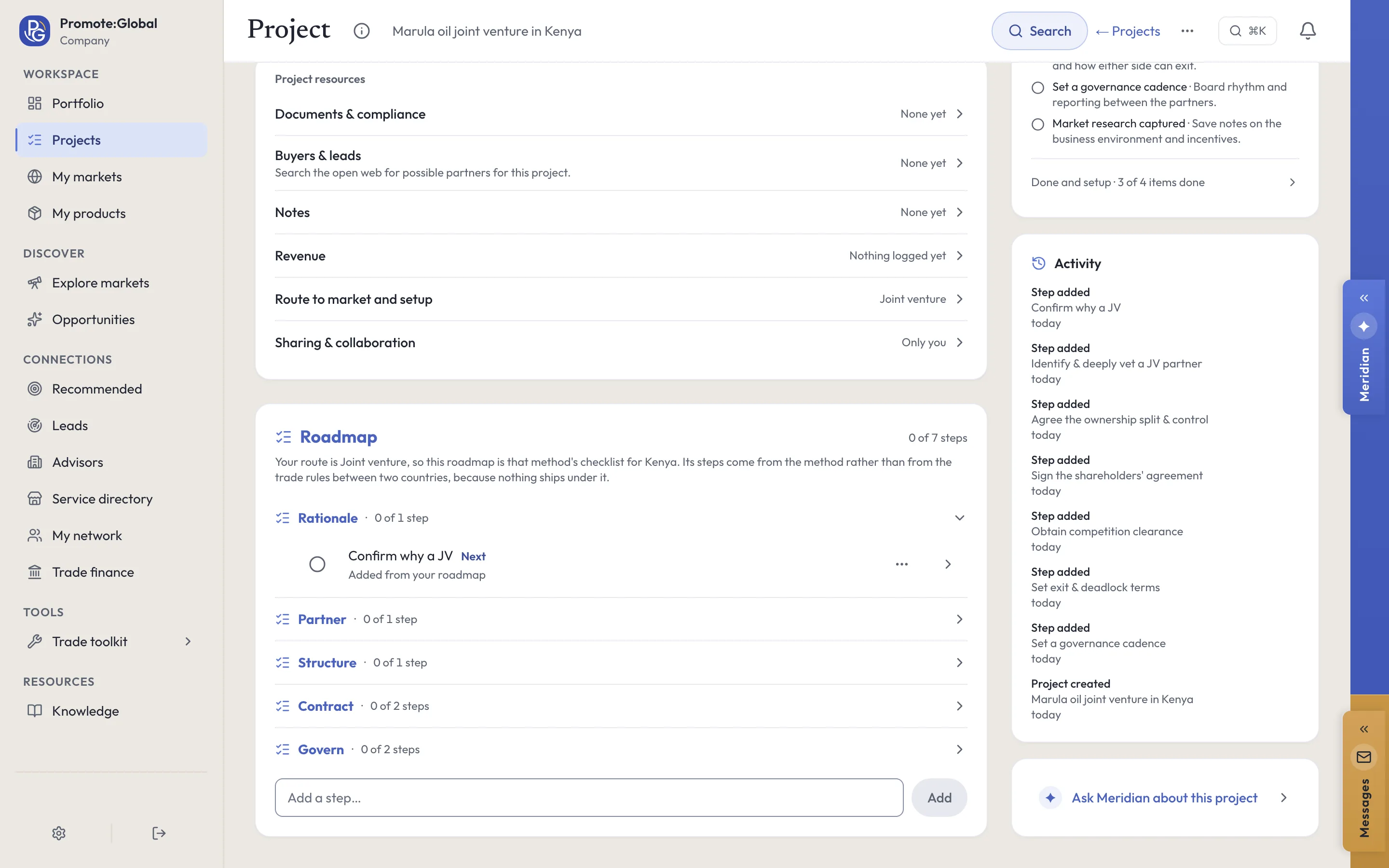
What a joint venture project looks like.
Create a project, choose “Joint venture” under “How are you entering?”, and Promote:Global writes this plan for your product and market. The route is in the list on the web and on iPhone. You tick steps off, skip one for now or add your own.
Rationale
- Confirm why a JV
Partner
- Identify & deeply vet a JV partner
Structure
- Agree the ownership split & controlButton: Find an advisor for this market
Contract
- Sign the shareholders’ agreementButton: Find an advisor for this market
- Obtain competition clearanceButton: Find an advisor for this market
Govern
- Set exit & deadlock terms
- Set a governance cadence
The plan is the route’s own checklist, with no customs steps by default. Where the work moves goods across a border, such as equipment, ingredients, samples or branded supplies, add those steps yourself. You can add, reorder and skip steps. In your own project, each step names your product and your countries. Building the plan uses no AI action.
On a project, Search for possible partners looks on the open web for established in-sector companies open to a joint venture, or for whoever you describe, ranked by fit, for 1 AI action. A result is a lead to check before you contact anyone, not a confirmed partner.
Make the plan fit this route
The plan for this route is its own checklist, from “Confirm why a JV” to “Set a governance cadence”. It has no step for the approvals check, your IP or closing, and it puts “Set exit & deadlock terms” after “Sign the shareholders’ agreement”. Add these four, and tick “Set exit & deadlock terms” off once the signed agreement holds them.
- Check which approvals each structure would need (after “Identify & deeply vet a JV partner”)
- Protect your IP before you share it (next, before “Agree the ownership split & control”)
- Agree the deadlock and exit terms (after “Agree the ownership split & control”, before “Sign the shareholders’ agreement”)
- Get the screening and sector approvals, then close (after “Obtain competition clearance”, where the approvals check found them)
On the project, type a step into Add a step under the roadmap, or ask Meridian to propose them: a step Meridian proposes is added only when you accept its card.
Meridian
Meridian, on your joint venture project.
Meridian, the built-in AI assistant on the web and on iPhone, reads the project you have open: its route, its countries, the steps still open and your notes. It answers questions about them, and it proposes changes as cards. Nothing changes on the project until you accept a card. Ask it to search for possible partners and it runs the project’s search in the conversation, looking on the open web for established in-sector companies open to a joint venture, for 1 AI action; every result is a lead to check.
Ask
- What’s the next step on this project?
- What’s blocking this project?
- What should the shareholders’ agreement cover?
Do
Add a step — to this plan, as a card you accept
Save a note — to the project
Set entry method — one of the eighteen routes, with its reason, if another fits you better
Every plan carries a monthly allowance of AI actions, and each question uses 1. Building the plan uses none, and neither do Where to invest and First hire. Meridian is AI. Verify before acting.
Documents
The paperwork.
- Nondisclosure agreement and term sheet
- The nondisclosure agreement before confidential information changes hands; the term sheet with the contributions, their valuation, the ownership split and the governance, agreed in principle.
- Partner due-diligence report
- Owners and beneficial owners, finances, litigation, licenses, links to the state or large groups, and references3.
- Filing analysis
- The merger-control, screening and licensing approvals each structure would need, and the timetable they set4,5.
- Shareholders’ agreement and articles, or a joint venture agreement
- For an equity joint venture, the shareholders’ agreement and the company’s constitution, with the deadlock and exit terms; for a contractual one, the joint venture agreement, for which the ICC publishes models6.
- IP license to the joint venture
- Your IP stays yours and is licensed, not assigned3.
- Supply, services or management agreements
- Between the joint venture and each partner, on terms the board has approved.
- Clearances and approvals
- Where thresholds or sector rules require them, given before the venture is put into effect4,5.
- Business plan, budget and funding schedule
- What the joint venture will do, and when each partner pays in.
Costs and timelines
What to budget for.
Get quotes for
- Local counsel on ownership rules
- Moves with how your activity is listed: an open activity needs a short note, a restricted or strategic one more work1,2.
- Partner due diligence
- Moves with the partner’s group structure, its links to the state or to large groups, and the number of places it operates3.
- Approval analysis and filings
- Moves with the number of jurisdictions where thresholds are met, and with the structure: in the EU, only a full-function joint venture under joint control is a notifiable concentration4.
- Patent and trademark filings
- One filing for each country or region where the venture will use the right, plus a local attorney; moves with the number of rights and places7,8.
- Valuing the contributions
- Non-cash contributions, such as IP, land or licenses, need a value both sides accept; moves with the method agreed and the evidence each side holds.
- Drafting the agreements
- The shareholders’ agreement and articles, or a joint venture agreement, plus any license, supply or management agreements; moves with how many there are and how far a model has to be adapted to local company law6.
What sets the timing
- Whether you need a partner at all: the ownership rules for your exact activity come first1,2.
- Finding and checking a partner, which takes time, more so where it is linked to the state or to a large group3.
- Registering the patents and trademarks the venture will use, before you share them3,7,8.
- Negotiating the structure, then the deadlock and exit terms, before anyone signs.
- Clearance: a notifiable joint venture cannot be put into effect until it is cleared, and mandatory regimes set a waiting period, so the review sets the earliest closing date4,5.
Ask for each quote in writing, for your product, market and volumes. Prices and timings differ by country, provider and year.
Mistakes and best practices
What goes wrong, and what works.
Common mistakes
- Negotiating the agreements before the due diligence is finished, so what it finds can no longer change the terms.
- Letting the venture’s dealings with each partner, such as supply, services or seconded staff, run on terms the board never approved.
Best practices
- Revisit the approvals analysis whenever the structure changes in negotiation: a change in who controls the venture, or in what it does, can change what must be filed4.
- Use a model agreement as a checklist, then adapt it to local company law6.
- Write reporting, audit rights and an annual review of the partnership into the agreement, so the review happens without anyone having to ask for it.
Questions
Questions people ask.
Do I need a local partner to do business abroad?
It depends on the country and the sector. The UAE now allows full foreign ownership of mainland companies in most activities, while restricted and strategic activities can still carry limits1, and China applies a negative list, with conditions in restricted fields2.
What is the difference between an equity and a contractual joint venture?
An equity joint venture creates a company the partners own together. A contractual joint venture shares work and risk under a contract with no new company, as in a construction consortium6.
What is the difference between a joint venture and a strategic alliance?
A joint venture shares ownership and control, usually through a company of its own with shared investment. A strategic alliance is a cooperation under contract in which both companies stay independent and share no equity.
What goes in a joint venture shareholders’ agreement?
The contributions, the board and the matters that need both partners’ consent, funding, dividends, limits on selling shares, deadlock and exit terms, and IP and non-compete terms, adapted to local company law.
Does a joint venture need merger-control approval?
Often, where it is a reviewable deal and the thresholds are met. In the European Union only a full-function joint venture under joint control counts, and it must be notified before it is put into effect4.
Sources
Where this guide comes from.
- [1]Full foreign ownership of commercial companies · Government of the United Arab Emirates (u.ae)
- [2]Foreign Investment Law of the People’s Republic of China · Government of the People’s Republic of China, 2019, in force 2020
- [3]China: market entry strategy (Country Commercial Guide) · U.S. International Trade Administration
- [4]Commission Consolidated Jurisdictional Notice under the EU Merger Regulation · European Commission, via EUR-Lex, 2008
- [5]Recommendation of the Council on Merger Review · OECD, revised 2025
- [6]ICC Model Joint Venture Contract · International Chamber of Commerce
- [7]Patents · World Intellectual Property Organization (WIPO), 2026
- [8]Trademarks · World Intellectual Property Organization (WIPO), 2026
- [9]Frequently asked questions on trade secrets · World Intellectual Property Organization (WIPO), 2026
Reviewed October 26, 2026. This guide is general information about how companies do this, written in our own words from the sources above; it is not legal, tax or financial advice. Rules differ by country and change, so check them with the authority or an advisor before you act. What it says Promote:Global does is what the product does today. The screens on this page come from our demo workspace, and the companies in them are invented.
Read next
Related guides.
The next rung up
How to acquire a company abroadAcquisition (M&A) · Investment / FDI
- How to form a strategic alliance abroad
Strategic alliance · Investment / FDI
- How to set up a subsidiary abroad
Wholly-owned subsidiary · Investment / FDI
- How to make a greenfield investment abroad
Greenfield investment · Investment / FDI
All eighteen guides Promote:Global for international expansion Plans and prices
Start your joint venture project.
Sign up, add what you sell, then create a project and choose “Joint venture” under “How are you entering?”. The plan above is written for your product and market.
Start this projectFree to start. No credit card needed. See plans and prices