How to find a contract manufacturer abroad
Have a factory abroad make your product to your specification, while you keep the design, the brand and the customers.
For a company with a product it can specify in drawings or a formula, held back by unit cost or capacity, that wants to keep the design, the brand and the customer while a factory abroad makes the goods.
On this page: In short
In short
In short
To find a contract manufacturer abroad, write a complete specification, have each factory sign a confidentiality, non-use and non-circumvention agreement before it sees that specification, then shortlist factories, compare their quotations and samples on landed cost, and audit the finalists by a visit or an independent firm1,2,3,4. Put the specification, acceptance criteria, inspection rights, tooling ownership and staged payment in a written manufacturing agreement, then run a pilot order and inspect it before you scale1,5.
The route in Promote:Global
Contract manufacturing · Contractual
Commitment
Control
Risk
Rated 1 to 5, as the iPhone app rates every route when you choose one. The ratings are general, for the route itself: your own commitment, control and risk depend on your market, your product and your partners. Grows into: greenfield investment.
When it fits
Is contract manufacturing the right route?
A good fit when
- Your product can be specified in drawings or a formula that another factory can follow, and unit cost or capacity is what holds you back.
- You want to keep design, brand and sales in-house, and can manage a supplier at a distance with inspections and visits.
- Your volumes meet a factory’s minimums, and your cash flow can carry deposits, tooling and longer lead times.
A poor fit when
- Your advantage is a secret process that neither a contract nor splitting the work between suppliers could protect2.
- You cannot audit the factory and its subcontractors, and you sell into a market that bans goods made with forced labor6,7.
- Moving production would lose the origin you need for a trade-agreement rate8,9.
The people involved
Who’s involved and how they work together
- Your company to Contract manufacturer: Specification, orders, payment
- Contract manufacturer to Your company: Finished goods
- Your company to Your customers: Goods under your brand
- Your customers to Your company: Payment for your goods
Step by step
How to find a contract manufacturer abroad, in 8 steps.
Each step says how companies do it, with sources, then what Promote:Global does there, or that the step is yours to do.
Prepare
Step 1: Write a complete specification
Put together drawings, the bill of materials, material and finish specifications, tolerances, test methods, packaging and labeling, and the standards the product must meet in each market where it will be sold. A precise specification is also what gives you the right to accept or reject a batch later1.
Decide at the same time what is confidential and what is not. A short outline of the product, its materials and its volumes lets a factory say whether it can make it; the drawings and the formula go out later, only to factories that have signed the agreement in the next step. WIPO’s guidance is to share only what a partner needs to know2.
What this step produces
- A specification package
- A target cost
- A plan of what is shared, with whom and when
Common mistake: A vague specification, which leaves the factory free to substitute materials.
You do this step yourself
The specification is yours, and Promote:Global does not write or check it. Each product you add holds its HS code, which you confirm, and the plan looks up its duty and origin steps from that code and the two countries.
Prepare
Step 2: Put a confidentiality agreement in place before sharing the specification
Know what protects what before anything leaves your hands. A patent protects an invention only in the country or region where it was granted, and trademarks are registered office by office, country by country, so ask counsel whether to file in the factory’s country as well as in your markets11,12. Drawings, formulas and process know-how that you keep secret are protected by keeping them confidential: WIPO’s guidance for working with outside partners is a confidentiality clause in every contract, and a separate non-disclosure agreement signed before any information changes hands2.
For factories in China, practitioners recommend an NNN agreement, covering non-disclosure, non-use and non-circumvention: the factory may use your information only to make your product, may not make it for anyone else, and may not go around you to your customers. It should name the real factory that will hold your drawings and be written for the deal rather than translated from a template, with local counsel advising on how it is enforced3. Have it ready now, and have each factory sign before it receives the full specification.
What this step produces
- A confidentiality or NNN agreement, ready to sign
- Patent or trademark filings, where counsel advises them
Common mistake: Sending full drawings to every factory that answers an inquiry, before any has signed.
You do this step yourself
Promote:Global does not register patents or trademarks, draft agreements or give legal advice. Find service providers lists legal and corporate firms that list themselves, where one is listed for the country.
Discover
Step 3: Search for factories and shortlist them
Sources include trade commissioners and export promotion agencies, industry associations, trade shows, sourcing agents and business-to-business marketplaces, and some trade commissioner services will run a background check on a potential partner10.
Then shortlist from the desk. Find out whether you are dealing with the factory itself or with a trading company that resells another factory’s output, and who will actually make your product3. Confirm the legal entity and its registration, the owners, who owns the building and the machinery, the certifications, the customers and the references, and get at least two business or credit reports from different providers4.
What this step produces
- A long list of factories
- A shortlist with ownership, references and credit reports
Common mistake: Shortlisting a trading company without knowing which factory will make your product3.
With Promote:Global
On a contract manufacturing project, Search for possible partners looks on the open web for contract manufacturers and OEM factories, ranked by fit to your product and route, for 1 AI action. Each result says where it was found and is a lead to check before you make contact; save the factories you pursue to the project. The provider directory has no manufacturing category, so it does not list factories, and Promote:Global does not check any firm.
Connect
Step 4: Request quotations and samples
Send the specification and your expected volumes to the shortlisted factories that have signed, and ask for the minimum order quantity, price breaks, lead times, tooling costs and payment terms. Order samples. Minimum orders and tooling costs vary widely by product and supplier, and the sources consulted give no reliable range, so compare like with like: the same materials and the same inclusions.
Compare the landed cost, not the unit price. The factory’s country decides the duty into your market, and whether the goods can claim a trade-agreement rate depends on that agreement’s own origin rule; the Rules of Origin Facilitator shows the product rules for more than 350 agreements8. For marking and ordinary duty, origin is often the country where the goods were last substantially transformed, and simple assembly or repackaging may not count9.
What this step produces
- Comparable quotations
- Samples, with your notes on each
- A landed-cost comparison by factory
Common mistake: Choosing on unit price, when the duty from each factory’s country changes what the goods cost you landed.
With Promote:Global
On the web, Export check lets you set the origin, so each factory’s country can be the origin and your market the destination. It gives the duty, standard and preferential, with its source and year, and the origin status; Estimate landed cost with this duty opens Landed cost with that duty, and the Origin qualifier walks the agreement’s origin rule one question at a time. All three are free, and all are guidance, not a customs ruling. Keep the quotes and your sample notes on the step, where Meridian reads them when you ask about the project.
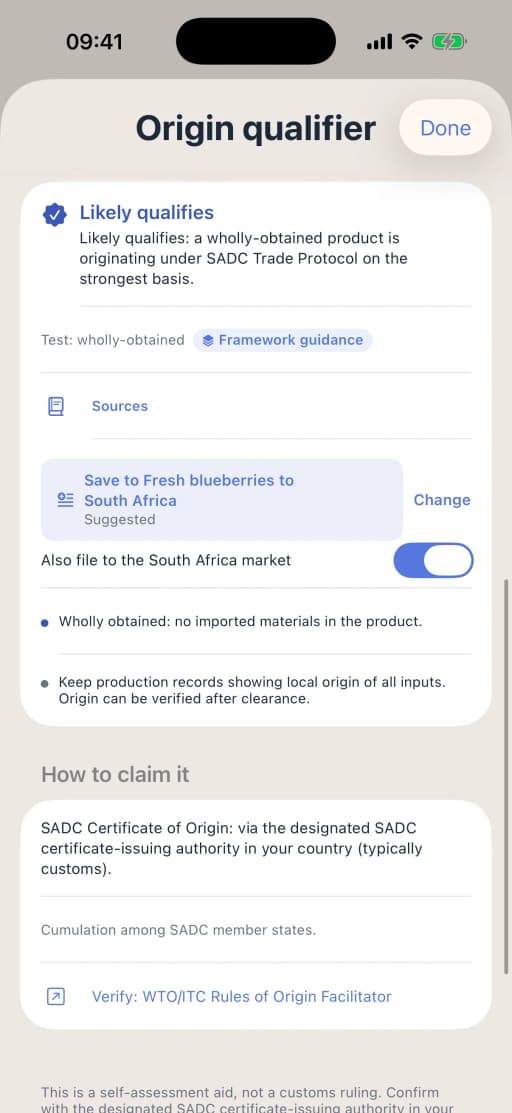
The Origin qualifier’s verdict for one product, on iPhone. Connect
Step 5: Audit the finalists
Visit the finalists, or commission an independent audit of the quality system, the capacity and the working conditions, and find out which processes go to subcontractors. The OECD’s due diligence guidance, written for companies of any size, sets out six steps: embed a policy, identify the risks, act on them, track the results, communicate, and provide remedy6.
If you sell into the European Union, its ban on products made with forced labor applies from 14 December 2027, and goods you source now may still be on sale then, so build traceability into your supplier records from the start7.
What this step produces
- An audit report and a corrective action list
- A list of subcontractors
Common mistake: Relying on certificates or photographs without a visit or an independent audit.
You do this step yourself
Promote:Global does not audit or check factories. Visit, or appoint an auditor yourself.
Prepare
Step 6: Negotiate the manufacturing and quality agreements
Cover the specification and approved materials; acceptance criteria and a period to reject; inspection rights during production and before shipment; pricing and any limits on price changes; minimum orders and forecasts; who owns tooling, molds and improvements; subcontracting only with your written consent; confidentiality that survives the end of the contract; remedies and liability; and notice and handover at the end, including the transfer of tooling and designs1. A separate quality agreement, setting out the quality procedures and inspections, often sits alongside it.
Set the purchase terms in the same round. Name an Incoterms rule and its place for the leg from the factory: the rule decides who arranges and pays for freight and insurance, who clears customs and where the risk passes, but not the price, the payment terms or when ownership passes13. Pay in stages, such as a deposit and then the balance against inspection or the shipping documents, since paying everything in advance puts the risk on you as the buyer5.
Tooling or materials you supply to the factory free or at a reduced price, known as assists, can be added to the customs value of the goods you import under the WTO’s valuation rules, so ask a customs broker whether yours count14.
What this step produces
- A manufacturing agreement
- A quality agreement
- A tooling schedule and ownership record
- Purchase terms: the Incoterm, its place and a payment schedule
Common mistake: Leaving tooling ownership unwritten, so the factory can hold your molds as leverage when you try to switch1.
You do this step yourself
Promote:Global does not draft or review manufacturing or quality agreements and gives no legal advice. The terms and the tooling are for you and your lawyer, and the customs value for you and your customs broker.
Grow
Step 7: Run a pilot production order
When the tooling is made, place a small first order. Approve a golden sample that later batches must match, inspect during production, and record every change to the specification as a written revision both sides sign, since the specification is what you accept or reject a batch against1.
What this step produces
- An approved golden sample
- In-process inspection notes
- Written revisions to the specification
Common mistake: Skipping the golden sample, so later batches have nothing agreed to be judged against.
You do this step yourself
Promote:Global does not inspect goods or monitor a factory. Record the golden sample’s approval and the pilot’s results as notes on the step, where Meridian reads them when you ask about the project.
Grow
Step 8: Inspect before shipment, then scale
Inspect the pilot before it ships, against the golden sample and the acceptance criteria in the agreement, and release the balance only when it passes1.
Then scale in steps, tracking defects and on-time delivery on each order and recording corrective actions. Each import entry declares the goods’ classification, origin and value, including any assists, so keep the records that support them14.
What this step produces
- Pre-shipment inspection reports
- A supplier scorecard
- Import entry records
Common mistake: Scaling up before the pilot order has passed inspection.
You do this step yourself
Promote:Global does not inspect goods or monitor a factory. Find service providers has a certification and inspection category, where firms list themselves; whether one is listed for the factory’s country varies.
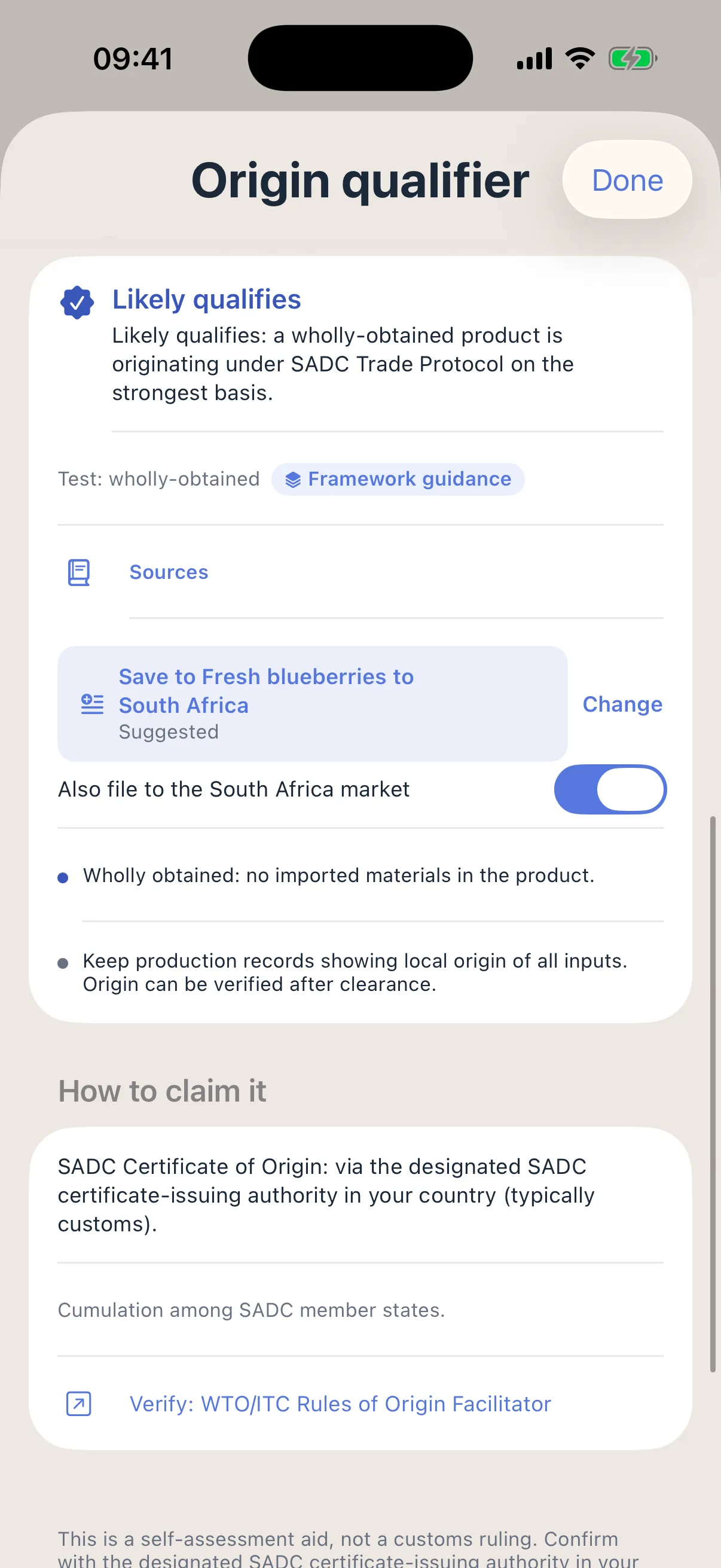
Your plan in Promote:Global
What a contract manufacturing project looks like.
Create a project, choose “Contract manufacturing” under “How are you entering?”, and Promote:Global writes this plan for your product and market. The web lists the route; on iPhone, the route advisor or Meridian sets it. You tick steps off, skip one for now or add your own.
Research
- Validate demand for your product in your target market
- Classify your product for customs (until the HS code is confirmed)
Compliance
- Confirm duty and landed cost into your target market
- Prove your product originates in your country (where a trade agreement offers a lower rate)
- Obtain a certificate (one for each certificate the route needs)
- Meet product, labeling and packaging rules for your target market
Outreach
- Find and shortlist buyers for your product in your target marketButton: Search for possible buyers in this market
Commercial
- Agree the Incoterm, price and payment terms with your buyer in your target market
Shipment
- Assemble the export document pack
- Book freight to your target market
- Ship a first order to your target market
Post-shipment
- Present the documents and collect payment from your target market (when paid by letter of credit or collection)
- Debrief the first shipment and fix the pack
The duty, origin and certificate steps are looked up from your product’s HS code and the two countries, so their number depends on what you sell and where. A step with a condition in brackets appears only where it applies. In your own project, each step names your product and your countries. Building the plan uses no AI action.
On a project, Search for possible partners looks on the open web for contract manufacturers or OEM factories, or for whoever you describe, ranked by fit, for 1 AI action. A result is a lead to check before you contact anyone, not a confirmed partner.
Make the plan fit this route
On this route Promote:Global writes its export corridor plan, from demand and customs classification through duty, origin and product rules to buyers, documents and the first shipment; it has no steps for choosing and contracting a factory. Add these eight in this order, and use Skip for now on the buyer steps if you already have the customers for the goods.
- Write a complete specification (in Research, after “Validate demand for your product in your target market”)
- Put a confidentiality agreement in place before sharing the specification (next, still before “Confirm duty and landed cost into your target market”)
- Search for factories and shortlist them (next, still before “Confirm duty and landed cost into your target market”)
- Request quotations and samples (just before “Confirm duty and landed cost into your target market”, since the factory’s country sets the duty and the origin)
- Audit the finalists (in Compliance, after “Meet product, labeling and packaging rules for your target market”)
- Negotiate the manufacturing and quality agreements (next, before “Find and shortlist buyers for your product in your target market”)
- Run a pilot production order (next, before “Find and shortlist buyers for your product in your target market”)
- Inspect before shipment, then scale (next, before “Find and shortlist buyers for your product in your target market”, and in any case before “Ship a first order to your target market”)
On the project, type a step into Add a step under the roadmap, or ask Meridian to propose them: a step Meridian proposes is added only when you accept its card.
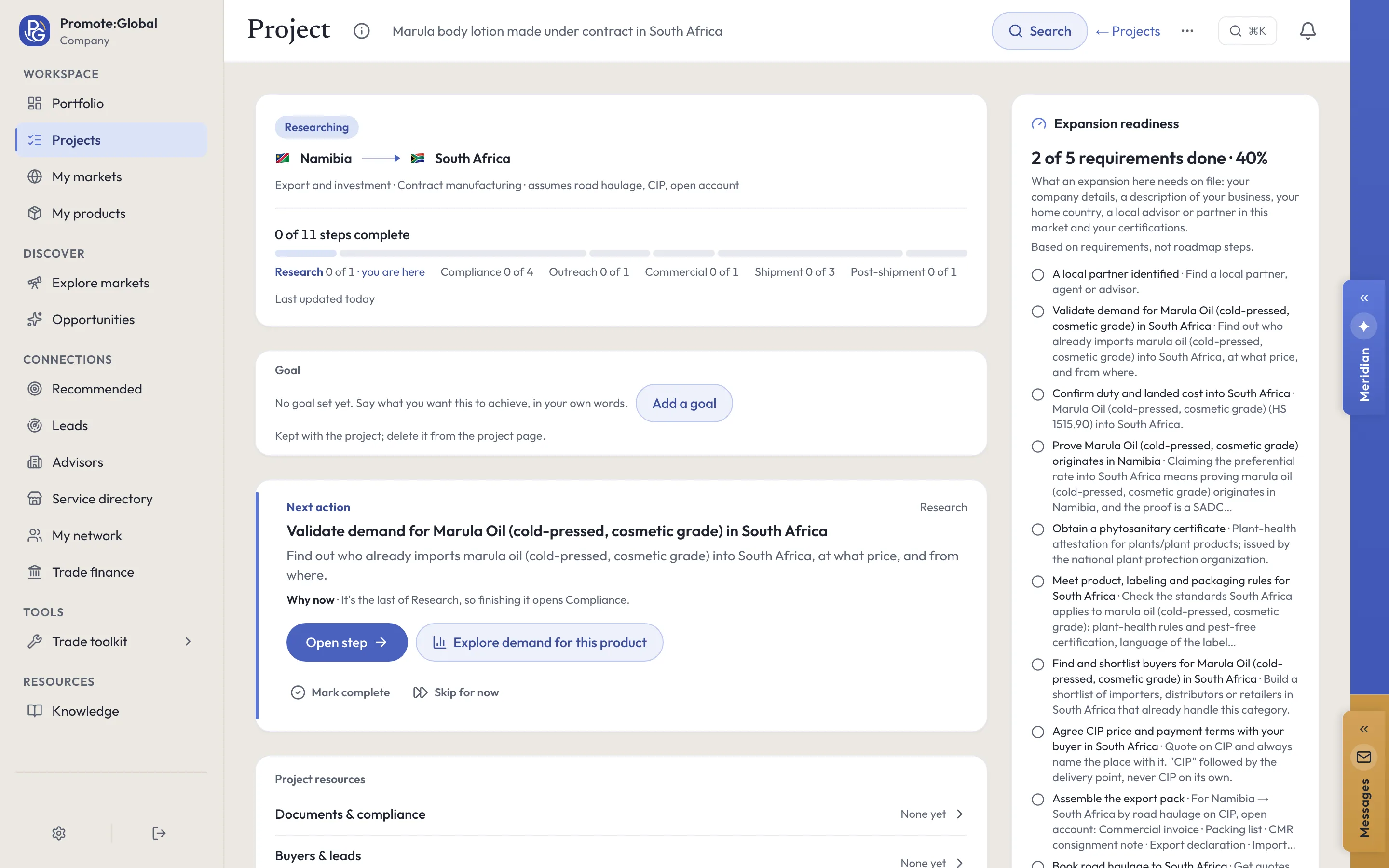
Meridian
Meridian, on your contract manufacturing project.
Meridian, the built-in AI assistant on the web and on iPhone, reads the project you have open: its route, its countries, the steps still open and your notes. It answers questions about them, and it proposes changes as cards. Nothing changes on the project until you accept a card. Ask it to search for possible partners and it runs the project’s search in the conversation, looking on the open web for contract manufacturers or OEM factories, for 1 AI action; every result is a lead to check.
Ask
- What’s the next step on this project?
- What’s blocking this project?
- What should we agree with the factory before production starts?
Do
Add a step — to this plan, as a card you accept
Save a note — to the project
Set entry method — one of the eighteen routes, with its reason, if another fits you better
Every plan carries a monthly allowance of AI actions, and each question uses 1. Building the plan uses none, and neither do Export check, Landed cost and the Origin qualifier. Meridian is AI. Verify before acting.
Documents
The paperwork.
- Specification package and golden sample
- What the factory must make, and the approved sample later batches are judged against1.
- NNN or confidentiality agreement
- Non-disclosure, non-use and non-circumvention, signed by the factory that holds your drawings before it receives them2,3.
- Manufacturing and quality agreements
- Specification, acceptance, inspection, pricing, tooling, subcontracting, confidentiality and termination1.
- Factory audit report
- Quality system, capacity, working conditions and subcontractors, with a corrective action plan6.
- Tooling schedule
- What tooling exists, who paid for it and who owns it1.
- Purchase order
- With the Incoterms rule and its named place13.
Costs and timelines
What to budget for.
Get quotes for
- Unit price and minimum order
- Moves with the materials, your volumes and the price breaks, and with the factory’s country. Have every factory quote the same specification; the sources consulted give no reliable range.
- Tooling and molds
- Moves with the product’s complexity. Get the price in writing together with who will own the tooling once it is paid for1.
- Samples and the pilot order
- Moves with the number of sample rounds before approval and the size of the pilot.
- Credit reports, audit and travel
- Two business or credit reports for each shortlisted factory, from different providers4; the audit moves with its scope (quality, capacity, working conditions, subcontractors) and the number of sites.
- Inspections
- Moves with the number of inspections on each order and the tests the product needs.
- Legal work in two countries
- The confidentiality agreement and the manufacturing and quality agreements, with counsel who knows the factory’s country3.
- Freight, insurance, duty and a customs broker
- Who pays for freight and insurance follows the Incoterm13; the duty follows the factory’s country and whether the goods meet a trade agreement’s origin rule8.
- Traceability records
- Moves with the number of suppliers and subcontractors you trace and the markets you sell into.
What sets the timing
- A complete specification: quotations compare only when every factory prices the same thing.
- The confidentiality agreement, drafted for the factory’s country and signed by each factory before it receives drawings.
- Sample rounds: each revision means another round of making and shipping samples.
- The audit and its corrective actions, closed before you sign.
- Tooling: production cannot start until it is made and approved.
- The pilot order and its inspection, before the first full order.
- Changing factory later: many agreements allow termination for convenience on 60 to 90 days’ notice, according to one law firm’s general guidance, and moving the tooling takes longer still1.
Ask for each quote in writing, for your product, market and volumes. Prices and timings differ by country, provider and year.
Mistakes and best practices
What goes wrong, and what works.
Common mistakes
- Planning cash around the unit price alone, without the deposits, tooling and longer lead times a factory abroad brings.
- Stopping the checks once orders flow. The OECD’s steps include tracking results, and a factory can add subcontractors or change materials after the audit6.
- Promising customers a “made in” claim or a trade-agreement rate before anyone has checked the origin of goods from the chosen factory9.
Best practices
- Qualify two or three factories, and keep a plan for moving your tooling, so a second source is ready if you need it.
- Split sensitive components or steps between suppliers where you can, so that no one factory holds the whole product2.
- Check the duty, origin and product rules again for each new market you sell the goods into8.
- Visit again after production starts, not only before you sign.
Questions
Questions people ask.
What is an NNN agreement, and do I need one?
It combines non-disclosure, non-use and non-circumvention terms, and is widely used with manufacturers in China, where a plain non-disclosure agreement may not stop a factory using your design or going to your customers. Have it written for your deal and the local law3.
Who should own the tooling and molds?
If you pay for them, the contract should say you own them, require them to be marked, and require their transfer when the contract ends, with the costs agreed in advance1.
Which Incoterm should I use when buying from a factory abroad?
The one that matches who you want to arrange the freight and customs. The Incoterms 2020 rules number 11, four of them for sea and inland waterway only; name the rule and its place in the purchase order13.
How is contract manufacturing different from licensing?
Under contract manufacturing you buy the finished goods and sell them under your own brand, so you keep the design and the customers. A licensee makes and sells on its own account and pays you royalties10.
Does the European Union ban goods made with forced labor?
Yes. From 14 December 2027 it prohibits placing products made with forced labor on the EU market, in every sector7.
Sources
Where this guide comes from.
- [1]Contract manufacturing agreement: key risks · Daeryun Law, law firm
- [2]WIPO Guide to Trade Secrets and Innovation, Part IV: trade secret management · World Intellectual Property Organization
- [3]Why NDAs fail in China: use an NNN agreement instead · Harris Sliwoski, law firm, 2019, updated 2026
- [4]Evaluate foreign representatives · U.S. International Trade Administration
- [5]Methods of payment · U.S. International Trade Administration
- [6]OECD Due Diligence Guidance for Responsible Business Conduct · Swiss State Secretariat for Economic Affairs, summarizing the OECD guidance
- [7]The EU Forced Labour Regulation: 10 questions every general counsel should be asking · Mayer Brown, law firm, 2026
- [8]About the Rules of Origin Facilitator · ITC, with the World Customs Organization and the World Trade Organization
- [9]Rules of origin and substantial transformation · U.S. International Trade Administration
- [10]Step 6: Entering your target market · Trade Commissioner Service, Government of Canada
- [11]Patents · World Intellectual Property Organization (WIPO), 2026
- [12]Trademarks · World Intellectual Property Organization (WIPO), 2026
- [13]Know your Incoterms · U.S. International Trade Administration
- [14]Customs valuation · World Trade Organization
Reviewed October 26, 2026. This guide is general information about how companies do this, written in our own words from the sources above; it is not legal, tax or financial advice. Rules differ by country and change, so check them with the authority or an advisor before you act. What it says Promote:Global does is what the product does today. The screens on this page come from our demo workspace, and the companies in them are invented.
Read next
Related guides.
The next rung up
How to make a greenfield investment abroadGreenfield investment · Investment / FDI
- How to license your IP abroad
Licensing · Contractual
- How to form an international joint venture
Joint venture · Investment / FDI
- How to export goods
Direct exporting · Export-based
All eighteen guides Promote:Global for international expansion Plans and prices
Start your contract manufacturing project.
Sign up, add what you sell, then create a project and choose “Contract manufacturing” under “How are you entering?”. The plan above is written for your product and market.
Start this projectFree to start. No credit card needed. See plans and prices