How to license your IP abroad
Let a firm abroad make or sell under your patent, trademark or know-how, for royalties, while you keep ownership.
For a company that owns a patent, trademark, design, software or know-how that a firm in another country could use, and would rather earn royalties than make or sell there itself.
On this page: In short
In short
In short
To license your IP abroad, protect each right the way its type requires: register the patents, trademarks and designs you will license in the market, and keep know-how and code confidential, since copyright arises without registration in most countries and trade secrets need none1,2,3. Check the local rules on technology contracts and the tax withheld on royalties before you set the terms, then find and check a licensee and sign a written agreement with quality control, audit rights and a way to take the rights back4,5,6.
The route in Promote:Global
Licensing · Contractual
Commitment
Control
Risk
Rated 1 to 5, as the iPhone app rates every route when you choose one. The ratings are general, for the route itself: your own commitment, control and risk depend on your market, your product and your partners. Grows into: joint venture.
When it fits
Is licensing the right route?
A good fit when
- You own registered or well-documented IP that a local firm can make, sell or operate under, in a market you cannot serve directly6.
- Making or selling there yourself would need capital, local licenses or scale you do not have, and an income stream with low overhead suits you.
- The market has high import barriers or local-content rules that favor local production.
A poor fit when
- The patent or trademark you would license is not registered in the country, and someone else could file first1.
- Your edge depends on day-to-day control of quality and customers, which a license hands to someone else.
- The country restricts technology contracts or taxes royalties so heavily that the deal does not work after tax4,5.
The people involved
Who’s involved and how they work together
- Your company to Licensee: License, know-how, standards
- Licensee to Customers: Licensed products
- Customers to Licensee: Payment at its price
- Licensee to Your company: Royalties and reports
Step by step
How to license your IP abroad, in 10 steps.
Each step says how companies do it, with sources, then what Promote:Global does there, or that the step is yours to do.
Discover
Step 1: List your IP and choose the market
List every right you hold, from patents, trademarks and designs to copyright, software and know-how, and who owns each one. A right created by an employee, a contractor or a university may need a written assignment before you can license it. Then choose the markets where a local firm could use the IP and you cannot serve directly. A patent landscape shows who is already active in the technology there, which is also a first list of possible licensees7.
What this step produces
- An IP register with ownership records
- A short list of markets
Common mistake: Licensing a right you do not fully own, or cannot show that you own.
With Promote:Global
Create a project, choose Licensing under “How are you entering?”, and Promote:Global writes the route’s own checklist, with no customs steps, using no AI action. A market’s page shows the economy and the investment climate from World Bank data, and the country’s official trade and investment bodies, to contact directly.
Prepare
Step 2: Protect each right the way its type requires
Patents, trademarks and industrial designs are registered office by office: a patent protects an invention only in the country or region where it was granted, and a trademark is filed with the office of each country where you want protection8,9. A registration at home does not protect you abroad, and most countries give a trademark to whoever files first, so file these in the market before you show them to anyone there1.
The international systems make filing cheaper. The Madrid System covers a trademark in many countries through one application, built on a home application or registration10. A PCT application has the effect of a patent filing in each of its 159 contracting states but grants no patent itself, the national phase generally starts by month 30 from your first filing, and a filing abroad more than 12 months after your first one loses that filing’s priority date11,12. The Hague System covers industrial designs, up to 100 in one application13.
Copyright, which covers software code, arises in most countries automatically, with no registration or other formality2. Trade secrets and know-how need no registration at all: they stay protected for as long as they stay secret, so their protection is a nondisclosure agreement signed before you show anything, controlled access, and confidentiality that outlasts the license3.
What this step produces
- Patent, trademark and design filings in the market
- A calendar of priority and national-phase deadlines
- A nondisclosure agreement for know-how and code
Common mistake: Waiting until a deal is close to file a patent or trademark, then finding that the licensee or a third party has filed first.
With Promote:Global
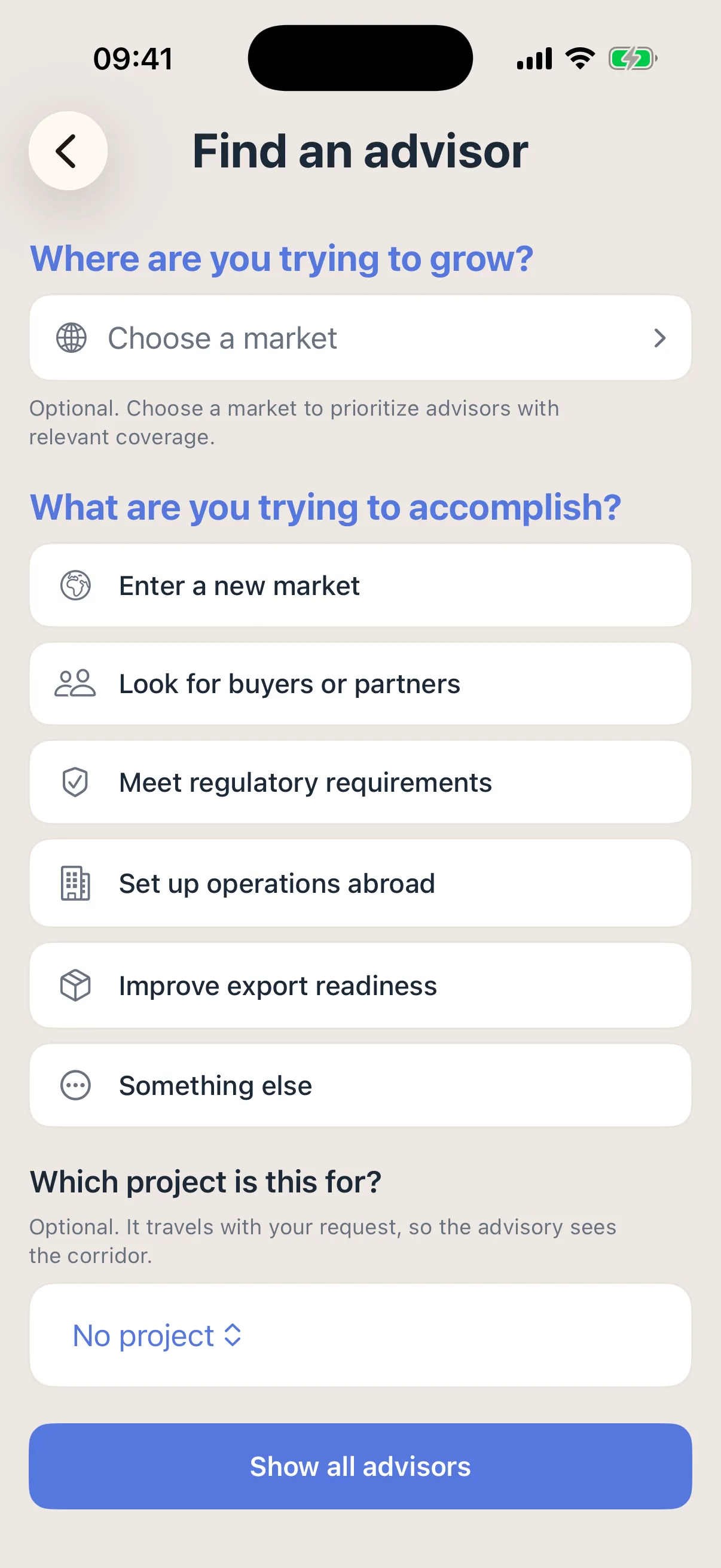
The plan’s first step, Register or confirm your IP in the market, carries Find an advisor for this market, which opens advisory firms with experience of the market; for know-how or code, which need no registration, it is where you confirm how each is kept protected. Find service providers lists legal and corporate firms that list themselves on Promote:Global. Promote:Global does not file or register IP: you or the firm you choose make the filing.
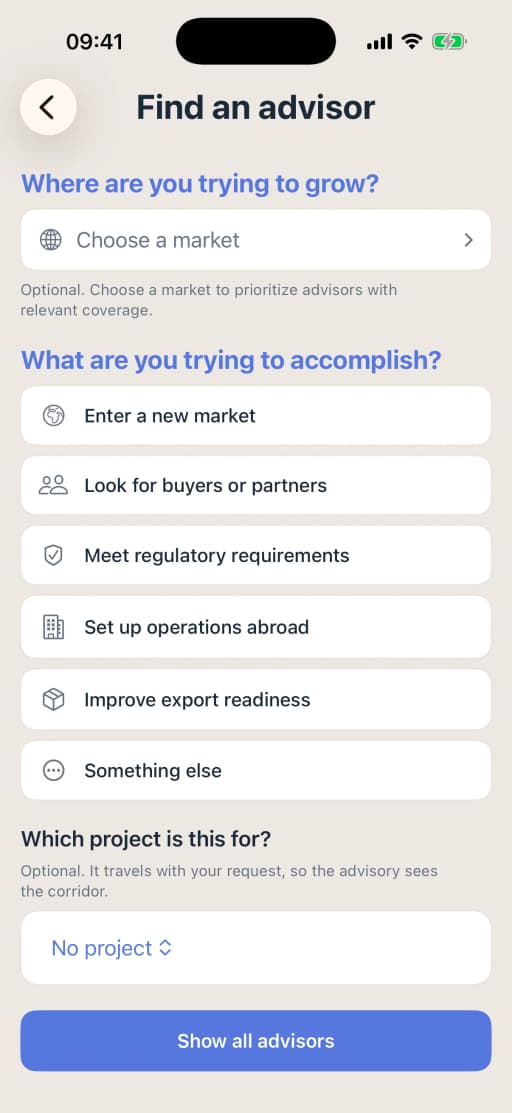
Finding an advisor for a market on iPhone. Prepare
Step 3: Check the local rules on technology contracts
Some countries register or approve contracts that bring in foreign technology, and some bar particular clauses. In China, a contract for technology that may be imported freely is registered, and registration is not what makes it valid; restricted technology needs an import license, and the contract takes effect only once that license is issued. The same regulations bar clauses that stop the licensee from improving the technology, or that charge royalties after a patent has expired or been invalidated4.
In the European Union, technology licenses are judged under competition law through a block exemption regulation, replaced by a new one from 1 May 202614. Ask local counsel which rules apply before any terms are set.
What this step produces
- A note from local counsel
- Contract registration or an import license, where required
Common mistake: Agreeing clauses the local authority will not accept, so the contract cannot work as written.
You do this step yourself
Registrations and approvals are made by you and your local counsel; Promote:Global does not register agreements or give legal advice. A market’s page lists the country’s official trade and investment bodies, to contact directly.
Prepare
Step 4: Work out the tax on royalties before you set the terms
Under the OECD Model Tax Convention, royalties are taxed only in the licensor’s country of residence when the licensor is their beneficial owner. Many treaties let the paying country withhold tax at a capped rate, and where there is no treaty, that country’s own law applies5.
So before you set a royalty, read the treaty between the two countries, decide who bears any tax withheld and whether the royalty is stated before or after it, find out what paperwork the licensee needs to withhold at the reduced rate (usually a tax residence certificate and a claim form), and check how you will claim credit for it at home.
What this step produces
- A tax note on the treaty
- Who bears the tax withheld, agreed in principle
Common mistake: Agreeing a net royalty without checking whether the tax withheld can be credited at home.
With Promote:Global
The plan’s Handle royalty tax & withholding step carries Find an advisor for this market, and Find service providers lists accounting and tax firms that list themselves. The plan places that step after Sign the license agreement: do the assessment now, and use the step for the paperwork once the agreement is signed. Promote:Global gives no tax advice.
Prepare
Step 5: Decide what the license covers
Decide whether the license is exclusive, the territory, the field of use, the term, and whether the licensee may grant sublicenses. WIPO publishes model contracts for know-how, exclusive and software licenses, which work as a checklist6. The right answer usually depends on the licensee’s capacity and market share, the size of the territory, and how strong your patent coverage is there.
What this step produces
- A term sheet
Common mistake: Granting exclusivity over a whole region to a firm that can serve one city.
You do this step yourself
You set the terms with your advisors; Promote:Global does not draft or review contracts. Keep the term sheet’s main points as a note on the project, where your team can see them and Meridian reads them when you ask about the project.
Prepare
Step 6: Value the IP and set the royalty model
WIPO describes valuing IP in qualitative and quantitative ways, by its cost, by comparison with the market or by the income it can earn, and the answer is usually a range rather than one number7. Royalties can be a running percentage of sales or an amount per unit, a lump sum, a minimum annual payment, or a mix of these6.
Define the base precisely, such as net sales or units sold, and how you will audit it, and set the rate on what reaches you after the tax withheld. WIPO flags audit rights, especially over what the licensee earns from its own sublicensees, as one of the harder points to negotiate6.
What this step produces
- A valuation range
- The royalty model: base, rate, minimums and audit rights
Common mistake: Agreeing a royalty on a base the licensee defines and you cannot audit.
You do this step yourself
Promote:Global does not value IP or suggest a royalty rate. The plan holds a Set the royalty model step, which you tick when the model is agreed, and Meridian reads the notes you keep on it when you ask about the project.
Connect
Step 7: Search for possible licensees
Start from the patent landscape and the firms already selling in your field, then widen the list through intermediaries and trade promotion agencies, which can make introductions7. Look for a firm with the capacity to make or sell under your rights, enough market share to pay a royalty worth having, and no licenses from your competitors that would conflict with yours.
What this step produces
- A long list of possible licensees
Common mistake: Choosing the first firm that answers with enthusiasm.
With Promote:Global
On the project, Search for possible partners looks on the open web for brand owners and manufacturers who license IP in your category, or for whoever you describe, ranked by fit, for 1 AI action. Each result says where it was found and is a lead to check before you make contact; save the ones you pursue to the project. If your trade agency or chamber works with you on Promote:Global, you can also ask it for an introduction, and the other side decides whether to accept.
Connect
Step 8: Check the licensee before you share know-how
Check the firm’s ownership, finances, references and compliance record, and ask which other licenses it holds and whether any compete with yours. Search the local IP register for marks or patents it has already filed: a partner that registers your rights in its own name can claim to own them once the relationship ends1.
What this step produces
- A due-diligence file on the finalist
- A search of the local IP register
Common mistake: Skipping the register search, so a filing in the firm’s own name surfaces only after the deal.
You do this step yourself
Promote:Global does not check firms. Search results come from the open web, so order credit reports, take references and search the IP register yourself or through an advisor.
Prepare
Step 9: Negotiate and sign the license agreement
The core terms are the scope, field and territory, the term, who owns the IP and any improvements, confidentiality, payment, sublicensing, warranties, and how disputes are settled6,15. Add a minimum performance or minimum royalty, so a licensee that does nothing cannot hold the market, and termination that returns the rights to you.
A trademark license also needs quality control: the standards the licensee must meet, approval of samples, and the right to inspect. Without it, products you have never seen sell under your name.
What this step produces
- The signed license agreement
- Schedules for royalties, quality standards and territory
Common mistake: Weak audit and quality-control clauses.
With Promote:Global
The plan’s Sign the license agreement step carries Find an advisor for this market. A request to an advisor carries your company’s contact card, listed before you send it, and the firm answers in Messages. Your lawyers draft the agreement: Promote:Global does not draft or review contracts.
Grow
Step 10: Record the license, hand over know-how, and monitor
Where it helps, record the license with the national IP office; a license on a Madrid mark can be recorded in the International Register16. Hand over know-how in stages tied to payments. Then read every royalty statement, use your audit rights, inspect quality, renew registrations on time and watch the register for filings in the licensee’s name1.
What this step produces
- License recordal
- Royalty statements and audit records
- An annual review
Common mistake: Handing over all the know-how before the first payment arrives.
With Promote:Global
The plan ends with Schedule quality audits & royalty reporting. The Revenue tracker adds up the revenue you log, such as royalties received, by market and by project, against the goal you set for each market. Promote:Global does not monitor a licensee’s sales: the figures are the ones you enter.
Your plan in Promote:Global
What a licensing project looks like.
Create a project, choose “Licensing” under “How are you entering?”, and Promote:Global writes this plan for your product and market. The route is in the list on the web and on iPhone. You tick steps off, skip one for now or add your own.
Protect
- Register or confirm your IP in the marketButton: Find an advisor for this market
- Run a freedom-to-operate checkButton: Find an advisor for this market
Value
- Set the royalty model
Partner
- Identify & vet a licensee
Contract
- Sign the license agreementButton: Find an advisor for this market
- Handle royalty tax & withholdingButton: Find an advisor for this market
Monitor
- Schedule quality audits & royalty reporting
The plan is the route’s own checklist, with no customs steps by default. Where the work moves goods across a border, such as equipment, ingredients, samples or branded supplies, add those steps yourself. You can add, reorder and skip steps. In your own project, each step names your product and your countries. Building the plan uses no AI action.
On a project, Search for possible partners looks on the open web for brand owners or manufacturers who license IP in the category, or for whoever you describe, ranked by fit, for 1 AI action. A result is a lead to check before you contact anyone, not a confirmed partner.
Make the plan fit this route
The plan for this route is its own checklist, from registering or confirming the IP to royalty reporting, and it places the tax on royalties after the agreement is signed. Add these four so the local rules and the tax are settled before you set the terms, and keep “Handle royalty tax & withholding” for the treaty paperwork once you have signed.
- List your IP and who owns each right (in Protect, before “Register or confirm your IP in the market”)
- Check the local rules on technology contracts (in Protect, after “Run a freedom-to-operate check”)
- Work out the tax on royalties before you set the terms (next, before “Set the royalty model”)
- Decide what the license covers (just before “Set the royalty model”)
On the project, type a step into Add a step under the roadmap, or ask Meridian to propose them: a step Meridian proposes is added only when you accept its card.

Meridian
Meridian, on your licensing project.
Meridian, the built-in AI assistant on the web and on iPhone, reads the project you have open: its route, its countries, the steps still open and your notes. It answers questions about them, and it proposes changes as cards. Nothing changes on the project until you accept a card. Ask it to search for possible partners and it runs the project’s search in the conversation, looking on the open web for brand owners or manufacturers who license IP in the category, for 1 AI action; every result is a lead to check.
Ask
- What’s the next step on this project?
- What’s blocking this project?
- What should we have in place before we talk to licensees?
Do
Add a step — to this plan, as a card you accept
Save a note — to the project
Set entry method — one of the eighteen routes, with its reason, if another fits you better
Every plan carries a monthly allowance of AI actions, and each question uses 1. Building the plan uses none. Meridian is AI. Verify before acting.
Documents
The paperwork.
- IP register and ownership records
- Every right you hold, with assignments from the employees and contractors who created it.
- Registrations or filings
- For patents, trademarks and designs: national filings, or international ones through the PCT, Madrid and Hague11,10,13.
- Nondisclosure agreement
- Protection for know-how and code you show before and during the license, which need no registration3.
- License agreement
- Scope, field, territory, term, royalties, audit, quality control, improvements, termination and disputes. WIPO publishes model contracts for know-how, exclusive and software licenses6.
- Technology-contract registration or license
- Where the country requires one, as China does for technology import contracts4.
- Tax residence certificate and treaty claim
- What the licensee needs to withhold at the treaty rate, and the receipts you need to claim credit at home5.
- License recordal
- The license recorded with the national IP office, or in WIPO’s International Register for a Madrid mark16.
- Royalty statements and audit records
- The licensee’s report for each period, and what your audits found.
Costs and timelines
What to budget for.
Get quotes for
- Trademark filings through Madrid
- A basic fee of 653 Swiss francs (903 for a mark in color), plus a fee for each country you designate (WIPO, 2026), and a local attorney where an office objects10.
- Patent filings through the PCT
- An international filing fee of 1,330 Swiss francs (as of 1 July 2026), plus a search fee of roughly 150 to 2,000 Swiss francs depending on the authority. The national phase, with translations and local agents, usually costs more than either12.
- Design filings through Hague
- A basic fee of 397 Swiss francs for one design and 50 for each additional one, plus publication and designation fees13.
- Know-how and code
- No registration fee. What it costs is keeping them secret: the nondisclosure agreements and the access controls3.
- Local counsel
- On the rules for technology contracts and on the agreement; moves with the number of markets and whether a contract must be registered or approved there4.
- Tax advice
- On the treaty, who bears the tax withheld and the credit at home; moves with the number of country pairs5.
- Valuation and royalty audits
- A valuation moves with the method, cost, market or income, and the evidence you have7; audits with how often you run them.
What sets the timing
- Patent priority: a filing abroad within 12 months of your first filing keeps its date, and the PCT national phase generally starts by month 3012.
- Trademark examination: each office you designate through Madrid has a set period, 12 or 18 months, to refuse protection16.
- Approval of the contract, where a country requires it. China decides an application to import restricted technology within 30 working days and issues the license within a further 10, and registers a contract for freely importable technology in 3 working days (regulations in force since 2002)4.
- The treaty paperwork, in place before the first royalty is paid5.
- Finding and checking a licensee, and negotiating the agreement.
Ask for each quote in writing, for your product, market and volumes. Prices and timings differ by country, provider and year.
Mistakes and best practices
What goes wrong, and what works.
Common mistakes
- Building international trademark registrations on a home mark that could be canceled in its first five years: for five years the international registration depends on it, though it can be turned into national applications that keep the original date16.
- Leaving the agreement silent on what happens to stock, sublicenses and know-how when it ends.
Best practices
- Use a local IP attorney in each country1.
- Weigh a patent against secrecy for each invention: a trade secret has no time limit but gives no right against someone who finds it out independently or by reverse engineering3.
- Keep one register of every license you grant, with its rights, field, territory, term and royalty base, so two licensees never hold the same ground.
Questions
Questions people ask.
Do I need to register my IP in a country before licensing it there?
It depends on the type. Patents, trademarks and designs protect you only where they are registered or granted, so register those in the market first8,9. Copyright arises without registration in most countries, and trade secrets and know-how need none: they are protected by keeping them confidential2,3.
Can I license software abroad?
Yes. Software code is protected by copyright, which in most countries needs no registration, and WIPO’s model contracts include a software license2,6.
How are royalties usually structured?
As a running percentage of sales or an amount per unit, a lump sum, a minimum annual royalty, or a combination, with audit rights over the licensee’s records6.
Is tax withheld on royalties paid to a foreign licensor?
Often. Many treaties let the paying country withhold a capped share, and without a treaty its own law applies, so check the treaty before you agree the price5.
Is it better to license my IP or sell it?
A license keeps ownership with you, earns for as long as it runs and can be ended; a sale brings one payment and hands control of the right to the buyer6. Which suits you depends on how central the IP is to your business.
Sources
Where this guide comes from.
- [1]Protect intellectual property · U.S. International Trade Administration
- [2]Copyright · World Intellectual Property Organization (WIPO), 2026
- [3]Frequently asked questions on trade secrets · World Intellectual Property Organization (WIPO), 2026
- [4]Regulations on Technology Import and Export Administration of the People’s Republic of China · State Council of China, published on WIPO Lex, 2002
- [5]Model Tax Convention on Income and on Capital, condensed version · OECD, 2017
- [6]Technology transfer agreements · World Intellectual Property Organization (WIPO)
- [7]Access to market and commercialization · World Intellectual Property Organization (WIPO)
- [8]Patents · World Intellectual Property Organization (WIPO), 2026
- [9]Trademarks · World Intellectual Property Organization (WIPO), 2026
- [10]How the Madrid System works · World Intellectual Property Organization (WIPO), 2026
- [11]Patent Cooperation Treaty (PCT) · World Intellectual Property Organization (WIPO)
- [12]PCT frequently asked questions · World Intellectual Property Organization (WIPO), 2026
- [13]The Hague System for industrial designs · World Intellectual Property Organization (WIPO)
- [14]Technology Transfer Block Exemption Regulation · European Commission, Directorate-General for Competition, 2026
- [15]Successful Technology Licensing · World Intellectual Property Organization (WIPO), 2015
- [16]Guide to the Madrid System · World Intellectual Property Organization (WIPO), 2024
Reviewed October 26, 2026. This guide is general information about how companies do this, written in our own words from the sources above; it is not legal, tax or financial advice. Rules differ by country and change, so check them with the authority or an advisor before you act. What it says Promote:Global does is what the product does today. The screens on this page come from our demo workspace, and the companies in them are invented.
Read next
Related guides.
The next rung up
How to form an international joint ventureJoint venture · Investment / FDI
- How to franchise internationally
Franchising · Contractual
- How to find a contract manufacturer abroad
Contract manufacturing · Contractual
- How to form a strategic alliance abroad
Strategic alliance · Investment / FDI
All eighteen guides Promote:Global for international expansion Plans and prices
Start your licensing project.
Sign up, add what you sell, then create a project and choose “Licensing” under “How are you entering?”. The plan above is written for your product and market.
Start this projectFree to start. No credit card needed. See plans and prices