How to deliver a turnkey project abroad
Design, build and hand over a working facility abroad, from the tender to the end of the warranty.
For an engineering or equipment company whose technology or design a client abroad wants delivered as a working plant, with the balance sheet, or the partners, to carry the guarantees.
On this page: In short
In short
In short
To deliver a turnkey project abroad, find the tender early, read the procurement rules that apply and qualify to bid, with partners where the work is beyond you, then bid a price that carries the risks of a fixed lump sum, backed by the bank guarantees the owner asks for and a plan for funding the work until milestone payments arrive1,2,3. Agree the contract and its milestones, usually on FIDIC’s Silver Book, then design, procure, ship the equipment through customs, build, test, hand over and close out the warranty4.
The route in Promote:Global
Turnkey project · Contractual
Commitment
Control
Risk
Rated 1 to 5, as the iPhone app rates every route when you choose one. The ratings are general, for the route itself: your own commitment, control and risk depend on your market, your product and your partners.
When it fits
Is a turnkey project the right route?
A good fit when
- You hold process technology or engineering that a client wants delivered as a working plant, not as parts.
- Projects funded by governments or development banks are being tendered in your sector, with published notices1,2.
- You can carry bank guarantees, working capital and a long payment cycle, or partner with a firm that can5.
A poor fit when
- The scope or the site is poorly defined: a fixed lump sum with unknown ground conditions, permits or client duties can wipe out the margin.
- You cannot provide the performance and advance payment guarantees, or have no local partner for permits, labor and subcontractors.
- You want a light, low-risk way in. Licensing or a management contract carries less risk.
The people involved
Who’s involved and how they work together
- Your company to Owner: A working plant, handed over
- Your company to Your bank: Fees and collateral
- Your company to Subcontractors: Subcontracts and payment
- Owner to Your company: Milestone payments
- Your bank to Owner: Guarantees it can call
Step by step
How to deliver a turnkey project abroad, in 10 steps.
Each step says how companies do it, with sources, then what Promote:Global does there, or that the step is yours to do.
Discover
Step 1: Find the project and qualify to bid
Many public projects abroad are funded by development banks and tendered under their rules. The World Bank runs a suppliers’ hub and a listing of business opportunities for the projects it funds, and publishes procurement notices1. Follow projects from their procurement plans and early notices, not only from the invitation to bid, so you have time to form a team. The bid goes to the borrower that runs the procurement, not to the bank2.
Read the rules that apply before you commit. For World Bank-funded projects they are the Procurement Regulations for IPF Borrowers, seventh edition of September 2025: the borrower runs the procurement with the Bank’s standard documents, joint ventures may bid, one firm may not submit more than one bid, and debarred firms are excluded2.
For large or complex contracts, turnkey and design-and-build among them, the borrower may prequalify bidders on their experience and their balance sheet, and may ask for a new prequalification if more than 12 months pass before bids are invited2. Prequalify with the team that will bid: where the project is beyond your size or experience, bring in consortium or joint venture partners now.
What this step produces
- A pipeline of projects, with the notices and the borrower’s contacts
- A checklist of the procurement rules
- A prequalification submission, with references that match its criteria
Common mistake: Tracking only invitations to bid, and missing the procurement plans that come before them.
You do this step yourself
Promote:Global has no tender search, holds no tender notices and does not prepare a prequalification. A market’s page lists official trade and investment bodies for the country, to contact directly.
Prepare
Step 2: Prepare and submit the bid
Large, complex turnkey plants may be tendered in stages: a first stage on a concept or a performance specification, with discussions, before the final priced bids2. Get quotes from the equipment suppliers and local subcontractors you will rely on, and price the risks you will carry: a lump sum is fixed unless the contract provides for adjustment, so ground conditions, customs, currency and inflation belong in the price.
Price the local tax too. Under the OECD Model Tax Convention, a building site or construction project that lasts more than 12 months generally creates a permanent establishment, a taxable presence, in the country, and the treaty and the local law decide how your payments are taxed6.
Include the bid security. Under the World Bank’s rules it is a bank guarantee, which may come from a bank in any eligible country, with a local bank making it enforceable where needed, or a bid-securing declaration where the borrower allows one2.
What this step produces
- The technical bid and the priced bid
- Supplier and subcontractor quotes
- The bid security or bid-securing declaration
Common mistake: Underpricing risks such as ground conditions, customs and inflation.
With Promote:Global
On a turnkey project, Search for possible partners has no default counterpart, so it looks on the open web for whoever you describe, such as equipment suppliers or civil works contractors in the country, for 1 AI action; each result is a lead to check, and Promote:Global checks no firm. For the equipment you will ship, Export check gives the duty in the country, with its source and year, and Landed cost adds freight, insurance, duty and tax; both are free. Promote:Global does not arrange bid security.
Prepare
Step 3: Arrange the guarantees
Beyond the bid security, owners usually ask for an advance payment guarantee, a performance guarantee and a retention or warranty guarantee, generally issued by banks as demand guarantees3. Read the wording before your bank issues anything: the amount should reduce as the work is delivered, and each guarantee should end on a fixed date.
What this step produces
- Advance payment, performance and retention guarantees
Common mistake: Signing guarantee wording with no fixed expiry, or with no reduction as the work is delivered.
You do this step yourself
Promote:Global does nothing about bonds or guarantees. Arrange them with your bank.
Prepare
Step 4: Confirm the funding and plan your cash
Find out how the owner pays for the project, from its own budget or with a development bank’s funding, and what has to happen before each payment is released: your milestone schedule depends on it.
Then plan your own cash through the project. You buy equipment and pay subcontractors before the milestone payments arrive, and banks usually want cash collateral for the guarantees, which ties up working capital. An export credit agency can reduce that: the US Export-Import Bank’s program, for example, lets an exporter use eligible inventory to collateralize 25 percent of the undrawn amount5.
What this step produces
- A cash plan for the project
- A facility agreement with your bank
Common mistake: Running short of cash because the collateral for the guarantees ties up working capital.
You do this step yourself
Promote:Global does not arrange funding, credit or guarantees. Plan the cash with your bank and, where it helps, your country’s export credit agency.
Prepare
Step 5: Negotiate the contract and its milestones
FIDIC’s Silver Book, the conditions for EPC and turnkey projects (second edition, 2017), is the standard form. The contractor designs against the employer’s requirements and carries the most risk; there is no independent engineer, and the employer’s representative, who administers the contract, has no duty of neutrality. Under the Red Book, by contrast, the employer designs and the contractor builds4.
Tie each payment milestone to progress you can show, such as approved designs, equipment delivered to site or tests passed, and match the milestones to your cash plan. Then check the delay damages, the performance tests, the caps on liability, the change and claims procedures with their notice periods, and the governing law and disputes clause.
What this step produces
- The signed contract, with its particular conditions
- A milestone and payment schedule
Common mistake: Accepting unamended terms that put unforeseeable risk on you.
You do this step yourself
Promote:Global does not draft, review or negotiate contracts and gives no legal advice. Use counsel who know FIDIC and the country.
Prepare
Step 6: Complete the design and procure the equipment
Complete the detailed design against the employer’s requirements, which under the Silver Book is the contractor’s responsibility4, and submit it for review where the contract asks. Order the equipment and place the subcontracts on terms that carry the main contract’s deadlines, tests and warranties down to each supplier. Register locally where the work requires it, and secure the permits before anyone mobilizes to site.
What this step produces
- Approved designs
- Purchase orders and subcontracts
- Local registrations and permits
Common mistake: Subcontracts that leave a supplier’s delay or defect with you alone.
You do this step yourself
Design, procurement and permits are yours; Promote:Global does not register companies or apply for permits. Find service providers lists construction, legal and corporate, and accounting and tax firms that list themselves, where one is listed for the country.
Grow
Step 7: Ship the equipment and clear it through customs
The equipment crosses at least one border on its way to site. Agree in the contract and the purchase orders who exports, who imports and who pays the duty and import taxes, with an Incoterms rule on each supply contract, and check whether the country relieves equipment for the project from duty. Each consignment needs its export documents and an import declaration, and a missing document holds the equipment at the border while the schedule runs on.
What this step produces
- Export and import documents for each consignment
- A delivery schedule matched to the work schedule
Common mistake: Leaving it unclear who imports the equipment and who pays the duty.
With Promote:Global
The project’s corridor plan carries the equipment across the border: the duty and landed cost, the export document pack, booking the freight and the shipment. Export check gives the duty in the country and the documents a shipment needs, by stage, with who issues each, as guidance, not a customs ruling. Find service providers lists logistics and freight, and customs and compliance firms that list themselves; Promote:Global does not file declarations or book freight.
Grow
Step 8: Build and install
Mobilize to the schedule, manage the subcontractors on site, and install the equipment. Keep a record of every instruction, delay and variation, and give notice of each claim within the contract’s deadline: a late notice can cost you the right to more time or money.
What this step produces
- A work schedule and progress reports
- A register of notices and claims
Common mistake: Missing notice deadlines on delays or variations.
You do this step yourself
Building and installing are yours and your consortium’s. Promote:Global does not manage construction or contract claims.
Grow
Step 9: Test the plant and hand it over
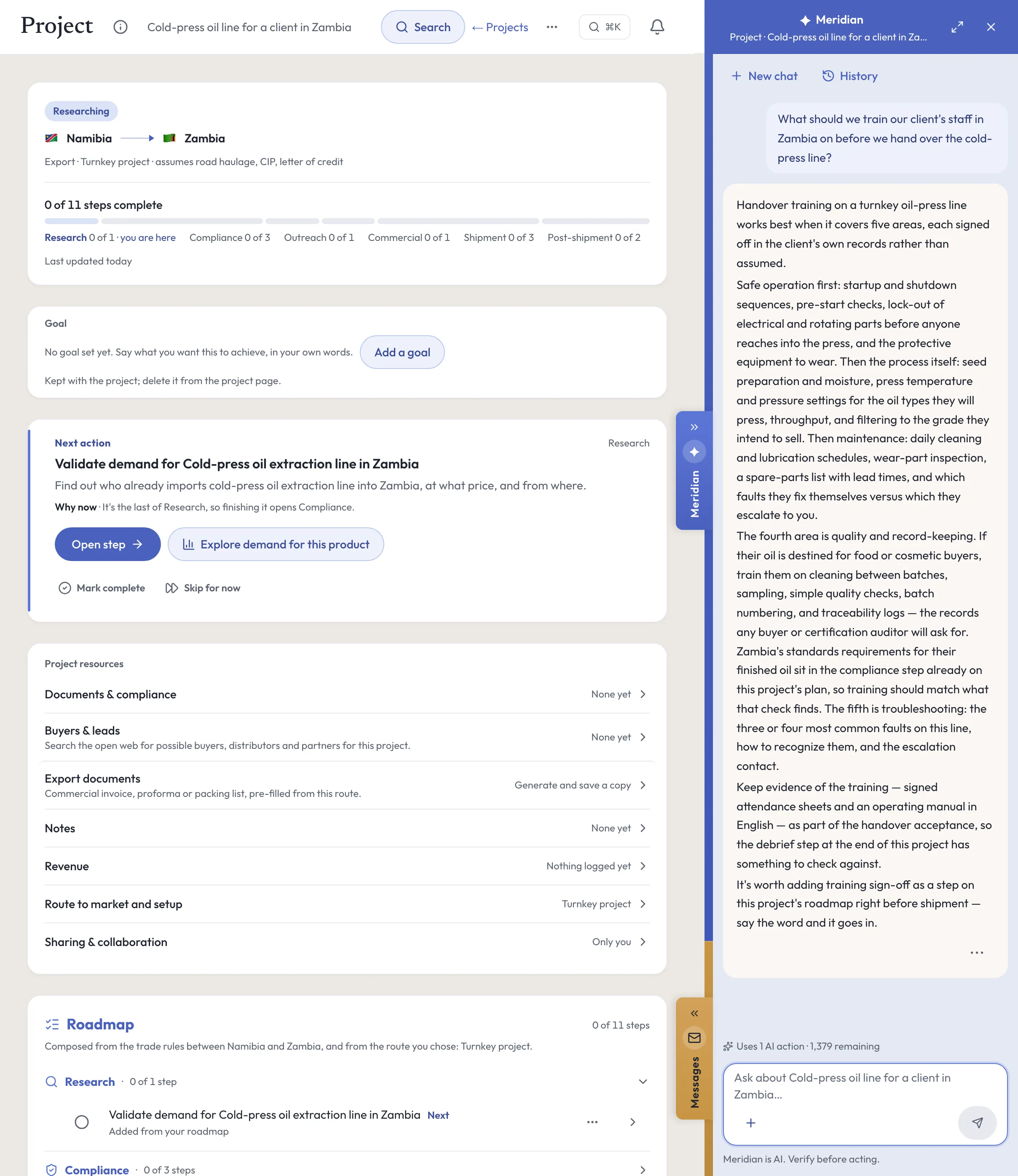
Run the tests on completion and the performance tests the contract sets, and read those clauses closely, because they decide what happens if the plant falls short. Train the owner’s staff, hand over the operating manuals and the as-built documents, and obtain the taking-over certificate.
What this step produces
- Test records
- The taking-over certificate
- As-built documents and operating manuals
- Training records
Common mistake: Leaving the owner’s staff untrained at handover, so early faults turn into warranty disputes.
You do this step yourself
Testing and handing over are yours; Promote:Global does not manage commissioning. Keep the test results and the handover list as notes on the step, where Meridian reads them when you ask about the project.
Grow
Step 10: Close out the warranty
Through the warranty or defects period, repair what fails and keep a record of each repair. At its end, obtain the final certificate the contract names, agree the final account, and have the retention paid and the retention or warranty guarantee released3.
What this step produces
- The final certificate
- The final account
- Retention paid and guarantees released
Common mistake: Not asking for the retention and the release of the guarantees when the period ends.
You do this step yourself
Promote:Global does not track warranties, retention or guarantees. Keep their dates as a note on the project, where your team can see them.
Your plan in Promote:Global
What a turnkey project looks like.
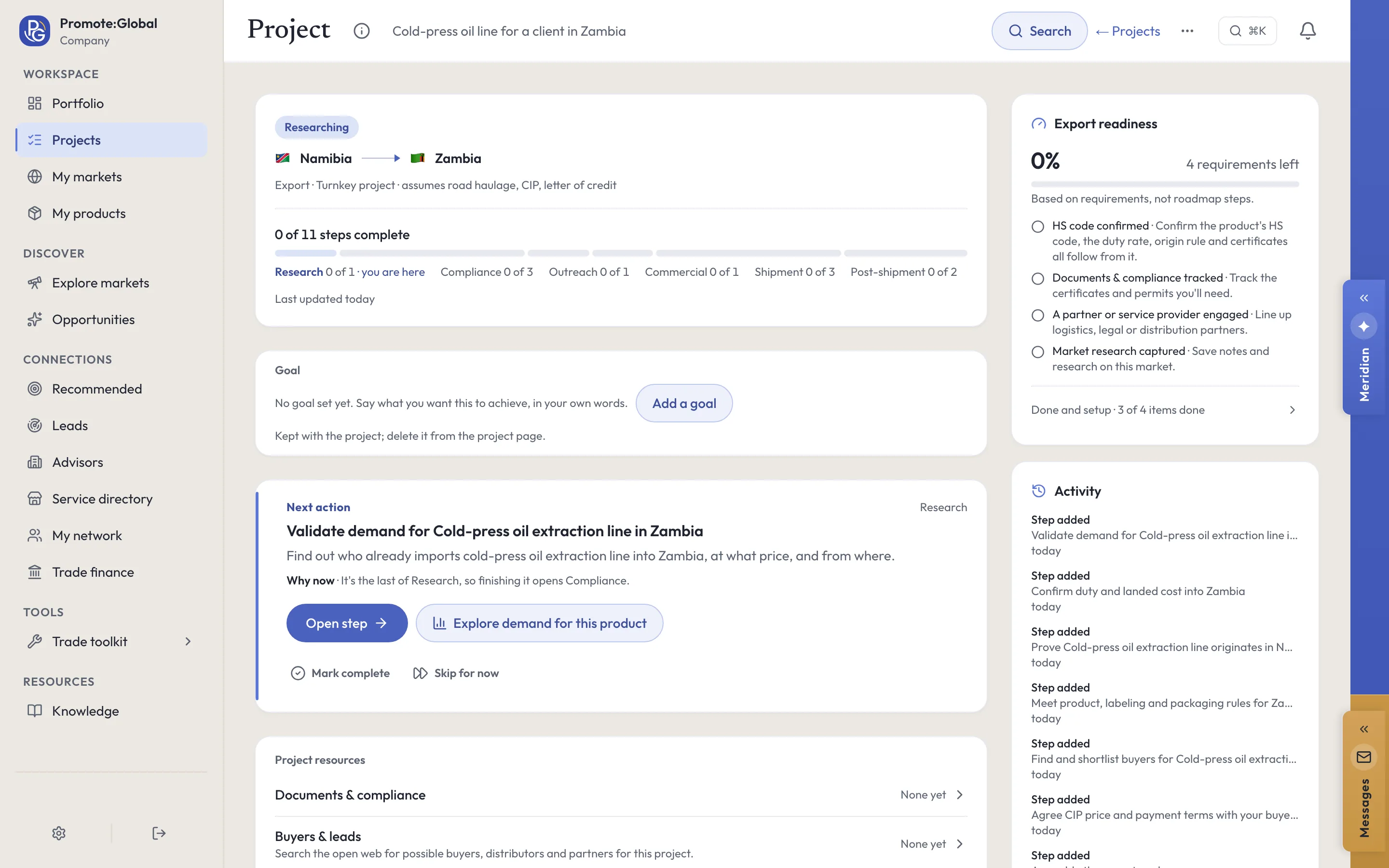
Create a project, choose “Turnkey project” under “How are you entering?”, and Promote:Global writes this plan for your product and market. The web lists the route; on iPhone, the route advisor or Meridian sets it. You tick steps off, skip one for now or add your own.
Research
- Validate demand for your product in your target market
- Classify your product for customs (until the HS code is confirmed)
Compliance
- Confirm duty and landed cost into your target market
- Prove your product originates in your country (where a trade agreement offers a lower rate)
- Obtain a certificate (one for each certificate the route needs)
- Meet product, labeling and packaging rules for your target market
Outreach
- Find and shortlist buyers for your product in your target marketButton: Search for possible buyers in this market
Commercial
- Agree the Incoterm, price and payment terms with your buyer in your target market
Shipment
- Assemble the export document pack
- Book freight to your target market
- Ship a first order to your target market
Post-shipment
- Present the documents and collect payment from your target market (when paid by letter of credit or collection)
- Debrief the first shipment and fix the pack
The duty, origin and certificate steps are looked up from your product’s HS code and the two countries, so their number depends on what you sell and where. A step with a condition in brackets appears only where it applies. In your own project, each step names your product and your countries. Building the plan uses no AI action.
On a project, Search for possible partners looks on the open web for whoever you describe, ranked by fit, for 1 AI action. A result is a lead to check before you contact anyone, not a confirmed partner.
Make the plan fit this route
On this route Promote:Global writes its export corridor plan, whose duty, document, freight and shipment steps cover delivering the equipment through customs; it has no steps for the tender, the guarantees, the funding, the contract or the work on site. Add these nine in this order, and use Skip for now on “Find and shortlist buyers for your product in your target market”, since the tender names your client.
- Find the project and qualify to bid (in Research, after “Validate demand for your product in your target market”)
- Prepare and submit the bid (in Compliance, after “Meet product, labeling and packaging rules for your target market”, once the equipment’s duty and landed cost are known)
- Arrange the guarantees (next, before “Agree the Incoterm, price and payment terms with your buyer in your target market”)
- Confirm the funding and plan your cash (next, before “Agree the Incoterm, price and payment terms with your buyer in your target market”)
- Negotiate the contract and its milestones (just before “Agree the Incoterm, price and payment terms with your buyer in your target market”, which then records the equipment’s delivery terms)
- Complete the design and procure the equipment (in Shipment, before “Assemble the export document pack”, which with “Book freight to your target market” and “Ship a first order to your target market” is the equipment’s delivery)
- Build and install (after “Ship a first order to your target market”)
- Test the plant and hand it over (next, after “Ship a first order to your target market”)
- Close out the warranty (last, after “Debrief the first shipment and fix the pack”)
On the project, type a step into Add a step under the roadmap, or ask Meridian to propose them: a step Meridian proposes is added only when you accept its card.
Meridian
Meridian, on your turnkey project.
Meridian, the built-in AI assistant on the web and on iPhone, reads the project you have open: its route, its countries, the steps still open and your notes. It answers questions about them, and it proposes changes as cards. Nothing changes on the project until you accept a card. Ask it to search for possible partners and it runs the project’s search in the conversation, looking on the open web for whoever you describe, for 1 AI action; every result is a lead to check.
Ask
- What’s the next step on this project?
- What’s blocking this project?
- Which documents will the equipment shipment need?
Do
Add a step — to this plan, as a card you accept
Save a note — to the project
Set entry method — one of the eighteen routes, with its reason, if another fits you better
Every plan carries a monthly allowance of AI actions, and each question uses 1. Building the plan uses none, and neither do Export check, Landed cost and the Origin qualifier. Meridian is AI. Verify before acting.
Documents
The paperwork.
- Prequalification submission
- Experience, references and the balance sheet, against the tender’s criteria2.
- Bid and bid security
- The technical and priced bid, with a bank guarantee or a bid-securing declaration2.
- Consortium or joint venture agreement
- Who does what, and how liability is shared between the partners2.
- Turnkey contract
- FIDIC Silver Book conditions with their particular conditions, or the owner’s own form, with the milestone schedule4.
- Guarantees
- Advance payment, performance, retention and warranty guarantees, usually bank demand guarantees3,5.
- Local registration, permits and tax documents
- Including a branch or company where the work creates a permanent establishment6.
- Export and import documents
- For each consignment of equipment, on both sides of the border.
- Taking-over and final certificates
- The proof of completion, then of the end of the warranty, that release the retention and the guarantees.
Costs and timelines
What to budget for.
Get quotes for
- Bid preparation
- Design and estimating to the depth the tender asks for, site visits and translation; more where the tender runs in stages.
- Equipment
- Supplier quotes against the employer’s requirements; they move with the specification, the quantities and the lead time.
- Freight, insurance, duty and customs clearance
- Move with the Incoterms rule on each supply contract, the route to site, and the duty and import taxes the country charges on the equipment.
- Subcontracts and local labor
- Civil works, installation and site services, quoted locally; they move with the ground conditions and the schedule.
- Guarantees
- Bank fees and cash collateral for each guarantee, which move with its amount and term, your bank and your credit standing5.
- Insurance
- For the works, the equipment in transit and third-party liability; it moves with the contract value and the risks the contract puts on you.
- Local setup, counsel and tax advice
- Registration, local counsel and tax advisers; the tax itself depends on how long you are on site, which decides whether you have a taxable presence there6.
- Contingency
- For ground conditions, currency and inflation, which a fixed price does not adjust for unless the contract says so.
- The warranty period
- Repairs, spares and staff on call until the final certificate.
What sets the timing
- The tender’s timetable: at least 30 business days to prepare a bid in a World Bank-funded open international competition, and longer where the tender runs in stages2.
- Prequalification first, renewed if more than 12 months pass before bids are invited2.
- The guarantees and the owner’s funding, in place before the advance payment is made.
- Design approval, then each supplier’s manufacturing lead time.
- Shipping and customs clearance for each consignment.
- Permits and local registration, before work starts on site.
- The tests on completion: taking over waits until they are passed.
- The warranty or defects period, which keeps the retention and the guarantees open until it ends.
Ask for each quote in writing, for your product, market and volumes. Prices and timings differ by country, provider and year.
Mistakes and best practices
What goes wrong, and what works.
Common mistakes
- Assuming national procurement practice applies to a tender funded by a development bank2.
- A consortium agreement that leaves liability between the partners unclear, including whether they are jointly and severally liable2.
- Taking on a fixed price with no record of the site conditions the price assumed.
Best practices
- Start with smaller, similar projects to build references, and partner for scale.
- Check the World Bank’s list of debarred firms, and its fraud and corruption rules, before you bid1,2.
- Ask your bank for its guarantee model forms early, and have counsel review them before anything is issued.
- Engage local counsel and tax advisers before you sign6.
Questions
Questions people ask.
What is the difference between turnkey and EPC?
In practice they describe the same approach: one contractor designs, procures and builds the facility and hands it over ready to operate. FIDIC’s form for it is the Silver Book4.
How do I bid on World Bank-funded projects?
The borrower, usually a government agency, runs the tender under the Bank’s rules. Find the notices through the Bank’s procurement and business opportunity pages, then bid to the borrower, not to the Bank1,2.
What is a performance guarantee?
A bank’s undertaking to pay the owner if you fail to perform the contract, usually issued as a demand guarantee3.
Will I pay tax in the country where I build?
Often, yes. A construction project lasting more than 12 months can create a permanent establishment under the OECD Model; check the treaty and the local law6.
Do I need a local partner?
Not always, but many owners prefer local participation, and some tenders give a preference to domestic firms2. Check the tender documents.
Sources
Where this guide comes from.
- [1]Project procurement · World Bank, 2025
- [2]Procurement Regulations for IPF Borrowers, seventh edition · World Bank, September 2025
- [3]ICC and Global Credit Data performance guarantees paper · International Chamber of Commerce and Global Credit Data, 2022
- [4]Guide to the FIDIC contracts · Charles Russell Speechlys, law firm, 2021
- [5]Bid and performance bonds · Export-Import Bank of the United States
- [6]Model Tax Convention on Income and on Capital, condensed version · OECD, 2017
Reviewed October 26, 2026. This guide is general information about how companies do this, written in our own words from the sources above; it is not legal, tax or financial advice. Rules differ by country and change, so check them with the authority or an advisor before you act. What it says Promote:Global does is what the product does today. The screens on this page come from our demo workspace, and the companies in them are invented.
Read next
Related guides.
- How to win a management contract abroad
Management contract · Contractual
- How to form an international joint venture
Joint venture · Investment / FDI
- How to export goods
Direct exporting · Export-based
All eighteen guides Promote:Global for international expansion Plans and prices
Start your turnkey project.
Sign up, add what you sell, then create a project and choose “Turnkey project” under “How are you entering?”. The plan above is written for your product and market.
Start this projectFree to start. No credit card needed. See plans and prices