How to win a management contract abroad
Run a hotel, utility or other operation that someone else owns abroad, for a base fee and a fee tied to results.
For a company whose value is know-how in running something, such as a hotel, a utility, a port terminal or a hospital, and which wants to run an operation abroad for fees without buying the asset.
On this page: In short
In short
In short
To win a management contract abroad, choose the sectors and countries where owners hire outside operators, check the tax on your fees there, follow public tenders (which often prequalify bidders) or approach private owners directly, and assess the owner and the asset before you bid1,2,3. Agree a base fee and an incentive fee tied to results, who prepares and funds the operating budget, and fair performance measures, then mobilize, report against those measures and plan the handover from the start2,4.
The route in Promote:Global
Management contract · Contractual
Commitment
Control
Risk
Rated 1 to 5, as the iPhone app rates every route when you choose one. The ratings are general, for the route itself: your own commitment, control and risk depend on your market, your product and your partners.
When it fits
Is a management contract the right route?
A good fit when
- Your value is know-how, such as operating systems, a brand, training or a technology platform, that an owner will pay to use.
- You want to work abroad with little capital and build a record for larger roles later: a management contract involves no significant private capital4.
- The owners are public authorities that want private operating skills without selling the asset, and development-bank rules cover hiring an operator this way1,4.
A poor fit when
- The owner will not fund the repairs and capital spending your standards need, and you would be blamed for results you cannot control2.
- Fees are hard to send home, or the tax on them in the owner’s country removes the margin.
- You cannot post experienced managers on site for long periods; staffing abroad is the main cost.
The people involved
Who’s involved and how they work together
- Owner to Your company: Asset, budget, approvals
- Owner to Your company: Base fee and incentive fee
- Your company to Guests or users: The service, run day to day
- Guests or users to Owner: Revenue, to the owner
- Your company to Owner: Reports and accounts
Step by step
How to win a management contract abroad, in 10 steps.
Each step says how companies do it, with sources, then what Promote:Global does there, or that the step is yours to do.
Discover
Step 1: Define the service you can sell abroad
State the operations you run, the standards and systems you bring, your record in numbers an owner can compare, and the managers you can post abroad. A management contract asks for no significant capital from the operator and usually runs for less time than a concession4, so what you are selling is the team and the system.
What this step produces
- A capability statement
- References with measured results
Common mistake: Describing the business in general terms instead of results an owner can compare.
With Promote:Global
Create a project on the Management contract route: the web lists it under “How are you entering?”, and on iPhone the route advisor or Meridian’s Set entry method card sets it. Promote:Global writes a services plan, with no duty, origin or shipping steps, using no AI action, and each step carries an objective and a Complete when checklist.
Discover
Step 2: Choose the sectors and countries, and check what they ask of a foreign operator
Look where owners hire outside operators: utilities and ports that want efficiency without selling the asset4, and hotel owners who want a brand and a manager2. Then check the legal frame in each country: whether a foreign operator needs a license, a local partner or a quota of local staff, and whether fees can be paid abroad.
What this step produces
- A list of target sectors and countries
- A note on each country’s rules for foreign operators
Common mistake: Ignoring sector licensing or ownership limits until a bid is due.
With Promote:Global
The plan’s compliance step on what the market asks of a foreign provider carries Find an advisor for this market, which opens advisory firms with experience of the market. A market’s page also lists the country’s official trade and investment bodies, to contact directly. Neither is legal advice.
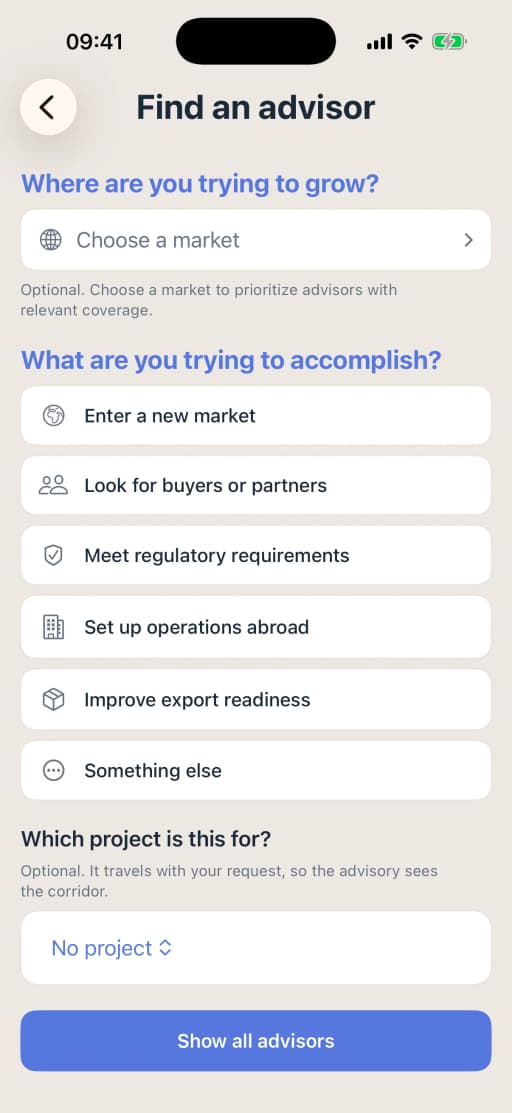
Finding an advisor for a market on iPhone. Prepare
Step 3: Check the tax on your fees before you price
Under the OECD Model, business profits are taxed in your home country unless you have a permanent establishment in the other, usually a fixed place of business5. The UN Model adds a services permanent establishment: providing services there through your people for more than 183 days in any twelve-month period can create one3.
The UN Model, since its 2017 edition, also lets the client’s country tax fees for managerial, technical or consultancy services at a rate set in the treaty3, and many countries withhold tax on service fees under their own law. Check the specific treaty between the two countries before you price.
What this step produces
- A tax note on the treaty
- Tax residence certificate
Common mistake: Assuming there is no local tax because you opened no office.
With Promote:Global
The plan’s compliance step on the tax on selling your service into the market carries Find an advisor for this market, and comes before the commercial step, so the tax is known before you name a price. Find service providers lists accounting and tax firms that list themselves. Promote:Global gives no tax advice.
Connect
Step 4: Find the opportunities: tenders and owners
Public owners usually hire under procurement rules, including a development bank’s rules when it pays for the project. The World Bank’s procurement regulations treat management contracting as a case for prequalification, because detailed bids are costly to prepare1, and its public-private partnership guide points to sample bidding documents and a technical note on procuring management contracts4.
Private owners, such as hotel investors, usually approach operators directly or through their advisors. Build those relationships before a tender is published.
What this step produces
- A pipeline of tenders and owners
Common mistake: Waiting for the tender notice instead of knowing the owners earlier.
With Promote:Global
The Outreach step, Find and shortlist owners or operators, opens the project’s search for possible partners, which looks on the open web for whoever you describe, ranked by fit, for 1 AI action. Each result says where it was found and is a lead to check before you contact anyone. Promote:Global does not search public tenders: there is no tender database, so watch the procurement portals yourself.
Prepare
Step 5: Prequalify and form the team
Where a tender prequalifies bidders1, your file has to show relevant experience, financial capacity and the key people you would post. Match the references to the scope you are bidding for, name the managers, and decide whether you need a local partner for licenses, language or local staff.
What this step produces
- A prequalification file
- Résumés of the key people
- A partner agreement, if you bid with one
Common mistake: Listing credentials that do not match the scope.
You do this step yourself
The prequalification file and the bid are yours to prepare; Promote:Global does not write bids. Keep the file’s checklist as subtasks on a step, where your team can work through it.
Connect
Step 6: Assess the owner and the asset before you bid
Find out whether the owner can fund the operating budget and the capital spending your standards need, and look at the asset’s condition, its debts and what its banks can require, its licenses, the labor arrangements you would inherit, and the political context. An owner that will not fund repairs leaves you blamed for results you cannot control2.
What this step produces
- An assessment of the owner and the asset
- A risk list
Common mistake: Taking over a poorly funded asset, then taking the blame for its results.
You do this step yourself
Promote:Global does not check owners or assets. Do it with local advisors, and write what you find on the project, where Meridian reads it when you ask about the project.
Prepare
Step 7: Set the base fee and the incentive fee
The usual structure is a base fee plus an incentive fee tied to results. Hotel management agreements commonly set the base fee on revenue and the incentive fee on operating profit, and charge separately for central services such as marketing and reservations2.
Define revenue, profit and costs precisely in the fee clause, make sure the base fee covers your own costs after the tax on it, and set any incentive hurdle at a level the asset can reach.
What this step produces
- A fee proposal
- A cost model for your team on site
Common mistake: A base fee that does not cover your own costs, or an incentive hurdle the asset has never reached.
You do this step yourself
Promote:Global does not price your services. Keep the fee proposal and the cost model as notes on the project, where Meridian reads them when you ask about the project.
Prepare
Step 8: Negotiate the agreement: budget and performance measures
Settle who does what with the money: who prepares the annual operating budget and capital plan, who approves it and by when, who funds shortfalls and capital spending, and the reserve for replacing furniture and equipment, which hotel agreements commonly set at 3 to 5% of revenue, according to one 2021 law-firm guide2.
Then the performance measures and the rest: the standard of operation, the tests the owner can terminate on and their cure periods, the owner’s approval rights over key staff and large contracts, the term and renewal, reporting and audit, who bears staff costs, insurance and liability, and disputes. Vague tests, with cure rights that never end, make termination nearly impossible for either side2. Large branded hotel operators often seek terms near 20 years, while public management contracts are much shorter than concessions2,4.
What this step produces
- The signed management agreement
- Schedules: fees, budget process, standards, performance measures, staff
Common mistake: Vague performance measures, or tests so strict they invite termination in the first year2.
With Promote:Global
The plan’s Commercial step, Agree scope, price and payment terms with your client, carries its objective and a Complete when checklist to work through. Your lawyers draft and negotiate the agreement: Promote:Global does not draft or review contracts.
Grow
Step 9: Mobilize and take over the operation
Obtain the owner’s and its banks’ consents and the operating licenses, appoint the general manager and key staff, install your systems and reporting, agree the opening budget with the owner, and hire and train local staff before the start date.
What this step produces
- A transition plan
- Consents and operating licenses
- The approved opening budget
Common mistake: Taking over before the owner has approved the opening budget.
With Promote:Global
The plan’s Delivery phase opens with Deliver a first engagement, with its Complete when checklist. Find service providers lists recruitment and HR, immigration and work permits, and relocation firms that list themselves, where one is listed for the country.
Grow
Step 10: Report on performance and plan the handover
Report on schedule against the performance measures, meet the owner regularly on the asset’s results, and keep the incentive-fee calculation open to inspection2. Plan the handover at the end of the term from the start: the staff, systems, records and contracts that pass back to the owner, and what happens to your brand and systems when they do.
What this step produces
- Monthly and annual reports
- A handover protocol
Common mistake: No plan for the handover at the end of the term.
With Promote:Global
The plan ends with Get paid and debrief the first engagement. The Revenue tracker adds up the fees you log, by market and by project, against the goal you set for each market. Promote:Global does not monitor the operation: the figures are the ones you enter.
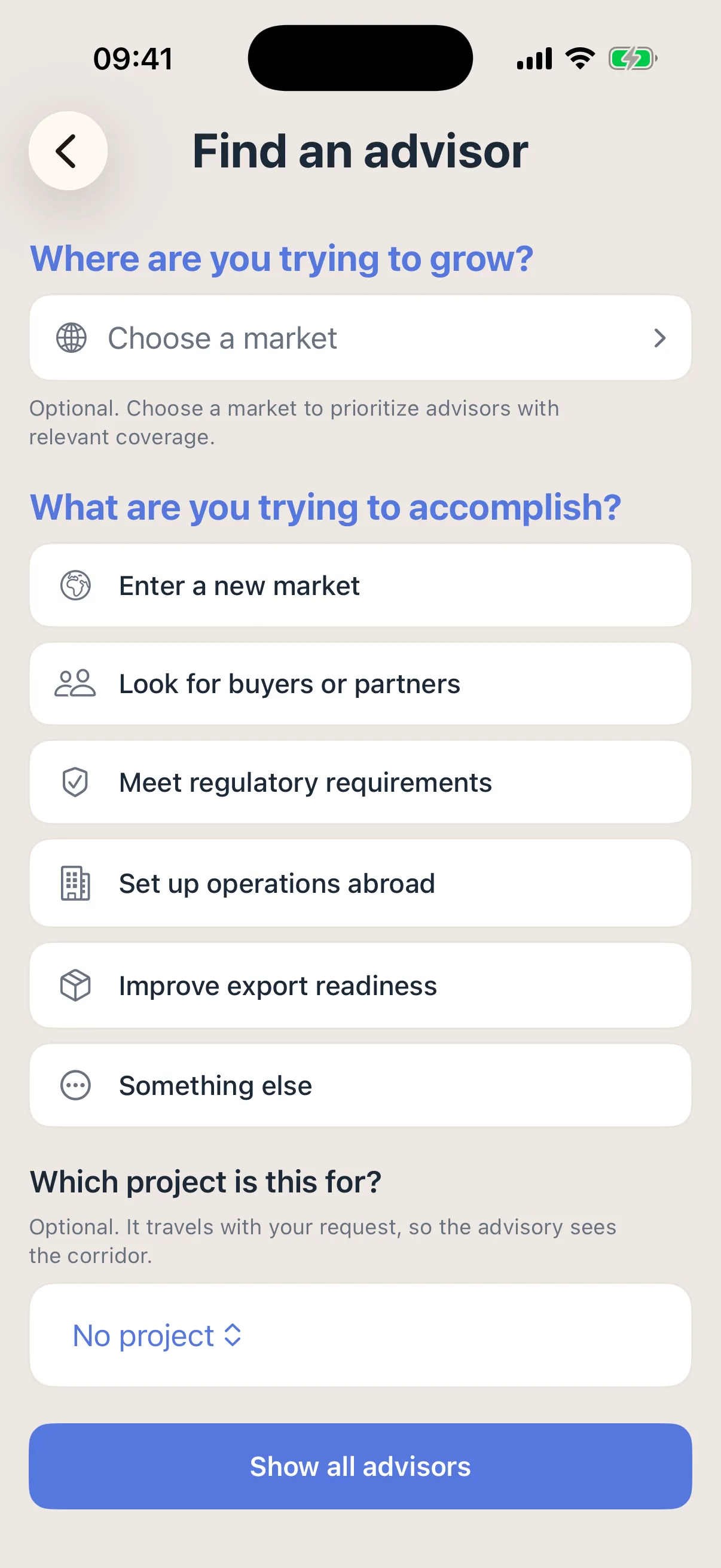
Your plan in Promote:Global
What a management contract project looks like.
Create a project, choose “Management contract” under “How are you entering?”, and Promote:Global writes this plan for your product and market. The web lists the route; on iPhone, the route advisor or Meridian sets it. You tick steps off, skip one for now or add your own.
Research
- Validate demand for your service in your target market
Compliance
- Check what your target market asks of a foreign providerButton: Find an advisor for this market
- Check the tax on selling your service into your target marketButton: Find an advisor for this market
Outreach
- Find and shortlist owners or operators for your service in your target marketButton: Search for possible buyers in this market
Commercial
- Agree scope, price and payment terms with your client in your target market
Delivery
- Deliver a first engagement in your target market
- Get paid and debrief the first engagement
A service crosses no customs border, so the plan has no duty, origin or shipping steps. It checks what the market asks of a foreign provider and the tax on your fee instead. In your own project, each step names your product and your countries. Building the plan uses no AI action.
On a project, Search for possible partners looks on the open web for whoever you describe, ranked by fit, for 1 AI action. A result is a lead to check before you contact anyone, not a confirmed partner.
Make the plan fit this route
The plan for this route is a services plan: demand, what the market asks of a foreign provider, the tax on your fee, the search for owners, the commercial terms, then a first engagement and payment. Add these six, in this order, for the bid, the owner and the asset, the fees, the budget and performance terms, mobilization and the handover.
- Prequalify and form the team (in Outreach, after “Find and shortlist owners or operators for your service in your target market”, where a tender prequalifies bidders)
- Assess the owner and the asset before you bid (next, before “Agree scope, price and payment terms with your client in your target market”)
- Set the base fee and the incentive fee (next, before “Agree scope, price and payment terms with your client in your target market”)
- Negotiate the agreement: budget and performance measures (just before “Agree scope, price and payment terms with your client in your target market”, which then records the terms)
- Mobilize and take over the operation (in Delivery, before “Deliver a first engagement in your target market”)
- Report on performance and plan the handover (last, after “Get paid and debrief the first engagement”)
On the project, type a step into Add a step under the roadmap, or ask Meridian to propose them: a step Meridian proposes is added only when you accept its card.
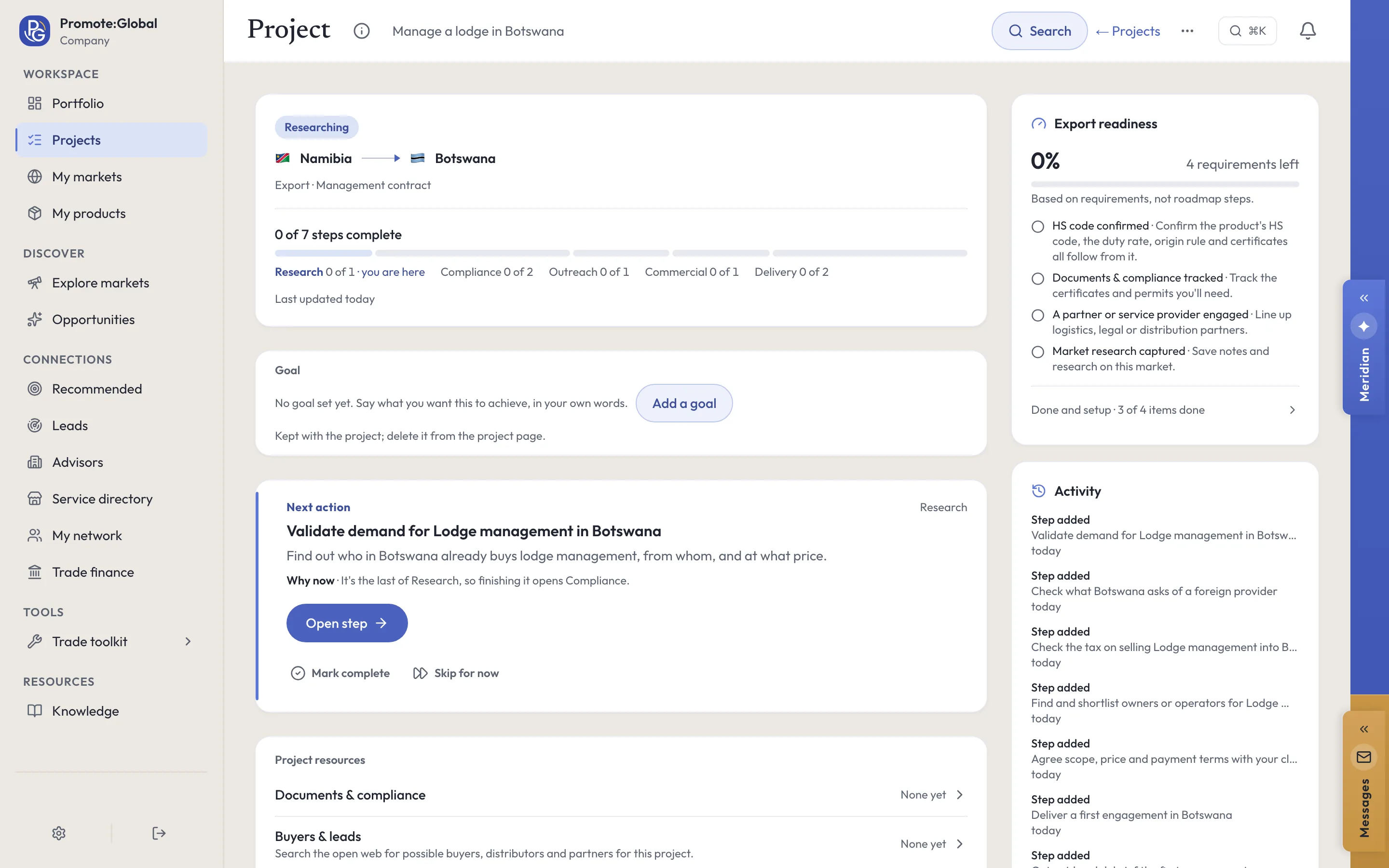
Meridian
Meridian, on your management contract project.
Meridian, the built-in AI assistant on the web and on iPhone, reads the project you have open: its route, its countries, the steps still open and your notes. It answers questions about them, and it proposes changes as cards. Nothing changes on the project until you accept a card. Ask it to search for possible partners and it runs the project’s search in the conversation, looking on the open web for whoever you describe, for 1 AI action; every result is a lead to check.
Ask
- What’s the next step on this project?
- What’s blocking this project?
- What tax will be taken from our fee in this market?
Do
Add a step — to this plan, as a card you accept
Save a note — to the project
Set entry method — one of the eighteen routes, with its reason, if another fits you better
Every plan carries a monthly allowance of AI actions, and each question uses 1. Building the plan uses none. Meridian is AI. Verify before acting.
Documents
The paperwork.
- Capability statement and references
- Your record in results an owner can compare, and the managers you can post.
- Prequalification submission
- Experience, financial capacity and key people, where a public tender prequalifies bidders1.
- Tender documents or the owner’s term sheet
- What the owner wants run, to what standard, and on what terms. The World Bank publishes sample bidding documents for management contracts4.
- Management agreement and schedules
- Fees, the budget process, standards, performance measures, owner approvals and staff2.
- Owner and bank consents, operating licenses
- The consents the owner’s banks require, and the licenses an operator needs in the country.
- Annual operating budget and capital plan
- Agreed with the owner each year, under the agreement’s approval process2.
- Tax residence certificate and withholding receipts
- For relief under the treaty, and to claim credit at home for tax withheld.
- Performance reports and handover protocol
- What you report each period, and how the operation passes back at the end.
Costs and timelines
What to budget for.
Get quotes for
- Bid and prequalification
- Moves with whether the tender prequalifies and how detailed the bid must be: detailed bids are costly to prepare1.
- Assessing the owner and the asset
- A survey of the asset’s condition and a legal and labor review; moves with the asset’s size and condition.
- Your team on site
- Pay, allowances, housing and travel for the managers you post, usually the largest cost; moves with the number of people and the length of the posting.
- Mobilization
- Installing your systems, training local staff and the operating licenses; moves with the size of the operation.
- Legal and tax advice
- On the agreement, the tax on your fees and whether your people create a permanent establishment3,5.
- Insurance and liability
- Moves with what the agreement puts on you as operator2.
What sets the timing
- The tender’s timetable, with prequalification first where the owner uses it1.
- Assessing the owner and the asset, before you bid.
- The owner’s and its banks’ consents, and the operating licenses, before you take over.
- Mobilization: posting the managers, installing systems and training local staff before the start date.
- The term, and the notice the agreement sets for the handover at its end.
Ask for each quote in writing, for your product, market and volumes. Prices and timings differ by country, provider and year.
Mistakes and best practices
What goes wrong, and what works.
Common mistakes
- Treating a public tender like a private negotiation and missing the procurement rules1.
- Poor records of the owner’s approvals, which later feed disputes over fees.
Best practices
- Start with one asset or a pilot contract, to build a local reference.
- Keep the owner’s approval rights specific and time-limited, so decisions are not blocked.
- License your brand and systems under a separate agreement from the management contract.
Questions
Questions people ask.
What is a management contract?
An agreement in which you run an operation that someone else owns, for fees, while the owner keeps the asset. Public examples include utilities and ports; private ones include hotels2,4.
How are management fees structured?
Usually as a base fee plus an incentive fee tied to results2. Fee levels vary widely by sector and country.
Do I pay tax abroad on management fees?
Possibly, through a permanent establishment or a tax on fees for managerial services; check the specific treaty between the two countries3.
How is a management contract different from a franchise?
Under a management contract you run the business for the owner and are paid fees. Under a franchise the owner runs it under your brand and system, and pays you fees and royalties.
Sources
Where this guide comes from.
- [1]Procurement Regulations for IPF Borrowers, seventh edition · World Bank, 2025
- [2]Hotel management agreements · Pinsent Masons, law firm, 2021
- [3]United Nations Model Double Taxation Convention between Developed and Developing Countries · United Nations, 2017
- [4]Public-Private Partnerships Reference Guide, Version 2.0 · World Bank, Asian Development Bank, Inter-American Development Bank and PPIAF, 2014
- [5]Model Tax Convention on Income and on Capital, condensed version · OECD, 2017
Reviewed October 26, 2026. This guide is general information about how companies do this, written in our own words from the sources above; it is not legal, tax or financial advice. Rules differ by country and change, so check them with the authority or an advisor before you act. What it says Promote:Global does is what the product does today. The screens on this page come from our demo workspace, and the companies in them are invented.
Read next
Related guides.
- How to franchise internationally
Franchising · Contractual
- How to deliver a turnkey project abroad
Turnkey project · Contractual
- How to form a strategic alliance abroad
Strategic alliance · Investment / FDI
All eighteen guides Promote:Global for international expansion Plans and prices
Start your management contract project.
Sign up, add what you sell, then create a project and choose “Management contract” under “How are you entering?”. The plan above is written for your product and market.
Start this projectFree to start. No credit card needed. See plans and prices