How to export through a trading company
Sell through an export intermediary at home that does the export work for you, for a margin or a fee.
For a company with no export team that wants its first sales abroad at little cost or risk, and is ready to let an intermediary at home handle the market, the paperwork and the shipping.
On this page: In short
In short
In short
To export through a trading company, decide what you want from the arrangement, choose between an intermediary that buys your goods outright and one that sells them for a fee or commission, check several firms, settle in writing who does each task, and sign an agreement with a trial period1,2,3. The intermediary, in your own country, does much of the export work, so you need little know-how or money to start, but you give up control of where, how and at what price your goods are sold3,4.
The route in Promote:Global
Indirect exporting · Export-based
Commitment
Control
Risk
Rated 1 to 5, as the iPhone app rates every route when you choose one. The ratings are general, for the route itself: your own commitment, control and risk depend on your market, your product and your partners. Grows into: distributor.
When it fits
Is indirect exporting the right route?
A good fit when
- You have no export staff or experience and want a first sale abroad with little investment3,4.
- A domestic buyer, a larger manufacturer or a buying office already wants your goods, to resell or to build into its own exports2.
- You want to test whether there is demand abroad before you commit to market research, a partner abroad or staff.
A poor fit when
- Your brand, price, service or customer data are central to what you sell, because they pass to the intermediary3,4.
- You need to learn the market at first hand, to adapt the product or to invest there later4.
- The intermediary also represents competitors, and no contract stops your goods being diverted to markets you want to keep3.
The people involved
Who’s involved and how they work together
- Your company to Intermediary at home: Goods and product information
- Intermediary at home to Customer abroad: Export, shipping, documents
- Customer abroad to Intermediary at home: Payment for the goods
- Intermediary at home to Your company: Payment, less margin or fee
Step by step
How to export through a trading company, in 10 steps.
Each step says how companies do it, with sources, then what Promote:Global does there, or that the step is yours to do.
Discover
Step 1: Decide what you want from an intermediary
Government export roadmaps put readiness and a plan before the choice of channel1. Write down what you want: a test sale, steady volume, or a first step toward a bigger presence. Then the markets you would accept, your lowest price, and what you will not hand over, such as your brand, your pricing or your after-sales service.
What this step produces
- A one-page brief for intermediaries
Common mistake: Signing with the first intermediary that calls, before you know which markets and channels you want to keep for yourself.
With Promote:Global
The Demand explorer ranks countries by how much of your product they import and how fast that is growing, with the year of every figure, for 1 AI action, so you know which markets to ask an intermediary about. On iPhone, the route advisor asks four questions (what you offer, how much you can invest, how much control you want, how long you plan to stay) and ranks up to three routes, each with its commitment, control and risk.
Discover
Step 2: Choose the kind of intermediary: one that buys or one that sells for you
An export management company works as your outside export department, often for several non-competing products. A trading company may work the same way, or buy your goods and resell them through its own network. A merchant or remarketer buys outright, may repackage the goods, and sells at its own risk. A confirming house is hired by a buyer abroad to purchase for it, and is paid by that buyer2,5,6. A domestic customer that builds your goods into products it exports is an indirect route too2.
The names are used loosely. What decides the work is whether the firm takes ownership of your goods or acts for a fee or commission, which the step on who does what sets out task by task2,5.
What this step produces
- The kind of intermediary you want, and why
Common mistake: Assuming that a firm calling itself a trading company buys your goods, when it only earns a fee.
You do this step yourself
Which kind of intermediary suits you is your decision, and Promote:Global does not know whether a given firm buys or only represents. Ask each firm, and read the contract.
Connect
Step 3: Build a long list of intermediaries
Ask your industry association, your national export promotion agency or trade commissioner and your embassy’s commercial section, and meet firms at trade shows3,7. Published directories help too: in the United States, the International Trade Administration keeps a directory of export management companies and another of business service providers6,8.
Both directories say that a listing is not an endorsement. A list is where your checks begin, not where they end.
What this step produces
- A long list of firms that handle your category
Common mistake: Treating a directory listing as a quality check6.
With Promote:Global
On this route, Search for possible buyers has no default counterpart, so it looks for whoever you describe: an export management company or a trading house that handles your category, for example. It searches the open web for 1 AI action and says where each result was found; each one is a lead to check, which you can save to the project. If your trade agency or chamber works with you on Promote:Global, you can also ask it for an introduction, and the other side decides whether to accept.
Connect
Step 4: Check each firm before you commit
Talk to several firms before you meet any of them. Ask each about its sales force, track record, territories, product mix, facilities and customers, and which other producers it represents, including any of your competitors3. Call the references. In some countries the trade commissioner service will run a background check on a prospective intermediary on request3.
What this step produces
- The same questionnaire, answered by each firm
- Reference notes
Common mistake: Relying on a brochure or a website alone.
You do this step yourself
Promote:Global does not check firms. Search results come from the open web and say nothing about whether a firm is sound, so take the references and order any credit reports yourself.
Prepare
Step 5: Settle who does what
Who does each task depends on whether the intermediary takes ownership of your goods or acts for a fee or commission, so settle it task by task, in writing2,5.
Either way, ask in writing who is the exporter of record, the party responsible for checking whether the goods need an export license2.
Finding the customer and setting the price
Shipping and export documents
Payment risk
Who does what, for an intermediary that buys outright and for one that sells for a fee or commission Task It buys outright It sells for a fee or commission Finding the customer and setting the price It owns the goods, finds the customer abroad, sets its own resale price and invoices that customer; you sell to it at home, on domestic terms2,5 It finds the customer and negotiates for you; you usually invoice the customer and approve the price2,5 Shipping and export documents It exports in its own name and arranges the shipping and the export documents; you supply the goods, the product information and the invoices it asks for2,9 It may prepare the paperwork while you ship2,9 Payment risk You carry the risk that it does not pay you; it carries the risk on the customer abroad2,5 The risk on the customer is yours: where you do not know the buyer, use a secure payment method or export credit insurance2,5,10 What this step produces
- A who-does-what list, agreed with the intermediary
- The exporter of record, named in writing
Common mistake: Not knowing whether the intermediary buys your goods or only represents you2.
You do this step yourself
Who does what is for you and the intermediary to agree; Promote:Global does not know whether a given firm buys or only represents, and does not check credit or insure a sale. Keep the list as a note on the project, where Meridian reads it when you ask about the project.
Prepare
Step 6: Agree the price or fee, exclusivity and reports
If the intermediary buys, agree the price per unit, the payment terms and when ownership passes. If it sells for you, agree its fee or commission and the prices it may sell at2,5.
Then settle exclusivity (which products, territories and channels), minimum performance, the reports you will receive, and who owns the customer information.
What this step produces
- A term sheet
Common mistake: Granting broad exclusivity with no minimums and no review date.
With Promote:Global
Landed cost shows what your goods cost by the time they reach a market: goods value, freight, insurance, duty, tax and fees, each line marked as your figure, an estimate or a live lookup. Set beside the price the intermediary sells at, it helps you judge the margin it keeps. It is free.
Prepare
Step 7: Sign a written agreement with a trial period
Canada’s trade commissioner service recommends a short trial contract to test the arrangement3. Cover the territory, exclusivity, the term, termination with and without cause, reporting, your trademark and confidential information, the governing law and how disputes are settled, and have a lawyer review it.
Add a clause against diversion. Without strong contracts, goods sold through a domestic middleman can turn up in markets or channels you meant to keep for yourself5.
What this step produces
- A signed intermediary agreement
Common mistake: Leaving out a clause against diversion, so your goods appear in markets you wanted to protect5.
You do this step yourself
Promote:Global does not draft or review contracts and gives no legal advice. Have your own lawyer review the agreement before you sign it.
Grow
Step 8: Prepare the goods and run the first orders
Supply what the agreed split leaves with you: the goods, packed and labeled for the market, the product information, the safety and origin documents, and invoices in the agreed form2,9. Run a first order end to end before you scale, so each side sees the other’s part work.
What this step produces
- A product data pack
- Invoices and certificates as agreed
Common mistake: Shipping a first order before the documents you owe the intermediary are agreed in form and content.
With Promote:Global
Export check lists the documents a shipment to the market needs, by stage, with who issues each, which gives you and the intermediary one list to divide between you. Export documents, on the web, fills a commercial invoice, a proforma invoice or a packing list from the project, to check and print.
Grow
Step 9: Ask for reports and compare them with the minimums
Ask for regular reports on the markets your goods reach, the customers, the prices they sell at and any complaints, and compare sales with the minimums you agreed3. Without reports you learn nothing about where your product goes or what it sells for.
What this step produces
- Regular sales and market reports
Common mistake: Accepting silence, so you never learn where your product goes or at what price.
With Promote:Global
The Revenue tracker adds up the revenue you log, by market and by project, against the goal you set for each market. Promote:Global does not monitor an intermediary’s sales: the figures are the ones you enter.
Grow
Step 10: Review, and decide whether to go direct
At the end of the trial, renew, renegotiate, change intermediary, or go direct in the markets where your volume justifies it. Many firms move from an intermediary to an export operation of their own, or to a partner abroad, as they gain experience4.
What this step produces
- A decision on the next step, market by market
Common mistake: Staying with the intermediary because it works, without asking what margin and market knowledge you are leaving behind.
With Promote:Global
When you are ready to change route, Meridian can recommend one for the project, with its reason, as a Set entry method card, and nothing changes until you accept it. In Promote:Global, the route this one grows into is a distributor.
Your plan in Promote:Global
What an indirect exporting project looks like.
Create a project, choose “Indirect exporting” under “How are you entering?”, and Promote:Global writes this plan for your product and market. The web lists the route; on iPhone, the route advisor or Meridian sets it. You tick steps off, skip one for now or add your own.
Research
- Validate demand for your product in your target market
- Classify your product for customs (until the HS code is confirmed)
Compliance
- Confirm duty and landed cost into your target market
- Prove your product originates in your country (where a trade agreement offers a lower rate)
- Obtain a certificate (one for each certificate the route needs)
- Meet product, labeling and packaging rules for your target market
Outreach
- Shortlist export intermediaries in your country for your product
Commercial
- Agree the Incoterm, price and payment terms with your buyer in your target market
Shipment
- Assemble the export document pack
- Book freight to your target market
- Ship a first order to your target market
Post-shipment
- Present the documents and collect payment from your target market (when paid by letter of credit or collection)
- Debrief the first shipment and fix the pack
The duty, origin and certificate steps are looked up from your product’s HS code and the two countries, so their number depends on what you sell and where. A step with a condition in brackets appears only where it applies. In your own project, each step names your product and your countries. Building the plan uses no AI action.
On a project, Search for possible buyers looks on the open web for whoever you describe, ranked by fit, for 1 AI action. A result is a lead to check before you contact anyone, not a confirmed buyer.
Make the plan fit this route
On this route Promote:Global writes its export corridor plan with a step to shortlist export intermediaries at home, and leaves freight, the buyer’s terms and collecting payment with you. Add these seven in this order, and once the intermediary’s role is agreed, use Skip for now on the plan steps it takes on, such as “Book freight to your target market”, with a note saying who does each.
- Decide what you want from an intermediary (in Research, after “Validate demand for your product in your target market”)
- Choose the kind of intermediary: one that buys or one that sells for you (in Outreach, before “Shortlist export intermediaries in your country for your product”)
- Check each firm before you commit (after “Shortlist export intermediaries in your country for your product”)
- Settle who does what (next, before “Agree the Incoterm, price and payment terms with your buyer in your target market”, which, where the intermediary buys, becomes your terms with it)
- Sign a written agreement with a trial period (after “Agree the Incoterm, price and payment terms with your buyer in your target market”)
- Ask for reports and compare them with the minimums (in Post-shipment, after “Debrief the first shipment and fix the pack”)
- Review, and decide whether to go direct (last, at the end of the trial period)
On the project, type a step into Add a step under the roadmap, or ask Meridian to propose them: a step Meridian proposes is added only when you accept its card.
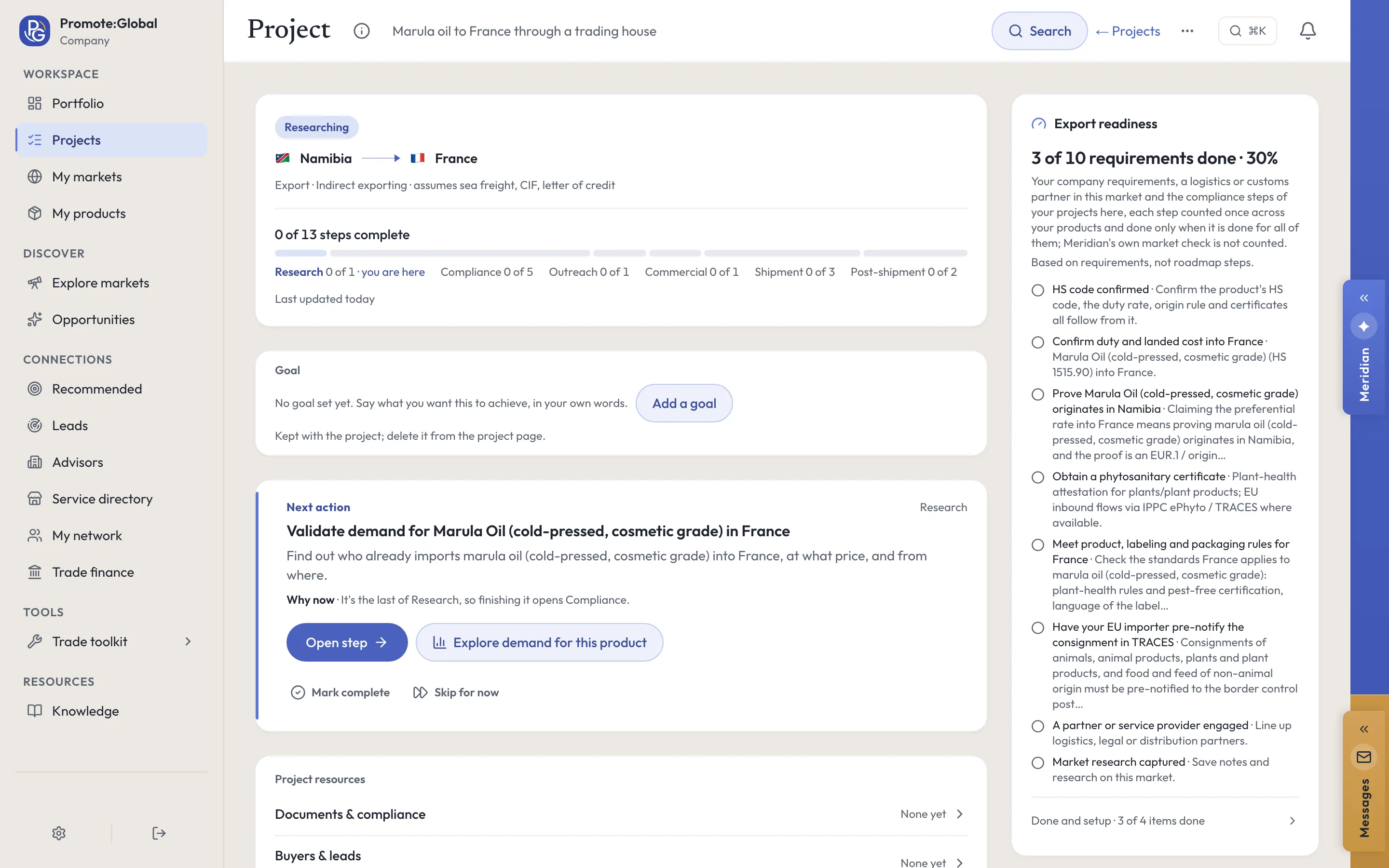
Meridian
Meridian, on your indirect exporting project.
Meridian, the built-in AI assistant on the web and on iPhone, reads the project you have open: its route, its countries, the steps still open and your notes. It answers questions about them, and it proposes changes as cards. Nothing changes on the project until you accept a card. Ask it to search for possible buyers and it runs the project’s search in the conversation, looking on the open web for whoever you describe, for 1 AI action; every result is a lead to check.
Ask
- What’s the next step on this project?
- What’s blocking this project?
- What should we compare between export trading companies?
Do
Add a step — to this plan, as a card you accept
Save a note — to the project
Set entry method — one of the eighteen routes, with its reason, if another fits you better
Every plan carries a monthly allowance of AI actions, and each question uses 1. Building the plan uses none, and neither do Export check, Landed cost and the Origin qualifier. Meridian is AI. Verify before acting.
Documents
The paperwork.
- Intermediary agreement
- Territory, exclusivity, term, termination, reporting, a clause against diversion, and governing law3,5.
- Who-does-what list
- Each task, from pricing and invoicing to shipping, documents and payment risk, with who does it under your arrangement2.
- Sales contract or purchase orders
- Where the intermediary buys: price, payment and when ownership passes2.
- Commercial invoice and packing list
- Issued to the intermediary or to the customer abroad, depending on who sells9.
- Export license or authorization
- Where the goods are controlled. The exporter of record is responsible2.
- Export credit insurance policy or credit limits
- Where you carry the risk that a buyer does not pay10.
- Export Trade Certificate of Review
- In the United States only: it protects the export conduct it describes, such as competitors exporting together, from federal and state antitrust actions and private damage suits11.
Costs and timelines
What to budget for.
Get quotes for
- The intermediary’s margin or commission
- Moves with the tasks it takes on, your volumes and whether it buys outright; the sources consulted give no reliable range.
- What stays with you
- Packing and labeling for the market, product documents and certificates, and delivery to the intermediary; on commission, often the freight, insurance and export documents as well2.
- Export credit insurance or a secure payment method
- Only where you carry the risk that a buyer abroad does not pay; moves with the buyer, the country and the amount10.
- A lawyer’s review of the agreement
- Moves with exclusivity, the number of territories and the governing law.
- Credit reports and reference checks
- For each firm on your shortlist.
What sets the timing
- Your brief and the kind of intermediary you want, settled before you approach firms.
- Checking several firms and calling their references3.
- Negotiating the agreement and its trial period, for which no standard length is given3.
- The first orders and the reports from them, before you renew, change or go direct.
Ask for each quote in writing, for your product, market and volumes. Prices and timings differ by country, provider and year.
Mistakes and best practices
What goes wrong, and what works.
Common mistakes
- Letting the intermediary represent your competitors with no clause on how conflicts are handled3.
- Judging an intermediary on its margin alone, without asking what it does for that margin.
Best practices
- Plan the exit: notice, a handover of customer information where the law allows it, and what happens to stock.
- Keep a copy of every export document issued for your goods, whoever prepared it.
Questions
Questions people ask.
What is the difference between an export management company and an export trading company?
An export management company works as your outside export department; a trading company may do the same, or buy your goods and resell them. The names are used loosely, so read the contract rather than the label2,6.
Is indirect exporting cheaper than exporting directly?
It costs less to start, because the intermediary carries the overhead of the export2,3. You pay for it in margin and in control.
Who is responsible for export licenses and paperwork?
Whoever is the exporter of record under your arrangement, which is not always the intermediary2.
Can I still sell in the same market myself?
Only if the contract allows it. Exclusivity usually limits you, so say which products, territories and customers you keep for yourself3.
What is a confirming house?
A firm hired by a buyer abroad to buy goods from suppliers on its behalf, and paid a commission by that buyer. To you, the sale is close to a domestic one2.
Sources
Where this guide comes from.
- [1]Learn how to export · U.S. International Trade Administration
- [2]Support for indirect exporters: an Exporting 101 guide · Export-Import Bank of the United States
- [3]Step 6: Entering your target market · Trade Commissioner Service, Government of Canada
- [4]Direct or indirect exporting: which is the best fit for your business? · Trade Ready, Forum for International Trade Training
- [5]Direct or indirect exporting: a guide to international channels of distribution · Food Export Association of the Midwest USA and Food Export USA Northeast
- [6]Export management company directory · U.S. International Trade Administration
- [7]Find international clients · Government of Alberta, Canada
- [8]Business service provider directory · U.S. International Trade Administration
- [9]Common export documents · U.S. International Trade Administration
- [10]Export credit insurance · U.S. International Trade Administration
- [11]Export Trade Certificate of Review · U.S. International Trade Administration
Reviewed October 26, 2026. This guide is general information about how companies do this, written in our own words from the sources above; it is not legal, tax or financial advice. Rules differ by country and change, so check them with the authority or an advisor before you act. What it says Promote:Global does is what the product does today. The screens on this page come from our demo workspace, and the companies in them are invented.
Read next
Related guides.
The next rung up
How to find a distributor abroadDistributor · Export-based
- How to export goods
Direct exporting · Export-based
- How to find a sales agent abroad
Sales agent · Export-based
- How to sell on international marketplaces
Online marketplace · Export-based
All eighteen guides Promote:Global for exporters Plans and prices
Start your indirect exporting project.
Sign up, add what you sell, then create a project and choose “Indirect exporting” under “How are you entering?”. The plan above is written for your product and market.
Start this projectFree to start. No credit card needed. See plans and prices