How to find a sales agent abroad
Find, check and appoint an agent abroad who wins orders for a commission while you keep the sale.
For a company with a technical, high-value or made-to-order product that wants someone selling for it in a new market, while it keeps the price, the brand and the contract with the customer.
On this page: In short
In short
In short
To find a sales agent abroad, define the agent’s role and territory, build a long list through your export agency, trade associations, chambers and trade shows, check each agent’s references and finances, and sign a written agency agreement that respects the local law1,2,3. An agent finds customers and negotiates for a commission but never owns your goods, so you keep control of the price and the brand, along with the invoicing, shipping and credit risk4,5. In the European Union an agent can claim an indemnity or compensation when the agency ends, even under a contract governed by a law from outside the Union6,7.
The route in Promote:Global
Sales agent · Export-based
Commitment
Control
Risk
Rated 1 to 5, as the iPhone app rates every route when you choose one. The ratings are general, for the route itself: your own commitment, control and risk depend on your market, your product and your partners. Grows into: distributor.
When it fits
Is a sales agent the right route?
A good fit when
- The product is expensive, technical or made to order, heavy machinery being a typical case, and selling it takes product knowledge5.
- You want to control the price, the brand and the terms of sale in a new market without setting up a company there1,5.
- You can ship and invoice customers directly, and manage the credit risk yourself, perhaps with export credit insurance.
A poor fit when
- The product is a low-value, high-volume item that needs local stock and service. A distributor usually suits that better5.
- You could not afford a payment when the agency ends: in the European Union, ending an agency can mean an indemnity or compensation6.
- You would want the agent to sign contracts for you, and have had no tax advice on whether that creates a permanent establishment8,9.
The people involved
Who’s involved and how they work together
- Your company to Sales agent: Commission on paid orders
- Sales agent to Customers: Introductions, negotiation
- Your company to Customers: Goods and your invoice
- Customers to Your company: Orders and payment
Step by step
How to find a sales agent abroad, in 10 steps.
Each step says how companies do it, with sources, then what Promote:Global does there, or that the step is yours to do.
Discover
Step 1: Define the agent’s role and territory
Decide what the agent will do: find leads, negotiate, or also conclude contracts in your name. Then set the products, the territory and the customer groups, and the accounts you keep for yourself. An agent secures orders for a commission and leaves the pricing with you1.
What this step produces
- A one-page role description
- A territory map, with the accounts you keep
Common mistake: Letting the agent’s role drift from introducing customers to signing contracts, which has legal and tax consequences8,9.
With Promote:Global
The Demand explorer ranks countries by how much of your product they import, how fast that is growing and how hard the market is to enter, from UN Comtrade and WITS data, with the year of every figure, for 1 AI action, so you can choose the territory on evidence.
Connect
Step 2: Build a long list of agents
Ask your national export promotion agency or trade commissioner (some prepare tailored contact lists), your industry association, chambers of commerce and your embassy’s commercial section, and meet agents at trade shows1,10. Note which lines each agent already carries.
What this step produces
- A long list of agents, with the lines each one carries
Common mistake: Choosing an agent that already carries a competitor’s line, with no agreement on conflicts.
With Promote:Global
On a sales agent project, Search for possible buyers looks for commission sales agents and manufacturers’ representatives in the market, and the buyer type can be set to Sales agents. It searches the open web, ranks what it finds by fit to your product and route, says where each result was found, and uses 1 AI action. Each result is a lead to check before contact. If your trade agency or chamber works with you on Promote:Global, you can also ask it for an introduction, and the other side decides whether to accept.
Connect
Step 3: Contact the agents and compare their answers
Ask each agent about its background and the companies it represents, how it would launch your product, its trade and bank references, whether it can meet any special requirements you have, and its own view of the market’s potential2. Speak to several before you meet any of them1.
What this step produces
- Comparable answers from each agent
Common mistake: Not asking for references from the other companies the agent represents.
With Promote:Global
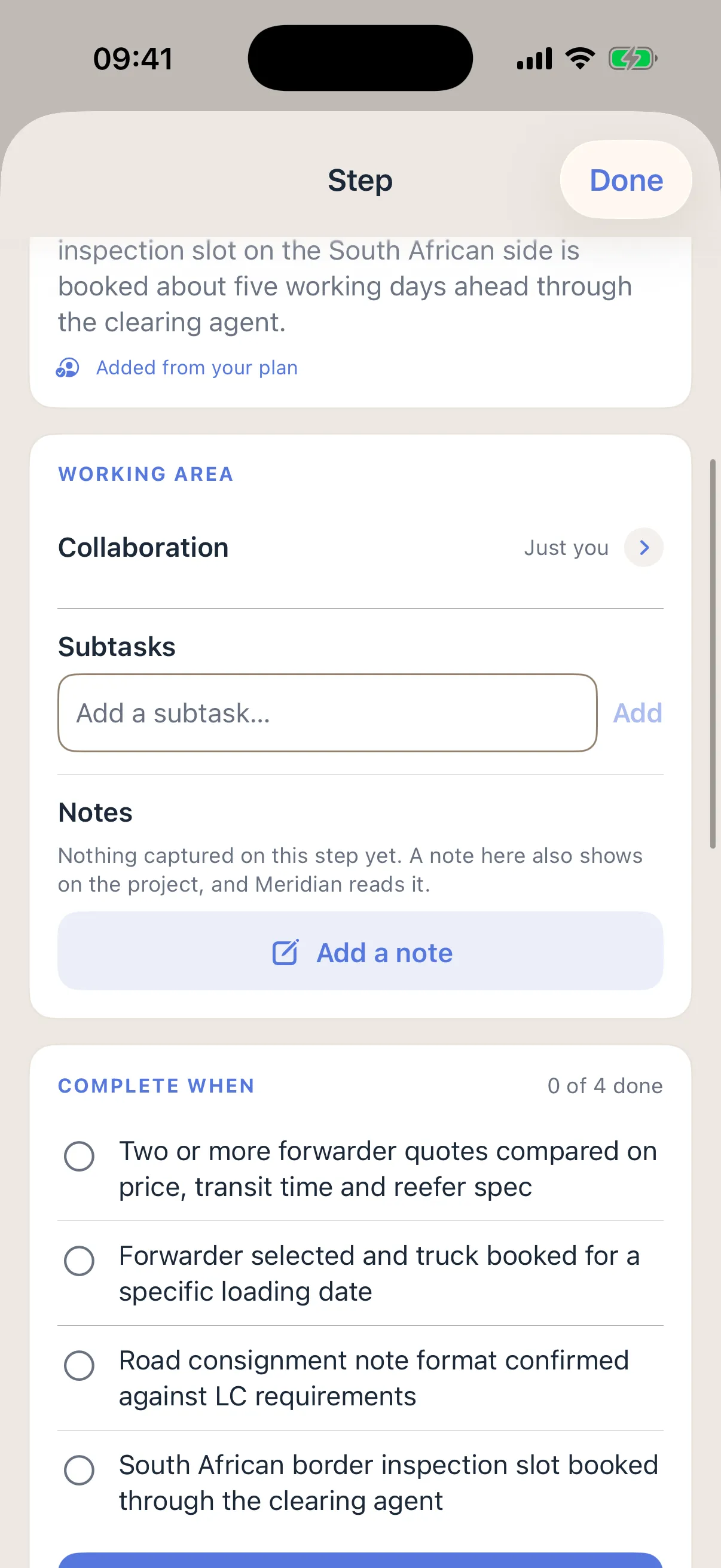
Save each agent you contact to the project as a lead, and keep your notes on the step, where your team can see them. Meridian reads a project’s notes when you ask it about that project.
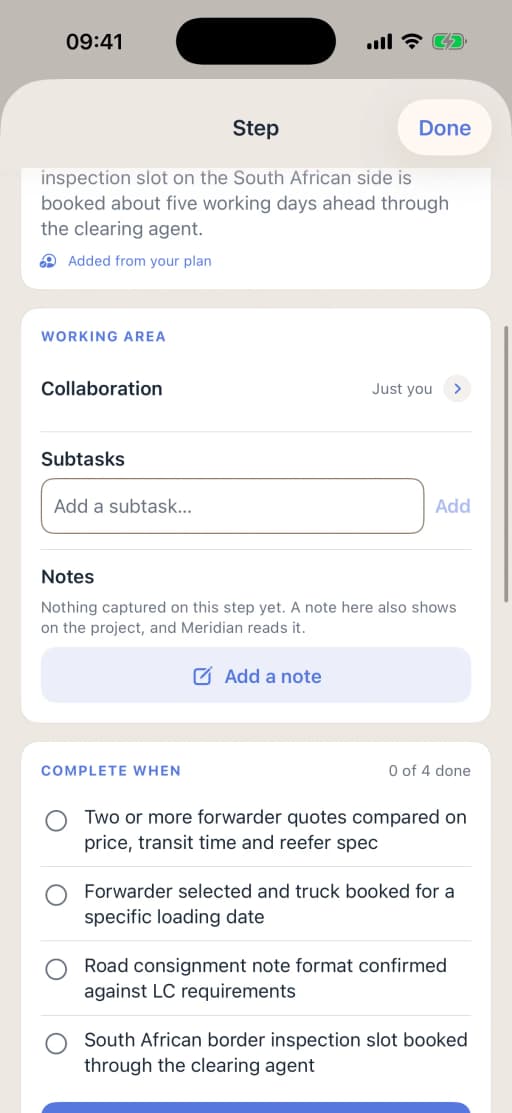
A plan step with its subtasks and notes, on iPhone. Connect
Step 4: Check references, finances and conflicts
Get at least two business or credit reports from different providers, call the references, and use a government background check where one is offered1,2. Find out how many customers the agent really reaches, and its sales record in your sector1.
What this step produces
- A due-diligence file for each finalist
- Two credit reports
Common mistake: Relying on a single report, or on a directory listing2.
You do this step yourself
Promote:Global does not check agents or anyone else. Search results are found on the open web, so order the credit reports and take the references yourself.
Connect
Step 5: Meet the finalists
Visit the agent’s office and meet the team, or meet at a trade show or by video where travel is hard2. A large agency may give a small principal little attention; a higher commission or a bonus can help keep your product on its list10.
What this step produces
- A ranked shortlist
Common mistake: Choosing a big name that will not put your product first.
You do this step yourself
Meetings and visits are yours to arrange. Write what you learn on the project as notes, where your team can see them.
Prepare
Step 6: Check the local agency law
Find out whether the country gives agents a payment when the agency ends, and whether agents must be registered. Inside the European Union, Directive 86/653/EEC sets the rules for self-employed commercial agents who sell goods6. Saudi Arabia, by contrast, has no statutory compensation scheme, but requires agents to be locally owned and the agency to be registered11.
Do not rely on the governing-law clause. In the Ingmar case, the Court of Justice of the European Union held that an agent working in a Member State keeps the Directive’s rights on termination even when the principal is outside the Union and the contract names a law from outside it7.
What this step produces
- A short note from local counsel on agency law
Common mistake: Assuming the law named in the contract decides the agent’s rights when the agency ends7.
With Promote:Global
Find service providers lists legal and corporate, and accounting and tax firms that list themselves on Promote:Global, and you can ask an advisory firm for help with the market; whether one is listed for yours varies. Neither is legal or tax advice, which comes from the firm you choose.
Prepare
Step 7: Set the agent’s authority limits, and check the tax position
Write down, before you negotiate the terms, what the agent may do and what it may not: quote from your price list, negotiate within the discounts you allow, pass orders to you for acceptance, and never sign for you unless your tax adviser has cleared it. Under the rule the OECD proposed in 2015, an agent that habitually concludes contracts for you, or plays the principal role in contracts you routinely conclude without material change, can create a permanent establishment for you8. Countries adopt it on their own timetable: in the UK, HMRC applies the updated test for periods beginning on or after 1 January 20269.
Keep the agent visibly independent too: no business cards, title or other trappings that present it as your employee, which can create tax or employment problems10.
What this step produces
- A list of the agent’s authority limits
- A note on the agent’s tax position
Common mistake: Letting the agent sign contracts for you without a tax review8,9.
You do this step yourself
Promote:Global gives no tax advice. Ask a tax adviser in the market whether the agent’s role creates a taxable presence for you, and settle the limits before the commission and the contract. The plan has no step for this, so add one (see Make the plan fit this route, below).
Prepare
Step 8: Negotiate the commission and the terms
Agree the rate, what it is calculated on (usually the net invoice value), when it is earned and paid (usually once the customer has paid you), what expenses it covers, and how direct sales and house accounts are credited10. Add the authority limits, minimum targets, reporting, confidentiality, and who pays for training and sales material.
Agents may ask a new exporter for a higher commission, and more for an unfamiliar territory or a customized product10. The sources consulted give no typical rate; it varies widely by country and sector.
What this step produces
- A term sheet
- A commission schedule
Common mistake: Leaving commission on repeat orders and direct sales unsettled10.
With Promote:Global
You sell to the customer yourself, so your price has to work in the market. Export check gives the duty your product pays there, with its source and year, and Landed cost shows what a unit costs by the time it arrives. On the web, Export check also takes the Incoterm, its named place and how you will be paid. Both are free.
Prepare
Step 9: Draft the agency agreement
The ICC Model Commercial Agency Contract is a framework built on international practice rather than one country’s law, and covers points such as internet sales, the indemnity and arbitration3. Use it as a checklist, then have local counsel adapt it, with the term, the minimums, termination and the governing law spelled out12.
In the European Union, an agency for an indefinite period needs at least one month’s notice in its first year, two in the second and three from the third, and the parties may not agree shorter periods. A restraint on competing after the agency ends is valid only in writing, only for the agent’s territory and goods, and for no more than two years6.
What this step produces
- A signed agency agreement
Common mistake: Copying a distributor contract for an agent.
You do this step yourself
Promote:Global does not draft or review agency agreements and gives no legal advice. Your own lawyer adapts the model contract to the market.
Grow
Step 10: Onboard the agent, track results and plan the exit
Train the agent, supply samples and material, track leads and orders, and review performance against the targets. Start with a time-limited agreement and review it at the end of the first term1.
Plan the end before it comes: notice, commission on orders already in the pipeline, and any indemnity or compensation. In the European Union, an agent loses its claim if it does not notify you within one year of the agency ending6.
What this step produces
- Regular reports of leads and orders
- Commission statements
Common mistake: Ending an agency abruptly in a country that gives agents rights on termination.
With Promote:Global
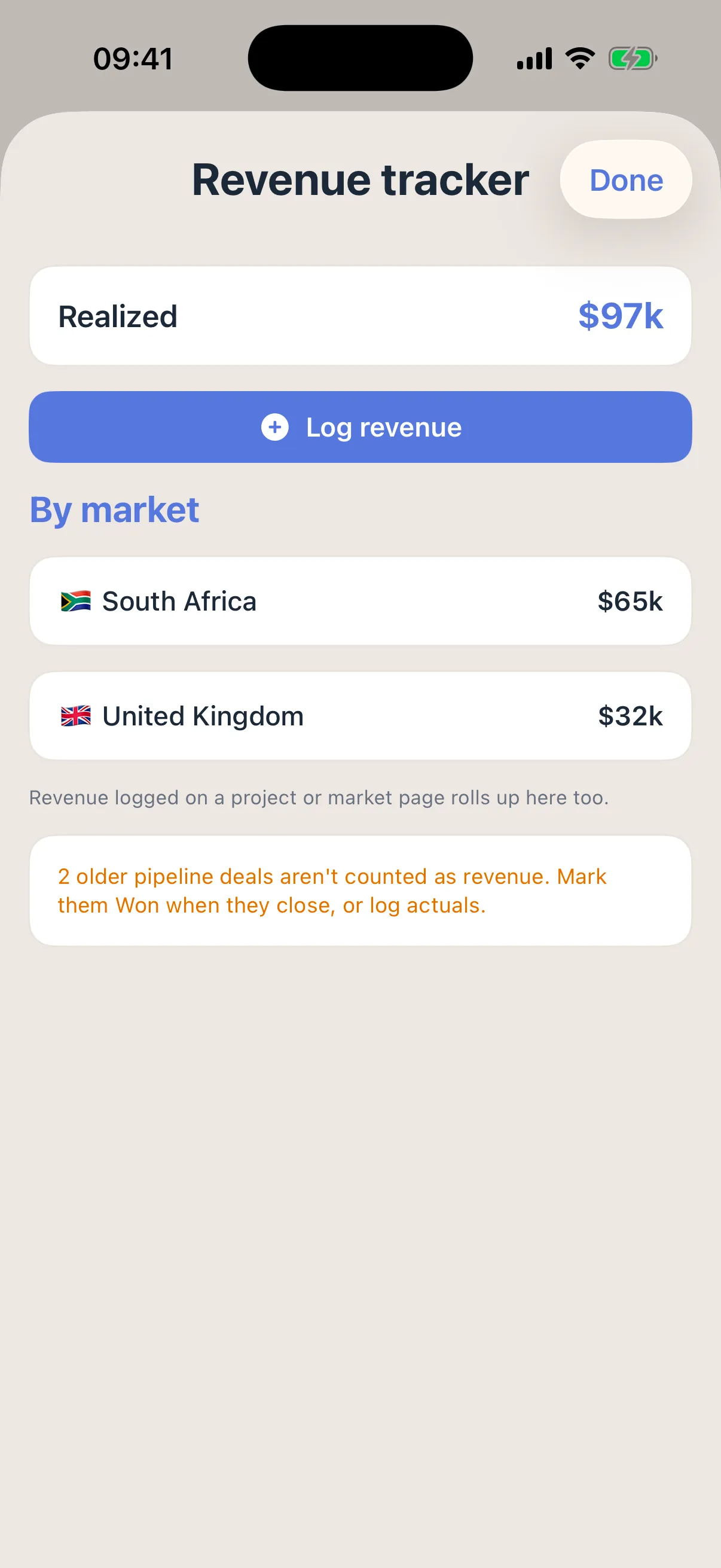
The plan carries your first orders through shipment and payment. The Revenue tracker adds up the revenue you log, by market and by project, against the goal you set for each market. Promote:Global does not monitor an agent’s activity: the figures are the ones you enter.
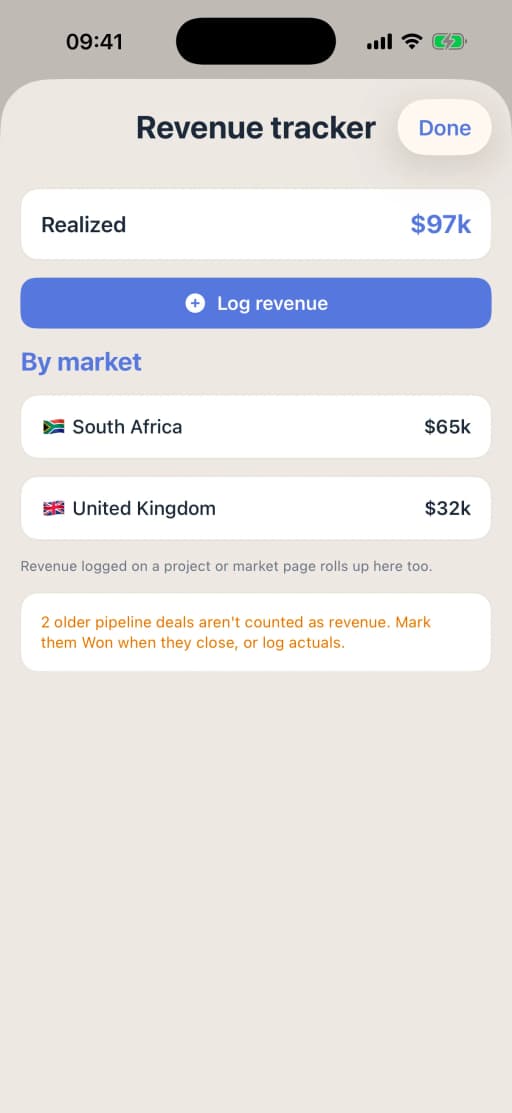
Revenue tracked on iPhone.
Your plan in Promote:Global
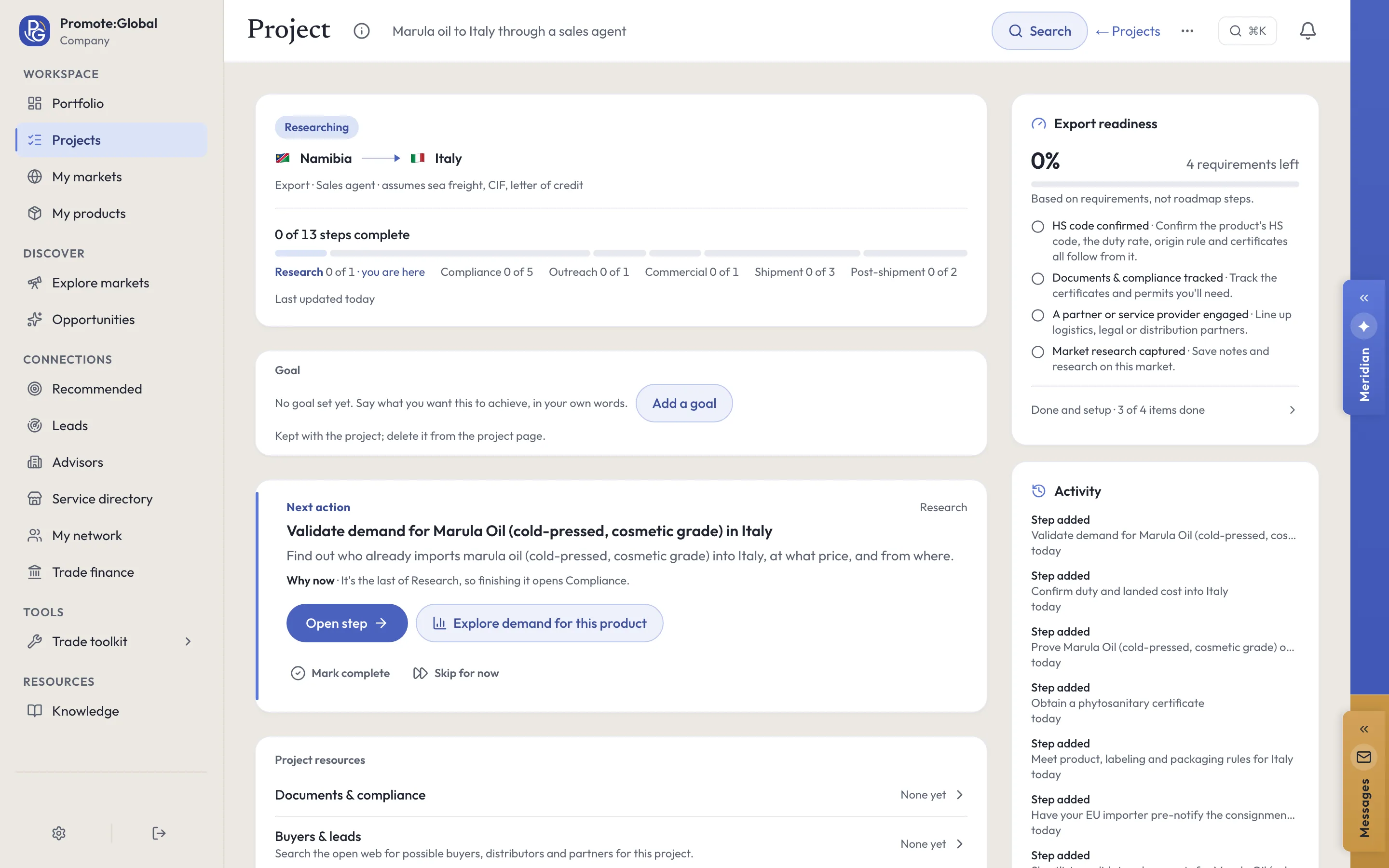
What a sales agent project looks like.
Create a project, choose “Sales agent” under “How are you entering?”, and Promote:Global writes this plan for your product and market. The web lists the route; on iPhone, the route advisor or Meridian sets it. You tick steps off, skip one for now or add your own.
Research
- Validate demand for your product in your target market
- Classify your product for customs (until the HS code is confirmed)
Compliance
- Confirm duty and landed cost into your target market
- Prove your product originates in your country (where a trade agreement offers a lower rate)
- Obtain a certificate (one for each certificate the route needs)
- Meet product, labeling and packaging rules for your target market
Outreach
- Shortlist sales agents for your product in your target marketButton: Search for possible buyers in this market
Commercial
- Agree the Incoterm, price and payment terms with your buyer in your target market
Shipment
- Assemble the export document pack
- Book freight to your target market
- Ship a first order to your target market
Post-shipment
- Present the documents and collect payment from your target market (when paid by letter of credit or collection)
- Debrief the first shipment and fix the pack
The duty, origin and certificate steps are looked up from your product’s HS code and the two countries, so their number depends on what you sell and where. A step with a condition in brackets appears only where it applies. In your own project, each step names your product and your countries. Building the plan uses no AI action.
On a project, Search for possible buyers looks on the open web for commission sales agents or manufacturers' reps, or for whoever you describe, ranked by fit, for 1 AI action. A result is a lead to check before you contact anyone, not a confirmed buyer.
Make the plan fit this route
The plan for this route is the export corridor: it shortlists sales agents, then goes straight to the price and payment terms with your buyer and the shipment, with no step for the agency itself. Add the agency work after the shortlist, in this order, and a performance review once the first shipment is done.
- Contact the agents and compare their answers (in Outreach, after “Shortlist sales agents for your product in your target market”)
- Check references, finances and conflicts (next)
- Meet the finalists (next)
- Check the local agency law (next)
- Set the agent’s authority limits, with tax advice (next)
- Agree the commission and the terms (next)
- Sign the agency agreement (next)
- Onboard the agent: training, samples and reporting (next, before “Agree the Incoterm, price and payment terms with your buyer in your target market”)
- Review the agent’s results against its targets (last, after “Debrief the first shipment and fix the pack”)
On the project, type a step into Add a step under the roadmap, or ask Meridian to propose them: a step Meridian proposes is added only when you accept its card.
Meridian
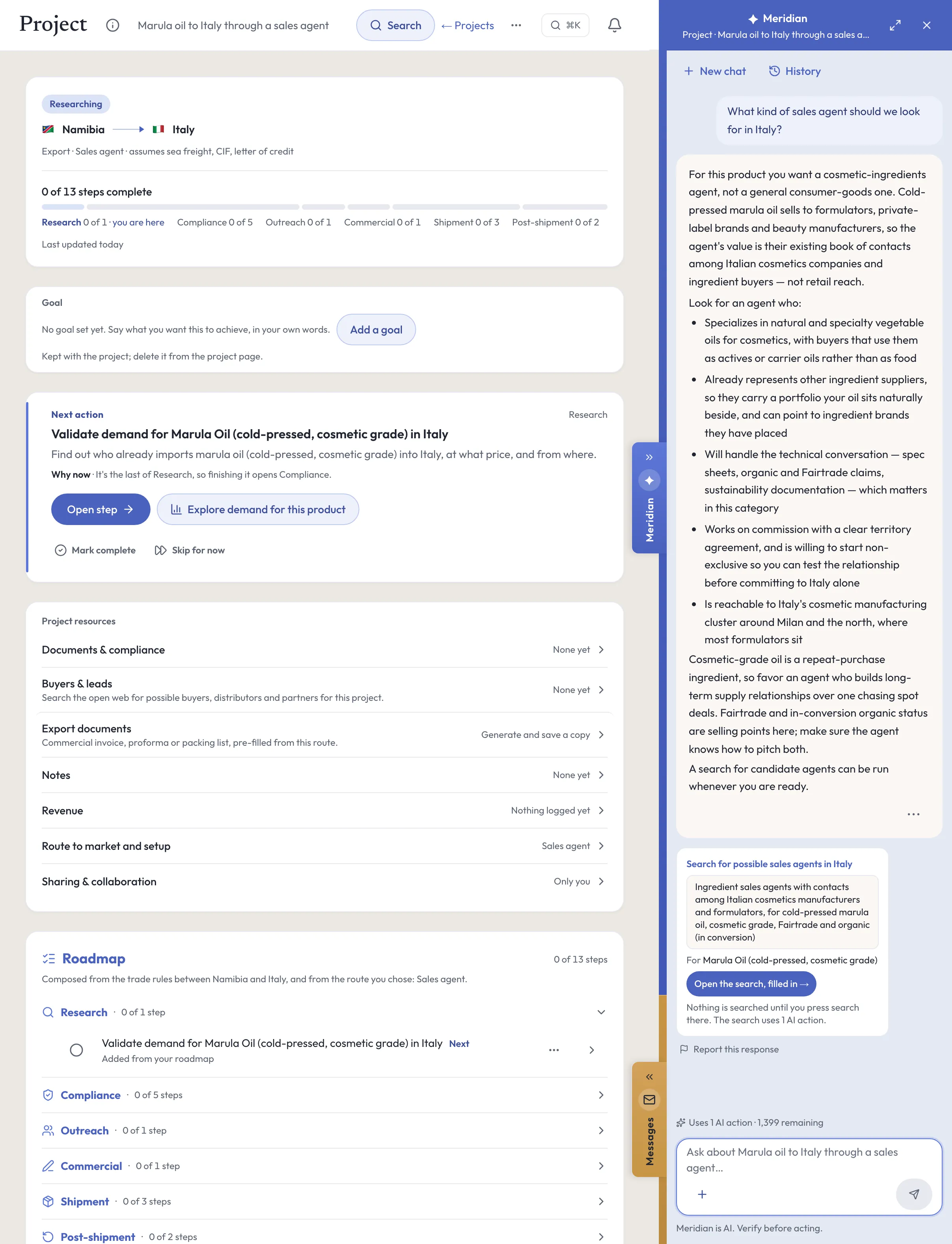
Meridian, on your sales agent project.
Meridian, the built-in AI assistant on the web and on iPhone, reads the project you have open: its route, its countries, the steps still open and your notes. It answers questions about them, and it proposes changes as cards. Nothing changes on the project until you accept a card. Ask it to search for possible buyers and it runs the project’s search in the conversation, looking on the open web for commission sales agents or manufacturers' reps, for 1 AI action; every result is a lead to check.
Ask
- What’s the next step on this project?
- What’s blocking this project?
- What should we look for in a sales agent?
Do
Add a step — to this plan, as a card you accept
Save a note — to the project
Set entry method — one of the eighteen routes, with its reason, if another fits you better
Every plan carries a monthly allowance of AI actions, and each question uses 1. Building the plan uses none, and neither do Export check, Landed cost and the Origin qualifier. Meridian is AI. Verify before acting.
Documents
The paperwork.
- Role description and territory map
- What the agent does, where and with which customers, and the accounts you keep.
- Due-diligence file
- Two credit reports, references and the registry record for each finalist2.
- Commercial agency agreement
- Role, territory, commission, targets, term, termination and governing law. The ICC model is a common framework3,12.
- Commission schedule and statements
- What commission is due on which orders, and when it is paid10.
- Registration filing
- Where the country requires agencies to be registered, as Saudi Arabia does11.
- Tax advice on permanent establishment
- Whether the agent’s role creates a taxable presence for you8,9.
- Termination notice and settlement
- Notice, final commission and, where due, the indemnity or compensation6.
Costs and timelines
What to budget for.
Get quotes for
- Commission
- The rate, what it is calculated on and when it is paid. The sources give no typical rate; agents may ask a new exporter for more, and more again for an unfamiliar territory or a customized product10.
- Credit reports and references
- Two reports for each finalist, from different providers, and a government background check where one is offered. Moves with the country and the provider2.
- Visits and trade shows
- Travel, and a stand or a visitor pass. Moves with the number of finalists and how far away they are.
- Local legal and tax advice
- Agency law, any registration, and whether the agent’s role creates a taxable presence. Moves with the country and how much authority the agent has6,8,11.
- Onboarding
- Training, samples and sales material. Moves with the product and the size of the agent’s team; the contract says who pays.
- Ending the agency
- Where the agent works in the European Union, an indemnity of up to one year’s remuneration, or compensation, can be due when the agency ends6. Budget for it from the start.
What sets the timing
- The long list, the credit reports and references, and the meetings with the finalists1,2.
- Local counsel’s note and the tax review, before the commission and the contract6,8.
- Registration, where the country requires it, as Saudi Arabia does11.
- The first term: start with a time-limited agreement and review it at its end1.
- Notice, when the agency ends: in the European Union, at least one month in the first year, two in the second and three from the third6.
Ask for each quote in writing, for your product, market and volumes. Prices and timings differ by country, provider and year.
Mistakes and best practices
What goes wrong, and what works.
Common mistakes
- Agreeing, before the agency ends, terms worse for the agent than the Directive’s indemnity and compensation rules, which the parties may not do6.
Best practices
- Keep a record of every order the agent introduced, so the commission and any end-of-agency claim are worked out from the same figures6.
- Pass the agent the inquiries that come from its territory, and ask for its notes on every deal you lose.
Questions
Questions people ask.
What is the difference between a sales agent and a distributor?
A distributor buys your goods and resells them at its own price. An agent finds and negotiates sales for a commission and never owns the goods, so you keep more control, and you also do the invoicing and carry the credit risk1,4,5.
How much commission does a sales agent get?
The sources consulted give no typical rate: it varies by country, sector and product, and agents may ask a new exporter for more10. In the European Union the parties set it, and without an agreement the agent is owed what is customary where it works6.
Does the EU Commercial Agents Directive apply to my agent?
It applies to a self-employed intermediary with continuing authority to negotiate the sale of goods for you, or to negotiate and conclude them in your name, when the agent works in an EU Member State, whatever law the contract names6,7.
How much is the termination indemnity in the European Union?
At most one year’s remuneration, based on the agent’s average annual earnings over the previous five years, and due only if the agent brought new customers or significantly grew the business and you keep benefiting6.
Sources
Where this guide comes from.
- [1]Step 6: Entering your target market · Trade Commissioner Service, Government of Canada
- [2]Evaluate foreign representatives · U.S. International Trade Administration
- [3]ICC Model Commercial Agency Contract · International Chamber of Commerce
- [4]Direct or indirect exporting: a guide to international channels of distribution · Food Export Association of the Midwest USA and Food Export USA Northeast
- [5]Find international clients · Government of Alberta, Canada
- [6]Council Directive 86/653/EEC on self-employed commercial agents · Council of the European Communities, text published on legislation.gov.uk, 1986, text as at 31 December 2020
- [7]California law governs, contract clause nixed by EU judges (Ingmar v Eaton Leonard) · Osborne Clarke, law firm
- [8]Preventing the artificial avoidance of permanent establishment status, Action 7: 2015 final report · OECD, 2015
- [9]INTM264510: dependent agent permanent establishment · HM Revenue & Customs, UK
- [10]9 things to consider to avoid getting swindled in negotiations with agents or distributors · Trade Ready, Forum for International Trade Training, 2015
- [11]Saudi Arabia’s commercial agency and distribution rules · Clyde & Co, law firm, 2026
- [12]Negotiating an agreement with a foreign representative · U.S. International Trade Administration
Reviewed October 26, 2026. This guide is general information about how companies do this, written in our own words from the sources above; it is not legal, tax or financial advice. Rules differ by country and change, so check them with the authority or an advisor before you act. What it says Promote:Global does is what the product does today. The screens on this page come from our demo workspace, and the companies in them are invented.
Read next
Related guides.
The next rung up
How to find a distributor abroadDistributor · Export-based
- How to export goods
Direct exporting · Export-based
- How to export through a trading company
Indirect exporting · Export-based
- How to sell on international marketplaces
Online marketplace · Export-based
All eighteen guides Promote:Global for exporters Plans and prices
Start your sales agent project.
Sign up, add what you sell, then create a project and choose “Sales agent” under “How are you entering?”. The plan above is written for your product and market.
Start this projectFree to start. No credit card needed. See plans and prices