How to find a distributor abroad
Find, check and appoint an in-market partner who buys your goods and resells them.
For a company that sells a product, wants steady volume in a new country without staffing an office there, and is ready to share margin with a local partner who knows the market.
On this page: In short
In short
In short
To find a distributor abroad, decide the territory and channels you need, build a long list from your export agency, trade associations, trade shows and a web search, check each firm’s references and finances, and then sign a written agreement with minimum purchases, a review date and a clear way out1,2,3. A distributor buys your goods and resells them, so it carries the stock and the local credit risk, and you give up some control of price and brand4,5.
The route in Promote:Global
Distributor · Export-based
Commitment
Control
Risk
Rated 1 to 5, as the iPhone app rates every route when you choose one. The ratings are general, for the route itself: your own commitment, control and risk depend on your market, your product and your partners. Grows into: wholly-owned subsidiary.
When it fits
Is a distributor the right route?
A good fit when
- The market is far away or unfamiliar, and needs local language, licenses, stock or after-sales service you cannot supply from home5.
- Your product is a standard or repeat-purchase item that a local firm can hold in stock and resell5.
- You want predictable volume and would rather a partner carried the credit risk on local customers.
A poor fit when
- You need tight control of price and brand, or want to learn directly from end customers. A sales agent or selling direct may suit you better5,6.
- The country protects distributors strongly when an agreement ends, and you may need to change partners quickly7.
- You would have to grant exclusivity before the partner has shown it can sell3.
The people involved
Who’s involved and how they work together
- Your company to Distributor: Goods, and ownership of them
- Distributor to Customers: Goods, marketing, service
- Customers to Distributor: Payment at its resale price
- Distributor to Your company: Payment at your export price
Step by step
How to find a distributor abroad, in 9 steps.
Each step says how companies do it, with sources, then what Promote:Global does there, or that the step is yours to do.
Discover
Step 1: Choose the market and define the territory
Pick the country on evidence first: who imports your product there, how fast that is growing, and what duty applies. Then write a one-page partner profile: the territory, the channels you want covered (retail, wholesale, industrial, government), and the warehousing, service and credit terms the partner must offer. Government export roadmaps put this after market research and before any search, because it is what you will measure each firm against1.
What this step produces
- A partner profile
- The terms you could accept
Common mistake: Starting the search before deciding the territory and whether you will offer exclusivity.
With Promote:Global
The Demand explorer ranks countries by how much of your product they import, how fast that is growing and how hard the market is to enter, from UN Comtrade and WITS data, and says the year of every figure. A run uses 1 AI action. Your distributor project then opens with Define your target territory as one of its steps.
Connect
Step 2: Build a long list of possible distributors
Good sources are your national export promotion agency or trade commissioner, some of which prepare contact lists for a fee, industry associations, trade shows and trade missions, and the commercial sections of embassies5,6,8. Aim for five to fifteen firms with reach in your category, and note which competing brands each already carries6.
A directory listing or a list from an agency is a starting point, not an endorsement of the firm2.
What this step produces
- A long list of five to fifteen firms
Common mistake: Choosing the one firm that approached you at a trade show without looking at any others.
With Promote:Global
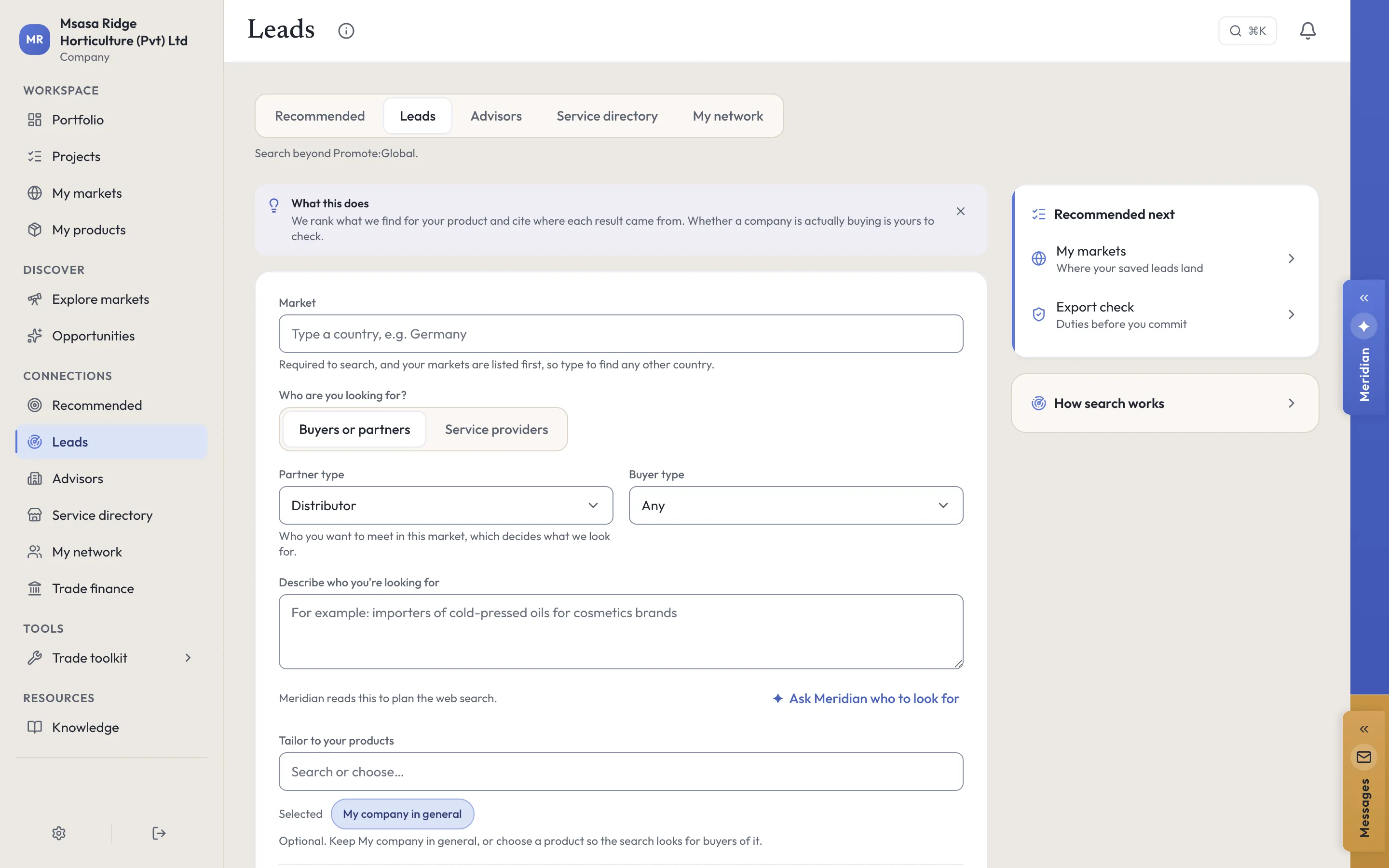
On the project, Search for possible buyers with the buyer type Distributors looks on the open web for in-market distributors and wholesalers, ranked by fit to your product and route, for 1 AI action. Each result says where it was found, and is a lead to check before you make contact. If your trade agency or chamber works with you on Promote:Global, you can also ask it for an introduction, and the other side decides whether to accept.
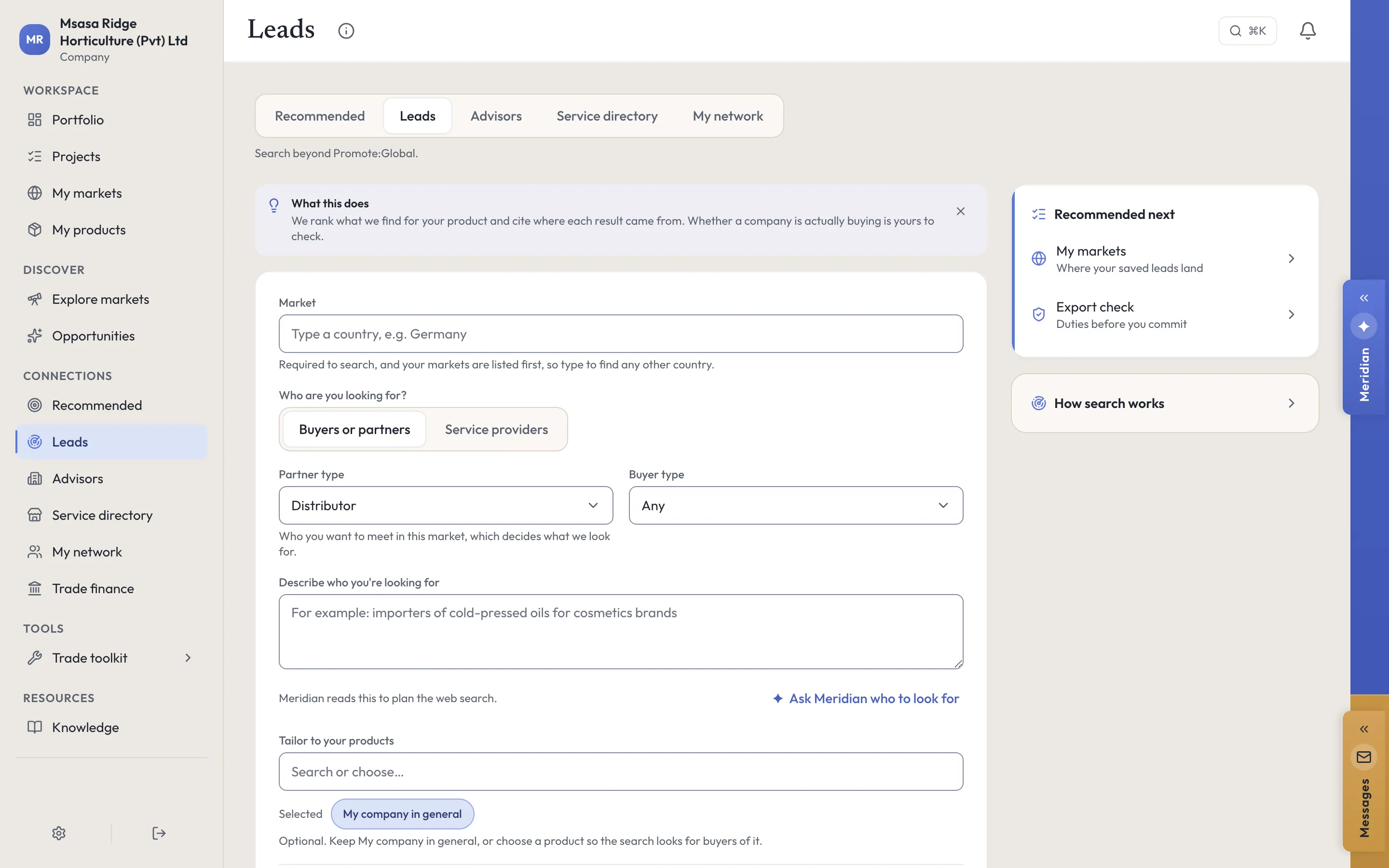
Leads on the web, searching for distributors. Click or tap to see the whole screen. Connect
Step 3: Contact the firms and compare their answers
Introduce your company, your product line and your export experience. Ask each firm about its ownership, the brands it represents, how it launches a new product, its bank and trade references, and its own view of the market. How well a firm answers that last question tells you how well it knows your sector2. Speak to several before you meet any of them6.
Keep the answers on one comparison sheet, a row for each firm and the same columns for all of them, taken from your partner profile: the territory it really covers, its channels and customer groups, the competing brands it carries, its references, its warehousing and delivery reach, and the sales it proposes for the first year2,6. A blank cell is a question for the next call. The checks and the meetings that follow fill in the rest, so the finalists are compared on the same evidence.
What this step produces
- A comparison sheet, one row for each firm
Common mistake: Not asking for the firm’s view of the market, which is the quickest test of how much it knows.
With Promote:Global
Save each firm you contact to the project as a lead, so the project’s Buyers & leads list shows who you are talking to, and keep the comparison sheet as a note on the step. Your notes on a project are what Meridian reads when you ask it about that project.
Connect
Step 4: Check references, finances and conflicts
Get at least two business or credit reports from different providers, call the bank and trade references, and ask other suppliers what the firm is like to work with2,6. Ask for the size of its sales force, its sales history and the lines it carries, and find out whether any of them compete with yours6. Some government agencies offer a background check on a foreign firm for a fee2.
What this step produces
- A due-diligence file for each finalist
- Two credit reports
- Reference notes
Common mistake: Relying on one report, or treating a directory listing as proof that a firm is sound2.
You do this step yourself
Promote:Global does not check firms. Search results are found on the open web and service providers list themselves, so order credit reports and take references yourself. The plan holds a Reference & financial check step, which you tick when it is done.
Connect
Step 5: Meet the finalists
Visit the offices and warehouse and meet the sales team, not only the owner. Where travel is hard, meet at a trade show or by video2. Ask each finalist how it would sell your product in its first year: who it would call, at what price, and with what support from you.
What this step produces
- A ranked shortlist
Common mistake: Skipping the site visit and hearing only from the person at the top.
You do this step yourself
Meetings and visits are yours to arrange. Write what you learn on the project’s step as notes, where your team can see them and Meridian reads them when you ask about the project.
Prepare
Step 6: Check the local law before you draft
Find out whether the country protects distributors, requires the agreement to be registered, or limits exclusivity, and whether those rules apply even when your contract names another country’s law. In Belgium, for example, a supplier that ends an exclusive distribution agreement without a serious breach by the distributor can owe reasonable notice or compensation instead, and possibly compensation for goodwill and expenses7. Saudi Arabia has no statutory compensation scheme, but requires distributors to be Saudi-owned and the agreement to be recorded in the Commercial Agencies Register9.
Inside the European Union, what a supplier may restrict, such as where and to whom a distributor sells, is limited by the vertical block exemption regulation of 202210.
What this step produces
- A short note from local counsel
Common mistake: Assuming the governing-law clause overrides protections that the distributor’s own country makes mandatory3,7.
With Promote:Global
The plan’s contract steps (Agree a term sheet, Sign the distributor agreement, Register the agreement if required) each carry Find an advisor for this market, which opens advisory firms with experience of the market. Find service providers lists legal and corporate firms that list themselves on Promote:Global. Neither is legal advice, and the advice itself comes from the firm you choose.
Prepare
Step 7: Agree the terms
Put it in writing: the territory, whether and when the appointment is exclusive, the term and renewal, minimum purchases with a growth target, your price and the distributor’s discount, payment terms, the use of your trademark, rules on competing products, and what happens to stock and customer records at the end3. Government guidance suggests a first term of one year with annual renewal, and exclusivity only once the partner has proved it can sell3.
The ICC Model Contract on Distributorship, revised in 2016, covers a distributor that buys and resells, and works as a drafting checklist that local counsel then adapts8. Choose the governing law and how disputes are settled; many suppliers choose arbitration, but the distributor’s country may not let its own courts or rules be set aside3.
What this step produces
- A term sheet
- Price list and discount schedule
- Minimum purchase schedule
Common mistake: Granting exclusivity with no minimum purchases and no review date3.
With Promote:Global
Before you agree a price, Export check gives the duty your product pays in the market, with its source and year, and Landed cost adds goods value, freight, insurance, duty and tax to show what a unit costs by the time it arrives. Both are free, and both open from the project’s Confirm duty and landed cost step already filled in.
Grow
Step 8: Sign, register and make the first shipment
Sign the agreement and, where the country requires it, register it in time: in Saudi Arabia, generally within three months of it taking effect9. Then train the distributor’s sales team, hand over product and marketing material, and agree the first order with its Incoterm, its named place and the payment terms.
What this step produces
- The signed agreement
- Registration, where required
- Proforma invoice for the first order
Common mistake: Signing before anyone has checked the agreement against local competition rules10.
With Promote:Global
The plan carries the shipment through: the document pack for your route, booking freight and the first order. Export documents fills a commercial invoice, a proforma invoice or a packing list from the project, to check and print.
Grow
Step 9: Manage performance, and plan the exit
Compare sales with the minimums every quarter, look at stock levels, pricing and complaints, and meet once a year to renew, adjust or replace. Agree in advance what happens to stock, customer records and spare parts when the agreement ends; in some markets service and parts obligations continue until a successor is appointed9.
What this step produces
- Quarterly sell-through reports
- An annual review
Common mistake: Letting an exclusive distributor that misses its targets run to the end of a long term with no trigger to change the terms.
With Promote:Global
The plan ends with Set a sell-through reporting cadence and Run an annual performance review. The Revenue tracker adds up the revenue you log by market and by project, against the goal you set for each market.
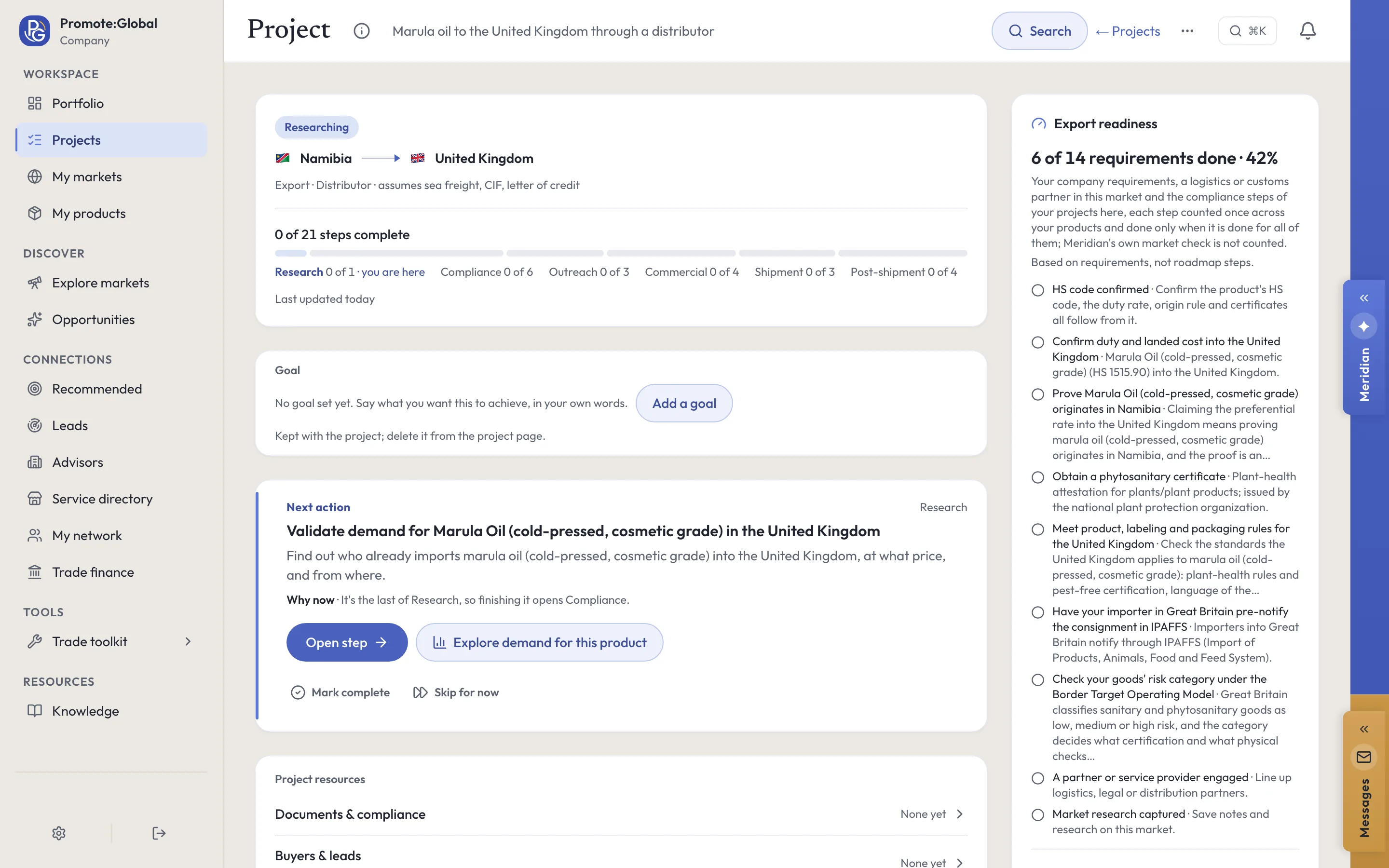
Your plan in Promote:Global
What a distributor project looks like.
Create a project, choose “Distributor” under “How are you entering?”, and Promote:Global writes this plan for your product and market. The route is in the list on the web and on iPhone. You tick steps off, skip one for now or add your own.
Research
- Validate demand for your product in your target market
- Classify your product for customs (until the HS code is confirmed)
Compliance
- Confirm duty and landed cost into your target market
- Prove your product originates in your country (where a trade agreement offers a lower rate)
- Obtain a certificate (one for each certificate the route needs)
- Meet product, labeling and packaging rules for your target market
Outreach
- Define your target territory
- Shortlist distributors for your product in your target marketButton: Search for possible buyers in this market
- Reference & financial check
Commercial
- Agree a term sheetButton: Find an advisor for this market
- Sign the distributor agreementButton: Find an advisor for this market
- Register the agreement if requiredButton: Find an advisor for this market
- Agree the Incoterm, price and payment terms with your buyer in your target market
Shipment
- Assemble the export document pack
- Book freight to your target market
- Ship a first order to your target market
Post-shipment
- Present the documents and collect payment from your target market (when paid by letter of credit or collection)
- Debrief the first shipment and fix the pack
- Set a sell-through reporting cadence
- Run an annual performance review
The duty, origin and certificate steps are looked up from your product’s HS code and the two countries, so their number depends on what you sell and where. A step with a condition in brackets appears only where it applies. In your own project, each step names your product and your countries. Building the plan uses no AI action.
On a project, Search for possible buyers looks on the open web for in-market distributors and wholesalers, or for whoever you describe, ranked by fit, for 1 AI action. A result is a lead to check before you contact anyone, not a confirmed buyer.
Make the plan fit this route
The plan for this route is the export corridor with the distributor’s own steps: the territory, the shortlist, the reference and financial check, the term sheet, the agreement and its registration, and sell-through and annual reviews after the first shipment. Add these three so the comparison, the meetings and the local-law check sit where the guide puts them.
- Contact the firms and compare them on one sheet (in Outreach, after “Shortlist distributors for your product in your target market”)
- Meet the finalists (after “Reference & financial check”)
- Check the local law on distribution (in Commercial, before “Agree a term sheet”)
On the project, type a step into Add a step under the roadmap, or ask Meridian to propose them: a step Meridian proposes is added only when you accept its card.
Meridian
Meridian, on your distributor project.
Meridian, the built-in AI assistant on the web and on iPhone, reads the project you have open: its route, its countries, the steps still open and your notes. It answers questions about them, and it proposes changes as cards. Nothing changes on the project until you accept a card. Ask it to search for possible buyers and it runs the project’s search in the conversation, looking on the open web for in-market distributors and wholesalers, for 1 AI action; every result is a lead to check.
Ask
- What’s the next step on this project?
- What’s blocking this project?
- What should the distributor agreement cover?
Do
Add a step — to this plan, as a card you accept
Save a note — to the project
Set entry method — one of the eighteen routes, with its reason, if another fits you better
Every plan carries a monthly allowance of AI actions, and each question uses 1. Building the plan uses none, and neither do Export check, Landed cost and the Origin qualifier. Meridian is AI. Verify before acting.
Documents
The paperwork.
- Partner profile, comparison sheet and shortlist
- What you need from a distributor, and the firms you measured against it, side by side.
- Due-diligence file
- Credit reports, references and company registry extracts for each finalist2.
- Distribution agreement
- Territory, exclusivity, term, minimums, pricing, trademark use, termination and governing law. The ICC model contract is a common starting framework3,8.
- Price list, discount and minimum purchase schedule
- Usually annexes to the agreement, reviewed each year.
- Registration filing
- Where the country requires distribution agreements to be recorded, such as Saudi Arabia’s Commercial Agencies Register9.
- Trademark license or use terms
- How the distributor may use your brand, and that it stops at the end3.
- Export shipment documents
- Commercial invoice, packing list and the certificates your route needs, for every order.
Costs and timelines
What to budget for.
Get quotes for
- Credit reports
- Two for each finalist, from different providers. Moves with the country and the provider2.
- Export agency services
- Some export promotion agencies prepare tailored contact lists6, and some government agencies run a background check on a foreign firm for a fee2. Ask each what it charges.
- Visits and trade shows
- Travel, and a stand or a visitor pass. Moves with the number of finalists and how far away they are.
- Local legal advice
- The note on local law, the agreement and any registration. Moves with how strongly the country protects distributors and whether the agreement must be recorded7,9.
- Ending the agreement
- Price it before you sign: in Belgium, the notice or compensation owed to an exclusive distributor depends on how long the relationship lasted7.
- Launch support
- Training for the distributor’s sales team, samples and marketing material. Moves with the channels and the size of the team.
What sets the timing
- Your partner profile and the long list, before you contact anyone1.
- Credit reports and references for each finalist, and the visits2.
- Local counsel’s note before the term sheet, so the terms fit the country’s rules7.
- Registration, where required, has its own deadline: in Saudi Arabia, generally within three months of the agreement taking effect9.
- The first order: production, the document pack and the freight booking.
Ask for each quote in writing, for your product, market and volumes. Prices and timings differ by country, provider and year.
Mistakes and best practices
What goes wrong, and what works.
Questions
Questions people ask.
How do I find a distributor in another country?
Ask your export promotion agency, your industry association and your embassy’s commercial section for contacts, and meet firms at trade shows. Then check references and credit before you commit2,5,6.
What is the difference between a distributor and a sales agent?
A distributor buys your goods and resells them on its own account, at its own price. A sales agent never owns the goods: it finds customers, you sell to them and invoice them, and you pay the agent a commission4,5.
Should I give a distributor exclusivity?
Only for a limited period or once the distributor has shown it can sell, and tied to minimum purchases and a review date3.
Can I end a distribution agreement whenever I want?
Not always: some countries require reasonable notice or compensation, as Belgium does for exclusive distributors7. Ask local counsel before you sign.
Sources
Where this guide comes from.
- [1]Learn how to export · U.S. International Trade Administration
- [2]Evaluate foreign representatives · U.S. International Trade Administration
- [3]Negotiating an agreement with a foreign representative · U.S. International Trade Administration
- [4]Direct or indirect exporting: a guide to international channels of distribution · Food Export Association of the Midwest USA and Food Export USA Northeast
- [5]Find international clients · Government of Alberta, Canada
- [6]Step 6: Entering your target market · Trade Commissioner Service, Government of Canada
- [7]Distribution law in Belgium (expert guide) · CMS, law firm
- [8]ICC Model Contract on Distributorship · International Chamber of Commerce, ICC Academy, 2016 edition
- [9]Saudi Arabia’s commercial agency and distribution rules · Clyde & Co, law firm, 2026
- [10]Vertical block exemptions · European Commission, Directorate-General for Competition
Reviewed October 26, 2026. This guide is general information about how companies do this, written in our own words from the sources above; it is not legal, tax or financial advice. Rules differ by country and change, so check them with the authority or an advisor before you act. What it says Promote:Global does is what the product does today. The screens on this page come from our demo workspace, and the companies in them are invented.
Read next
Related guides.
The next rung up
How to set up a subsidiary abroadWholly-owned subsidiary · Investment / FDI
- How to find a sales agent abroad
Sales agent · Export-based
- How to export goods
Direct exporting · Export-based
- How to export through a trading company
Indirect exporting · Export-based
- How to sell on international marketplaces
Online marketplace · Export-based
All eighteen guides Promote:Global for exporters Plans and prices
Start your distributor project.
Sign up, add what you sell, then create a project and choose “Distributor” under “How are you entering?”. The plan above is written for your product and market.
Start this projectFree to start. No credit card needed. See plans and prices