How to form a strategic alliance abroad
Cooperate with a company abroad on a bid, a product or a market under a contract, with no new company and no shared equity.
For a company that needs a partner abroad for a defined goal, such as a joint bid, shared research, co-marketing or access to a market, without setting up a shared company. Promote:Global files this route under Investment / FDI, beside joint ventures, although an alliance involves no shared equity.
On this page: In short
In short
In short
To form a strategic alliance abroad, write down what the alliance is for, who does what and when you will review it, choose and check a partner, and sign a written agreement on scope, contributions, IP, governance and exit, without creating a shared company1. If the partner is a competitor, have counsel check the plan against competition law before you sign: the European Union exempts some research and specialization agreements below market-share limits, and treats price fixing, market sharing and bid rigging as among the most serious restrictions2.
The route in Promote:Global
Strategic alliance · Investment / FDI
Commitment
Control
Risk
Rated 1 to 5, as the iPhone app rates every route when you choose one. The ratings are general, for the route itself: your own commitment, control and risk depend on your market, your product and your partners. Grows into: joint venture.
When it fits
Is a strategic alliance the right route?
A good fit when
- You need a partner’s local presence, complementary product or tender credentials for a defined project, and a joint venture would be too heavy.
- You want to share research costs or combine capabilities for a joint bid, and EU rules exempt some such agreements below market-share limits2,3.
- You want to test a relationship before committing equity: a contract keeps each partner independent1.
A poor fit when
- The partners are close competitors with a high combined market share and the plan touches prices, output or markets, which competition authorities treat most severely2.
- Your main asset is secret know-how and you cannot control who sees it.
- No one on either side will be accountable for the work, so the alliance would drift.
The people involved
Who’s involved and how they work together
- Your company to Alliance partner: Skills, IP license, access
- Alliance partner to Your company: Its skills, local access
- Your company to Customers: Joint offer, bid or product
- Customers to Your company: Revenue, shared as agreed
Step by step
How to form a strategic alliance abroad, in 8 steps.
Each step says how companies do it, with sources, then what Promote:Global does there, or that the step is yours to do.
Discover
Step 1: Define what the alliance is for, and its form
Write down the joint objective (a market, a bid, a product), what each side brings, who is responsible for what, how success will be measured and the date you will review it. A narrow, measurable objective is easier to govern and easier to end than a broad partnership.
For example: a producer of cold-pressed marula oil in Namibia and a natural-cosmetics brand in Germany agree to launch a co-branded face oil in 40 German stores within a year. The producer supplies the oil, its batch records and the origin story; the brand formulates, markets and sells the product; each names one alliance manager; and on a fixed date six months after launch they review sales, costs and customer feedback against the objective, and decide whether to widen, renew or end the alliance.
Then choose the lightest form that does the job: a cooperation or co-marketing agreement, joint research and development, a bidding consortium or cross-licensing, or, if you need shared ownership, a joint venture. A European Commission guide for small firms forming alliances breaks the set-up into stages, and notes that language and communication, more than technical issues, often slow the negotiation1.
What this step produces
- A one-page alliance concept: the objective, who does what, the measures and the review date
- A decision on the form
Common mistake: A broad “partnership” with no measurable objective, or equity where a contract would do.
With Promote:Global
Create a project on the Strategic alliance route: the web lists it under “How are you entering?”, and on iPhone the route advisor or Meridian’s Set entry method card sets it. Promote:Global writes the route’s own checklist, opening with Define what the alliance is for, using no AI action.
Connect
Step 2: Search for possible partners
Write the criteria before you look: capabilities that complement yours, reputation in the market, financial strength, a way of working you can live with, and conflicts with the partner’s other alliances or customers. Ask your trade agency, chamber and industry association who works in the field, and look at who has bid on the tenders, or served the customers, you are after.
What this step produces
- Partner criteria
- A long list of possible partners
Common mistake: Starting from a contact you already have instead of from the criteria.
With Promote:Global
On the project, Search for possible partners looks on the open web for whoever you describe, such as a firm with the tender credentials or the product you lack, ranked by fit, for 1 AI action. Each result says where it was found and is a lead to check before you make contact. If your chamber or trade agency works with you on Promote:Global, you can ask it for an introduction, and the other side decides whether to accept.
Connect
Step 3: Check the partner
Check who owns and controls the firm, its financial statements, litigation, compliance record and exposure to sanctions, and take references from its customers and past partners. A personal connection is not a substitute for a background check.
What this step produces
- A due-diligence file on the partner
Common mistake: Choosing a partner on a personal connection, without a background check.
You do this step yourself
Promote:Global does not check firms. Search results come from the open web, so run the checks yourself or with an advisor, and keep the file as notes on the project.
Prepare
Step 4: Agree the scope, the contributions and the IP
If the partner competes with you, agree before these talks what may be shared in them, and who may see it. Then set out the scope, what each side contributes, and how costs and revenue are shared, in a term sheet.
Each side usually keeps its own background IP. Agree who owns the results, who may use them, and in which fields and territories. For joint research and development, the EU framework deals with access to the results and their joint exploitation, and allows limits on exploiting them only within bounds2.
What this step produces
- A term sheet
- An IP schedule
- A confidentiality agreement
Common mistake: Leaving the ownership of improvements and joint results unwritten.
With Promote:Global
Agree scope, contributions & IP carries Find an advisor for this market, which opens advisory firms with experience of the market; they see what you share with them for that work. You and your counsel set the IP terms: Promote:Global does not draft them or register IP.
Prepare
Step 5: Check the competition-law limits, and set rules for what you share
If the partners are actual or potential competitors, the agreement has to be assessed under competition law, whether or not a company is formed. In the European Union, the 2023 Horizontal Guidelines cover research and development, production, commercialization, purchasing, information exchange and standardization; the block exemption for research and development applies up to a combined market share of 25%, and the one for specialization up to 20%2, under regulations adopted in 20233. In the UK, the Competition and Markets Authority’s guidance of August 2023 explains the prohibition and the UK’s own block exemptions4. In the US, the Federal Trade Commission and the Department of Justice withdrew their 2000 guidelines on collaboration among competitors on 11 December 2024 and assess collaborations case by case5; in February 2026 they asked for public comment on new guidance6, so check whether any has been published since.
Sharing competitively sensitive information, such as prices, costs, strategy or customers, is one of the main concerns of the EU rules, which give information exchange a chapter of its own2. Agree in writing what may be shared, who may see it, and what stays with a small clean team kept apart from pricing decisions.
What this step produces
- A competition-law note from counsel in each key market
- An information-sharing protocol
Common mistake: Assuming an alliance is exempt because it is not a joint venture.
With Promote:Global
Check the competition-law limits carries Find an advisor for this market, which opens advisory firms with experience of the market; they see what you share with them for that work. Promote:Global gives no legal advice: the assessment comes from the counsel you choose.
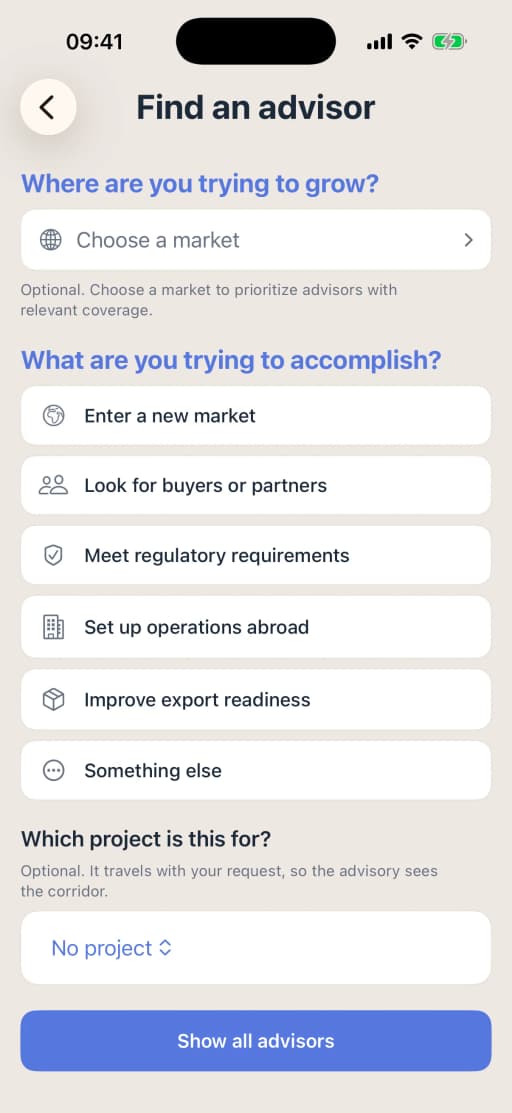
Finding an advisor for a market on iPhone. Prepare
Step 6: Sign the alliance agreement, with its exit terms
The core terms are the scope, each side’s contributions, governance, the budget and how costs are shared, milestones and review dates, confidentiality, IP, liability, the term, dispute resolution and the governing law. Exclusivity and non-compete clauses belong only where the cooperation needs them: under the EU rules, a restriction must be objectively necessary to the cooperation and proportionate to it, not merely convenient2.
Write the exit into the same agreement: the notice period, how rights and data return, what happens to joint IP, customers and stock, and any buy-out.
What this step produces
- The signed alliance agreement, with its exit terms
Common mistake: A broad non-compete that goes beyond the cooperation and may be unenforceable or unlawful.
With Promote:Global
Sign the alliance agreement carries Find an advisor for this market, as do the other steps in the plan’s Agree phase. Your lawyers draft the agreement: Promote:Global does not draft or review contracts.
Prepare
Step 7: If you bid together, keep it a genuine consortium
A joint bid needs a lead bidder, an agreed split of work and liability, and a clear line between the consortium and everything else. Agreeing the content of separate bids, sharing out tenders or taking turns to win is bid rigging, which the EU rules treat as one of the most serious restrictions2.
Read each tender’s own rules too. World Bank-funded tenders, for example, accept joint ventures but let a firm submit only one bid, including as a partner in someone else’s7.
What this step produces
- A consortium agreement
- Each tender’s rules on joint bids
Common mistake: A joint bid that also coordinates the partners’ separate bids.
You do this step yourself
Promote:Global does not search tenders (there is no tender database) and gives no legal advice: read each tender’s rules yourself, with counsel.
Grow
Step 8: Run a pilot, review it on fixed dates, then renew or exit
Set up a joint steering group, a named lead for each workstream, regular reporting, escalation steps and a rule for breaking a deadlock. Start with a small pilot. On each review date, measure the results against the joint objective, then decide whether to widen, renew or end the alliance under its exit terms.
What this step produces
- A governance charter
- Review notes and the renewal decision
Common mistake: No one assigned to run the alliance day to day.
With Promote:Global
The plan ends with Set a governance & review cadence. Keep minutes and decisions as notes on the project, which Meridian reads when you ask about it, and log what the alliance earns in the Revenue tracker, by market and by project.
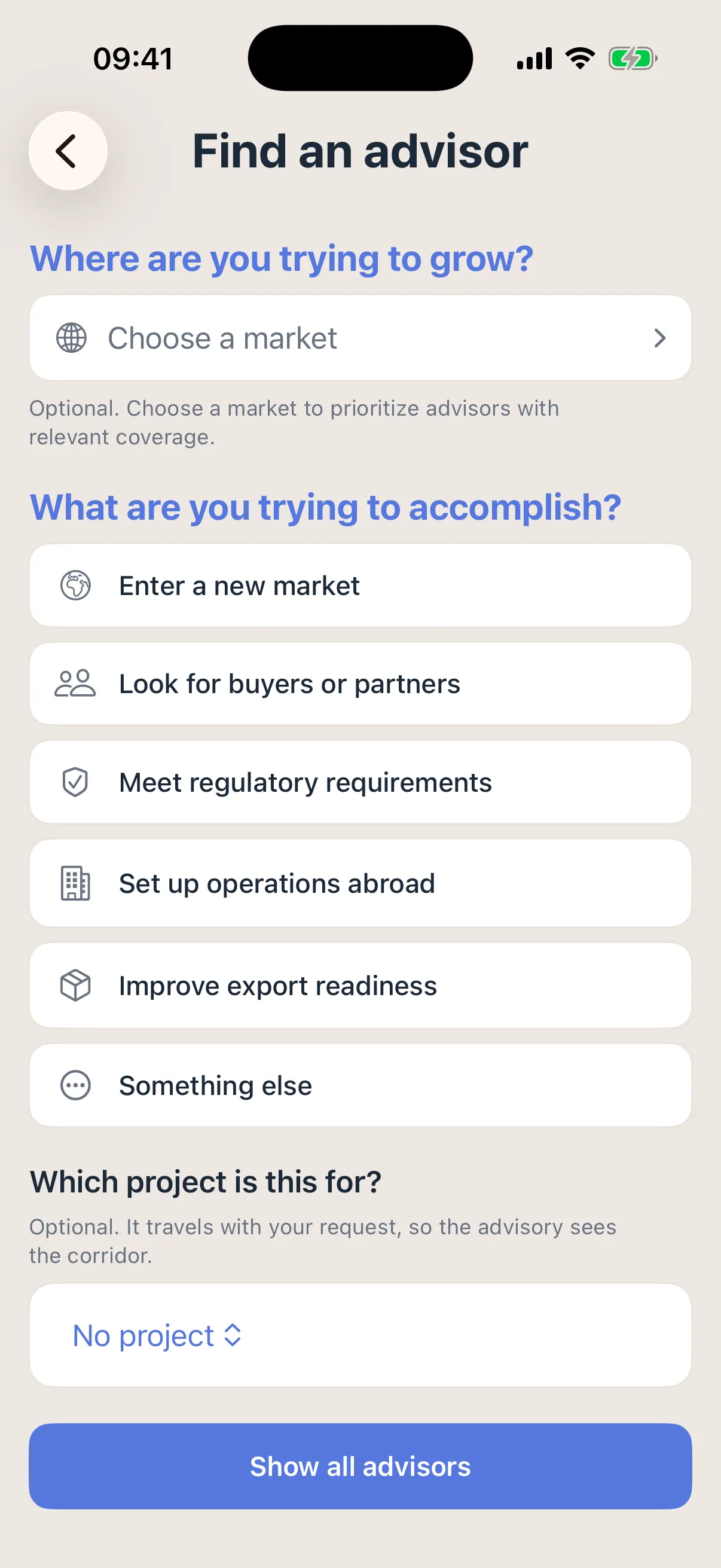
Your plan in Promote:Global
What a strategic alliance project looks like.
Create a project, choose “Strategic alliance” under “How are you entering?”, and Promote:Global writes this plan for your product and market. The web lists the route; on iPhone, the route advisor or Meridian sets it. You tick steps off, skip one for now or add your own.
Rationale
- Define what the alliance is for
Partner
- Identify & vet an alliance partner
Agree
- Agree scope, contributions & IPButton: Find an advisor for this market
- Check the competition-law limitsButton: Find an advisor for this market
- Sign the alliance agreementButton: Find an advisor for this market
Govern
- Set a governance & review cadence
The plan is the route’s own checklist, with no customs steps by default. Where the work moves goods across a border, such as equipment, ingredients, samples or branded supplies, add those steps yourself. You can add, reorder and skip steps. In your own project, each step names your product and your countries. Building the plan uses no AI action.
On a project, Search for possible partners looks on the open web for whoever you describe, ranked by fit, for 1 AI action. A result is a lead to check before you contact anyone, not a confirmed partner.
Make the plan fit this route
The plan for this route is its own checklist, from “Define what the alliance is for” to “Set a governance & review cadence”, in the order this guide follows. Two steps apply only to some alliances: add them where they fit yours.
- Set rules for what you share, if the partner competes with you (after “Check the competition-law limits”, before “Sign the alliance agreement”)
- Sign a consortium agreement for each joint bid, if you bid together (after “Sign the alliance agreement”)
On the project, type a step into Add a step under the roadmap, or ask Meridian to propose them: a step Meridian proposes is added only when you accept its card.
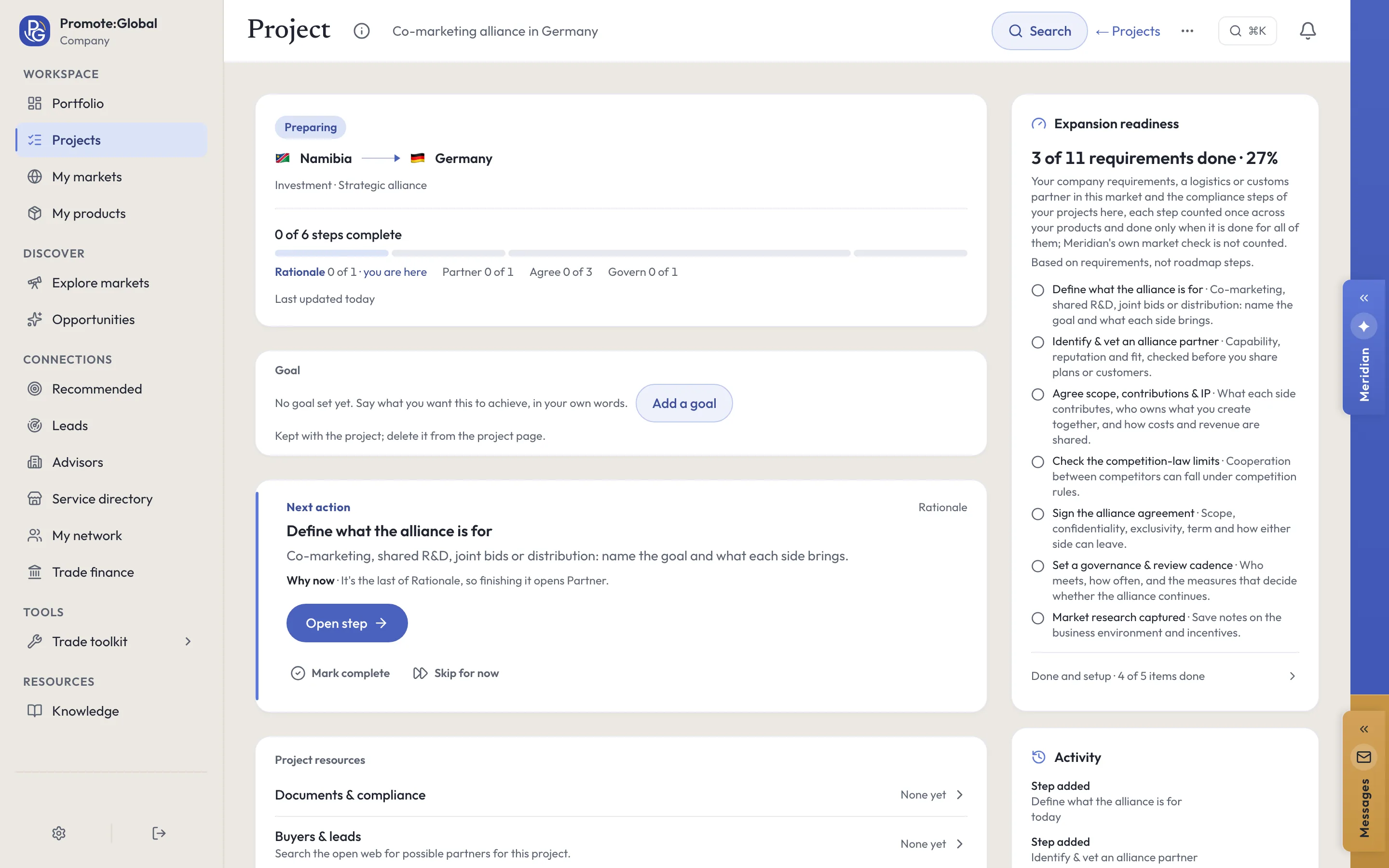
Meridian
Meridian, on your strategic alliance project.
Meridian, the built-in AI assistant on the web and on iPhone, reads the project you have open: its route, its countries, the steps still open and your notes. It answers questions about them, and it proposes changes as cards. Nothing changes on the project until you accept a card. Ask it to search for possible partners and it runs the project’s search in the conversation, looking on the open web for whoever you describe, for 1 AI action; every result is a lead to check.
Ask
- What’s the next step on this project?
- What’s blocking this project?
- What may we share with a partner that competes with us?
Do
Add a step — to this plan, as a card you accept
Save a note — to the project
Set entry method — one of the eighteen routes, with its reason, if another fits you better
Every plan carries a monthly allowance of AI actions, and each question uses 1. Building the plan uses none. Meridian is AI. Verify before acting.
Documents
The paperwork.
- Alliance concept and term sheet
- The joint objective, who does what, the measures of success, the review date and the term.
- Confidentiality agreement
- Signed before any sensitive information changes hands.
- Alliance or cooperation agreement
- Scope, contributions, governance, costs, IP, exclusivity only where it is necessary, liability, term, exit and disputes2.
- IP schedule
- The background IP each side keeps, who owns the results, and the licenses between you2.
- Information-sharing protocol
- What may be shared, with whom, and what stays with a clean team, where the partners compete2.
- Competition-law assessment
- Counsel’s note for each key market, such as the EU, the UK and the US2,4,5.
- Consortium agreement
- If you bid together: the lead bidder, the shares of work and liability, and each tender’s rules7.
- Governance charter and review notes
- Who decides what, how often you review against the objective, and the renewal decision.
Costs and timelines
What to budget for.
Get quotes for
- Partner due diligence
- Ownership and control, financial statements, litigation, compliance and sanctions checks, and references; moves with the partner’s size and the number of countries it works in.
- Competition-law advice
- Only where the partners compete; moves with the number of markets you need advice for, such as the EU, the UK and the US, and with how close the cooperation comes to prices, output or customers2,4,5.
- Drafting the agreement
- Moves with the scope: a co-marketing agreement is lighter than joint research with shared results and licenses between you2.
- Consortium agreements
- If you bid together, one for each tender, written to that tender’s rules7.
- Running the alliance
- A named manager’s time on each side, the steering group’s meetings and the pilot’s costs, shared as the agreement sets.
What sets the timing
- Finding and checking a partner.
- The competition-law check, where the partners compete, before anything is signed2,4,5.
- Negotiating the scope, the contributions, the IP and the exit terms.
- For a joint bid, the tender’s own deadline and its rules on joint bids7.
- The pilot and its first review date, which the agreement fixes.
Ask for each quote in writing, for your product, market and volumes. Prices and timings differ by country, provider and year.
Mistakes and best practices
What goes wrong, and what works.
Common mistakes
- Letting the cooperation widen in practice beyond what the agreement and the competition-law check covered2.
- Measuring the alliance by activity, such as meetings held and materials shared, instead of against the joint objective.
Best practices
- Keep your core know-how outside the alliance, and disclose in stages.
- Write the joint objective so that someone outside the alliance could tell whether it was met.
Questions
Questions people ask.
What is the difference between a strategic alliance and a joint venture?
An alliance is a contract that keeps both companies separate. A joint venture usually creates a shared company, with shared equity, profits and control1.
Is a strategic alliance between competitors legal?
Often, if it does not restrict competition. EU rules exempt some research and specialization agreements below market-share limits, and treat price fixing, market sharing and bid rigging as serious restrictions2.
Sources
Where this guide comes from.
- [1]European guide to alliances between subcontracting SMEs · European Commission and the Lyons Chamber of Commerce, 1997
- [2]Guidelines on the applicability of Article 101 TFEU to horizontal co-operation agreements (Horizontal Guidelines) · European Commission, 2023
- [3]Horizontal block exemptions · European Commission, Directorate-General for Competition, 2023
- [4]Guidance on horizontal agreements · UK Competition and Markets Authority, on GOV.UK, 2023
- [5]FTC and DOJ withdraw guidelines for collaboration among competitors · U.S. Federal Trade Commission, 2024
- [6]FTC and Department of Justice seek public comment on guidance for business collaborations · U.S. Federal Trade Commission, 2026
- [7]Procurement Regulations for IPF Borrowers, seventh edition · World Bank, 2025
Reviewed October 26, 2026. This guide is general information about how companies do this, written in our own words from the sources above; it is not legal, tax or financial advice. Rules differ by country and change, so check them with the authority or an advisor before you act. What it says Promote:Global does is what the product does today. The screens on this page come from our demo workspace, and the companies in them are invented.
Read next
Related guides.
The next rung up
How to form an international joint ventureJoint venture · Investment / FDI
- How to license your IP abroad
Licensing · Contractual
- How to win a management contract abroad
Management contract · Contractual
- How to deliver a turnkey project abroad
Turnkey project · Contractual
All eighteen guides Promote:Global for international expansion Plans and prices
Start your strategic alliance project.
Sign up, add what you sell, then create a project and choose “Strategic alliance” under “How are you entering?”. The plan above is written for your product and market.
Start this projectFree to start. No credit card needed. See plans and prices