How to franchise internationally
License your whole business format to operators abroad, directly or through a master franchisee, for fees and royalties.
For a business with a proven, repeatable format, such as a restaurant, retail or service concept, that wants units in another country run by local operators who invest their own capital.
On this page: In short
In short
In short
To franchise internationally, prove and document the model at home, register your trademark in the target market, choose between franchising directly, through an area developer or through a master franchisee, settle the fees and the tax on them, and meet the market’s disclosure and registration rules before anyone signs1,2,3,4. Then choose a partner on its ability to open units, sign an agreement whose development schedule starts once a pilot unit has been reviewed, and support the network from that pilot outward2,5.
The route in Promote:Global
Franchising · Contractual
Commitment
Control
Risk
Rated 1 to 5, as the iPhone app rates every route when you choose one. The ratings are general, for the route itself: your own commitment, control and risk depend on your market, your product and your partners. Grows into: wholly-owned subsidiary.
When it fits
Is franchising the right route?
A good fit when
- The business is proven at home, ideally across several units, and its operations can be written down and taught.
- You want to grow fast in a market where you lack capital, language or local legal knowledge; master and development structures suit this5.
- You can protect the brand: the trademark is registered in the market and you control a supply or know-how element1,2.
A poor fit when
- The business depends on the founder personally, or has not yet worked in more than one location.
- The country restricts franchise structures, requires approval of each agreement or limits royalty payments abroad5.
- You cannot supply training, support and quality control from a distance; weak support is a main drawback of direct franchising far from home5.
The people involved
Who’s involved and how they work together
- Your company to Master franchisee: Brand, system, training
- Master franchisee to Unit franchisees: Sub-franchises and support
- Unit franchisees to Master franchisee: Fees and royalties
- Master franchisee to Your company: Share of fees and royalties
Step by step
How to franchise internationally, in 10 steps.
Each step says how companies do it, with sources, then what Promote:Global does there, or that the step is yours to do.
Prepare
Step 1: Prove the model at home and write it down
A franchise passes on a whole business format: the brand, the operating system, the training and continuing support2. Before you offer it abroad, confirm that units are profitable, that the operation can be repeated without the founder, and that it can be taught. Write the operations manual and the training program, and build the unit economics a franchisee would face, including the fees and royalties it will pay you.
What this step produces
- Operations manual and brand standards
- Training program
- Unit economics for a franchisee
Common mistake: Franchising a concept that works only because the founder runs it.
With Promote:Global
Create a project on the Franchising route and Promote:Global writes the route’s own checklist, with no customs steps by default, using no AI action. It opens with Codify your operating system and Build the unit-economics model: tick each one off when it is done, and keep notes and subtasks on the step; Meridian reads the notes when you ask about the project.
Discover
Step 2: Choose the market and check that the model is allowed there
Compare demand, competition and the cost of sites, then the rules that decide whether the model can work at all: franchise law, foreign-ownership and currency rules, and how fees and royalties can be paid out. Some countries require each franchise agreement to be registered with or approved by a government authority, and the structure you want must be permitted by local law5.
What this step produces
- A short list of markets
- A note on each market’s franchise rules
Common mistake: Choosing a market because the language is familiar, without checking the law.
With Promote:Global
A market’s page shows the economy (GDP, population, inflation) and the investment climate from World Bank indicators, and lists the country’s official trade and investment bodies, to contact directly. Franchise law is not on the page: check it with local counsel.
Prepare
Step 3: Register the trademark before you name a partner
Trademark rights are territorial, and most countries give a mark to the first to file1. File the brand in the market, in your own name, before you talk to partners or announce a launch. The Madrid System lets you designate many countries in one application once you have a home filing6. Guides on franchising in China warn that local parties sometimes register a foreign brand first7.
Mark the operations manual confidential, and share it only under a signed agreement.
What this step produces
- Trademark filings in your own name
- Confidentiality agreements
Common mistake: Letting the local partner register the brand, even on your behalf.
You do this step yourself
Your IP attorney files the trademark; Promote:Global does not register IP. Add a step of your own for the filing, so the plan shows it beside the others.
Prepare
Step 4: Choose direct franchising, area development or a master franchise
There are three common routes. In direct franchising you sign each local franchisee yourself; in area development one developer opens and runs several units in a territory; and in master franchising a local master franchisee can also grant sub-franchises, which makes a three-tier chain2,5. Direct franchising keeps control and the whole fee but stretches your support far from home, while a master or developer brings speed and local knowledge in exchange for a share of the fees and some control5.
Master agreements are long, often twenty years or more, because the master invests heavily in building the network2. Some franchisors use a subsidiary or a joint venture in the role instead, which adds control but needs capital5.
What this step produces
- A structure decision
- A territory map
Common mistake: Signing a long, exclusive master agreement with no development schedule.
You do this step yourself
You choose the structure with franchise counsel in the market; Promote:Global does not advise on structure or draft agreements.
Prepare
Step 5: Plan the fees, tax and currency
Fees and royalties paid across a border may have tax withheld. The OECD Model gives the right to tax royalties to the recipient’s country of residence, but many treaties let the paying country withhold a capped share4. Decide who bears that tax, the currency, and how often franchisees report and pay, and check whether currency rules limit what can be paid abroad5. Settle this before the disclosure document, which sets out the fees.
What this step produces
- A tax note on the treaty
- Fee, payment and reporting terms
Common mistake: Modeling fees without the tax withheld at source or the cost of converting currency.
You do this step yourself
Fees, tax and currency are settled with your tax advisor; Promote:Global gives no tax advice. Accounting and tax firms list themselves in Find service providers.
Prepare
Step 6: Meet the disclosure and registration rules
Many markets require a disclosure document before a franchise agreement is signed, and the timing and content differ. In the US, the Federal Trade Commission’s Franchise Rule applies when there is a trademark, significant control or assistance, and a required payment, and the document must reach the prospective franchisee at least 14 calendar days before it signs or pays3,8. Australia’s Franchising Code of Conduct sets duties for the disclosure document, a register and a cooling-off period9. In China, according to a 2019 guide, a franchisor needs two outlets run for at least a year (which may be abroad), must disclose in writing 30 days before signing, and must file a record with the commerce authority within 15 days of its first contract7.
UNIDROIT’s model disclosure law of 2002 lists what such a document usually contains, such as the fees, litigation history and financial statements, and makes a useful checklist10.
What this step produces
- A disclosure document for each market that requires one
- Record filings or registrations
- Signed acknowledgments of receipt
Common mistake: Assuming the home-country disclosure document satisfies every market.
With Promote:Global
Prepare the franchise disclosure document carries Find an advisor for this market, which opens advisory firms with experience of the market; they see what you share with them for that work. Promote:Global does not prepare or review disclosure documents.
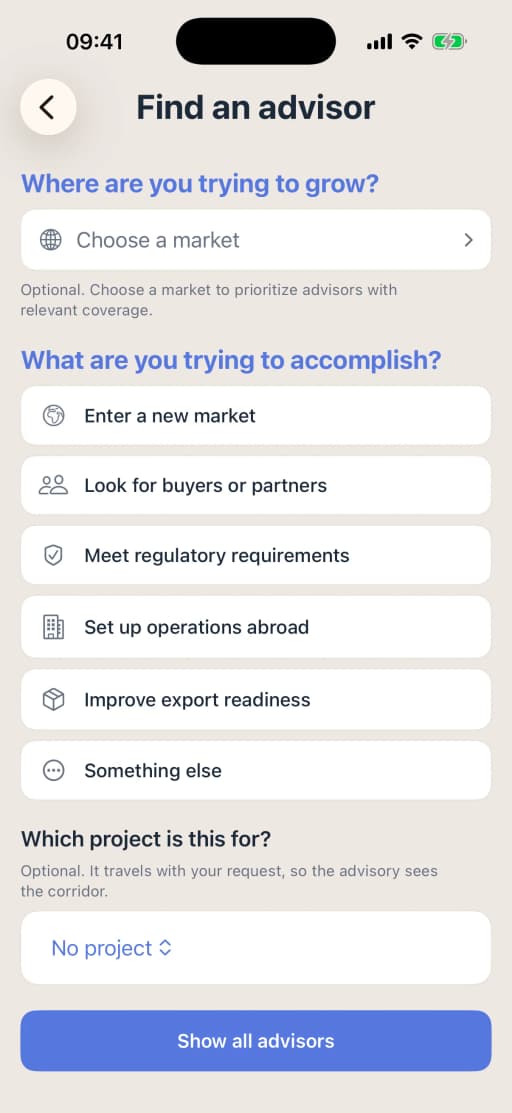
Finding an advisor for a market on iPhone. Connect
Step 7: Define the franchisee profile, search and check the finalists
Write the profile first: the capital the partner must have, its record of running retail or service outlets, its access to funding, and how many units it should open each year. Master and development structures exist to bring in capital, language and local legal knowledge you lack5, so look for a partner that has all three, and ask each serious prospect for a development plan with minimum openings.
Then check each finalist’s owners, accounts and bank references, the brands it already runs and whether any compete with yours, and visit its existing outlets. A weak master franchisee can damage the brand across a whole country5, so the test is its ability to open and run units.
What this step produces
- A franchisee profile
- A long list of prospects
- A due-diligence file for each finalist
Common mistake: Choosing the partner who pays the biggest upfront fee, not the one who can open units.
With Promote:Global
Define the franchisee profile & qualify carries Find service providers, the directory of firms that list themselves by category, such as consulting, market research, and events and missions. On the project, Search for possible partners looks on the open web for multi-unit operators and franchise investors, or for whoever you describe, for 1 AI action. Each result says where it was found and is a lead to check: Promote:Global checks no firm, so take references, order credit reports and visit outlets yourself.
Prepare
Step 8: Negotiate the franchise agreement
UNIDROIT’s guide to master franchise arrangements sets out the terms to settle: the rights granted, term and renewal, initial and continuing fees, advertising funds, training, supply, IP and know-how, quality control, transfer, remedies, termination and its effect on the sub-franchise agreements, and the governing law and how disputes are resolved2.
Add a development schedule with minimum openings that starts once the pilot unit has been reviewed, and the right to end exclusivity or shrink the territory if the schedule is missed.
What this step produces
- Master or development agreement
- Sub-franchise agreement template
- Development schedule, tied to the pilot review
Common mistake: No plan for the sub-franchisees if the master agreement ends2.
With Promote:Global
The plan’s Sign the franchise agreement + trademark license step carries Find an advisor for this market. Your franchise counsel drafts the agreement: Promote:Global does not draft or review contracts.
Grow
Step 9: Train the partner and open a pilot unit
Train the partner’s team, adapt the manuals to the market, and set up approved suppliers. If the units need equipment, ingredients or branded supplies from you or your home suppliers, those goods cross a border: before the pilot opens, check the duty, the import rules that apply to them, such as food safety, labeling or product standards, and who imports them. Then open one pilot unit.
What this step produces
- Training records
- Approved supplier list
- Import checks for any supplies that cross a border
Common mistake: Finding out at the border that the ingredients or equipment the format depends on need a permit or a label the pilot did not plan for.
With Promote:Global
The plan’s Support phase opens with Deliver training & launch. It has no customs steps by default: where supplies cross a border, Export check gives the duty and the documents a shipment needs for a product you add, and Landed cost what it costs on arrival, both free; add those steps to the plan yourself.
Grow
Step 10: Review the pilot, then support the network
Run the pilot long enough for its sales to settle, then review it against the unit economics: sales, costs, margins, the supply chain, and how well the brand standards held. Fix the manuals, the training and the supply arrangements before the development schedule moves on to further units.
As the network grows, audit quality, collect sales reports, and run the advertising fund openly, with its rules on how contributions are collected, spent and reported2.
What this step produces
- A pilot review against the unit economics
- Revised manuals and training
- An audit calendar
Common mistake: Opening more units before the pilot proves the local economics.
With Promote:Global
The plan’s last step covers quality checks and royalty collection. Keep the pilot review as a note on the step, where Meridian reads it when you ask about the project. The Revenue tracker adds up the fees and royalties you log, by market and by project, against the goal you set for each market. Promote:Global does not monitor a franchisee’s sales: the figures are the ones you enter.
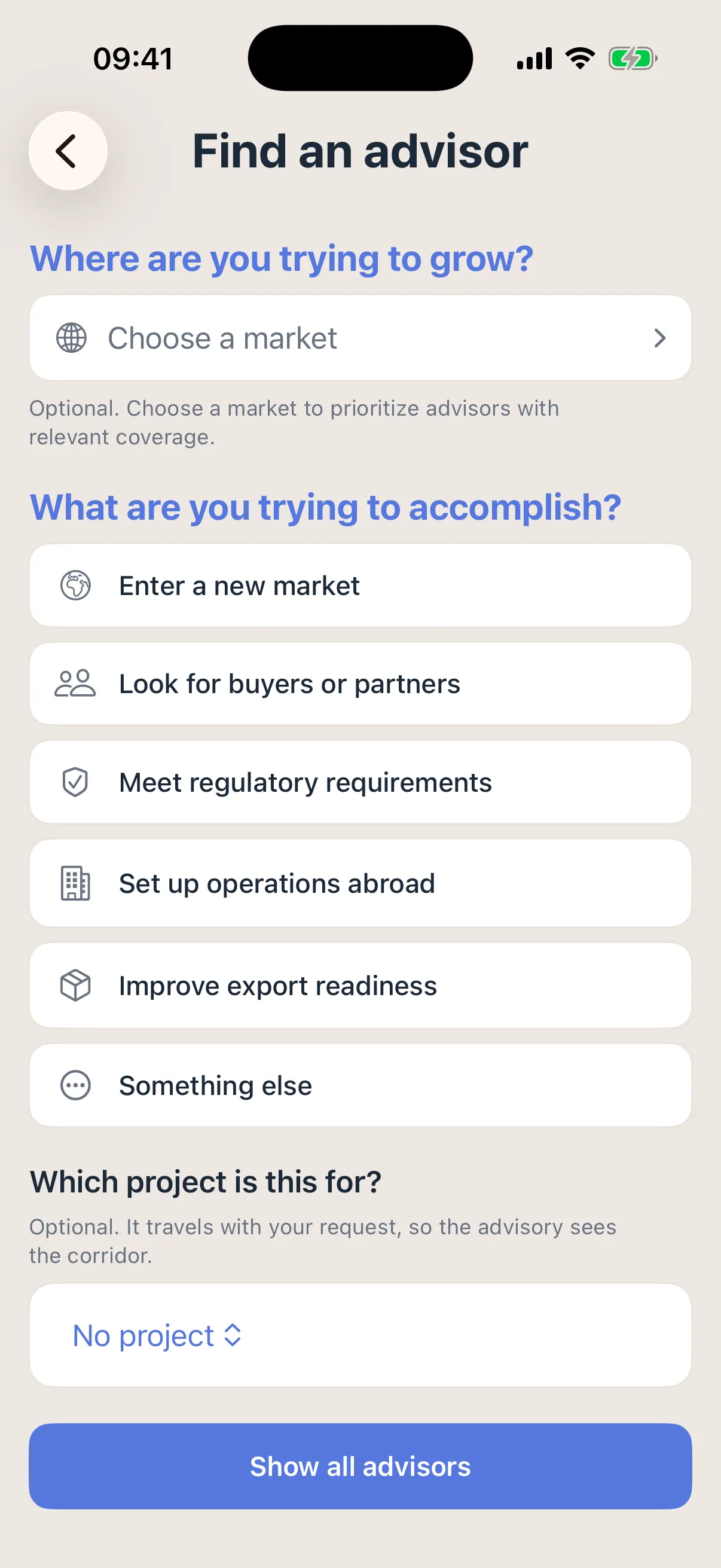
Your plan in Promote:Global
What a franchising project looks like.
Create a project, choose “Franchising” under “How are you entering?”, and Promote:Global writes this plan for your product and market. The route is in the list on the web and on iPhone. You tick steps off, skip one for now or add your own.
Package
- Codify your operating system
- Build the unit-economics model
Disclose
- Prepare the franchise disclosure documentButton: Find an advisor for this market
Recruit
- Define the franchisee profile & qualifyButton: Find service providers
Contract
- Sign the franchise agreement + trademark licenseButton: Find an advisor for this market
Support
- Deliver training & launch
- Set ongoing QA & royalty collection
The plan is the route’s own checklist, with no customs steps by default. Where the work moves goods across a border, such as equipment, ingredients, samples or branded supplies, add those steps yourself. You can add, reorder and skip steps. In your own project, each step names your product and your countries. Building the plan uses no AI action.
On a project, Search for possible partners looks on the open web for multi-unit operators and franchise investors, or for whoever you describe, ranked by fit, for 1 AI action. A result is a lead to check before you contact anyone, not a confirmed partner.
Make the plan fit this route
The plan for this route is its own checklist, from codifying the operating system to ongoing quality checks and royalty collection, with no customs steps by default. Add these in this order: the market, trademark, structure and fee decisions before the disclosure document, a pilot review before more units open, and customs checks only if equipment, ingredients or branded supplies cross a border.
- Choose the market and check that the model is allowed there (in Package, after “Build the unit-economics model”)
- Register the trademark before you name a partner (next, before “Prepare the franchise disclosure document”)
- Choose direct franchising, area development or a master franchise (next, before “Prepare the franchise disclosure document”)
- Plan the fees, tax and currency (just before “Prepare the franchise disclosure document”, which sets out the fees)
- Check the duty and import rules for supplies shipped to the units (only if equipment, ingredients or branded supplies cross a border: in Support, before “Deliver training & launch”)
- Review the pilot unit before more units open (in Support, after “Deliver training & launch”, before the plan’s last step on quality checks and royalty collection)
On the project, type a step into Add a step under the roadmap, or ask Meridian to propose them: a step Meridian proposes is added only when you accept its card.
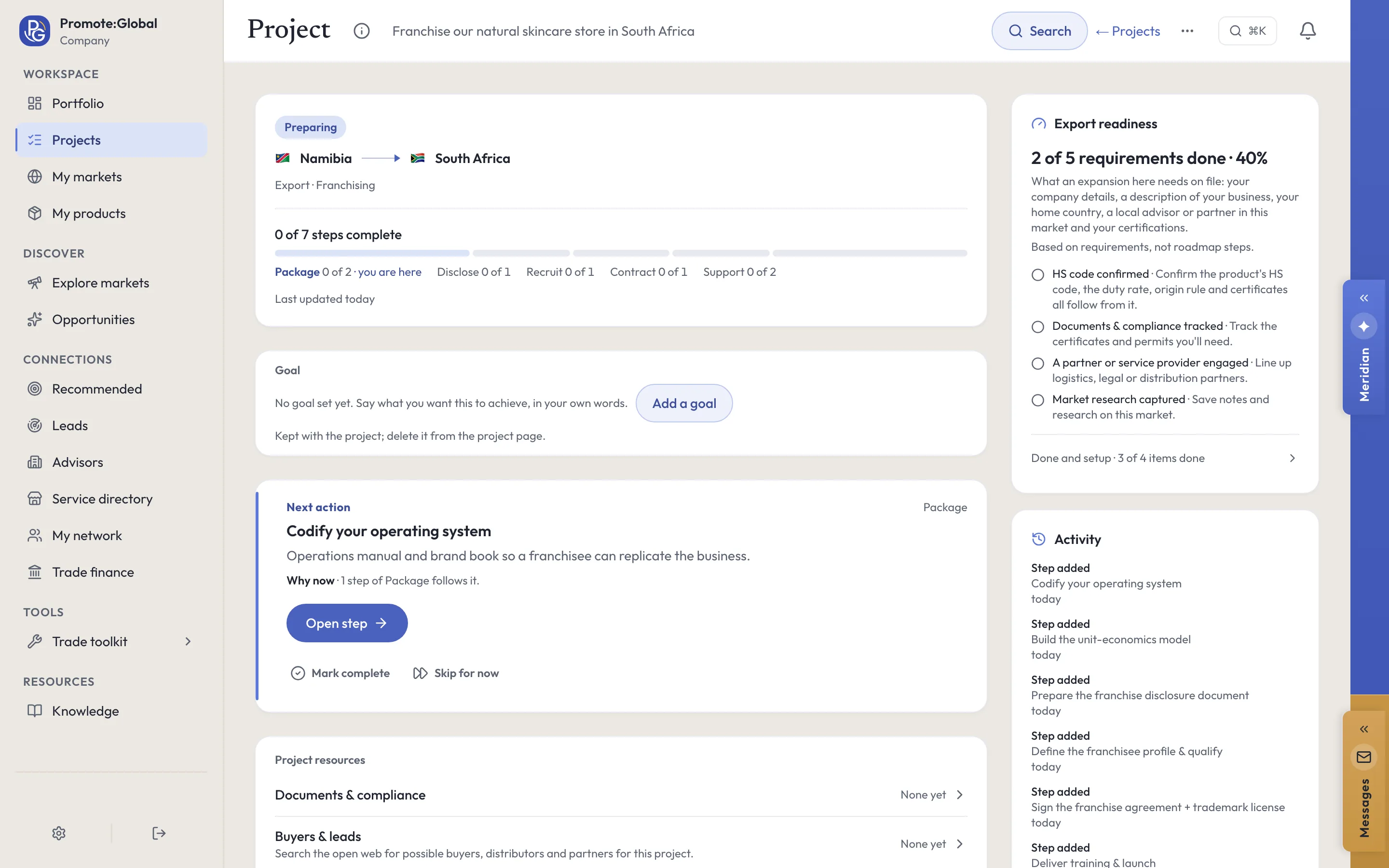
Meridian
Meridian, on your franchising project.
Meridian, the built-in AI assistant on the web and on iPhone, reads the project you have open: its route, its countries, the steps still open and your notes. It answers questions about them, and it proposes changes as cards. Nothing changes on the project until you accept a card. Ask it to search for possible partners and it runs the project’s search in the conversation, looking on the open web for multi-unit operators and franchise investors, for 1 AI action; every result is a lead to check.
Ask
- What’s the next step on this project?
- What’s blocking this project?
- What goes into the franchise disclosure document?
Do
Add a step — to this plan, as a card you accept
Save a note — to the project
Set entry method — one of the eighteen routes, with its reason, if another fits you better
Every plan carries a monthly allowance of AI actions, and each question uses 1. Building the plan uses none. Meridian is AI. Verify before acting.
Documents
The paperwork.
- Operations manual and brand standards
- The system written down, with the training program that teaches it.
- Franchise disclosure document
- Where the market requires one before signing, as the US, Australia and China do3,7,9. UNIDROIT publishes a model law on what it should contain10.
- Government record filing or registration
- Where required, as China requires after the first franchise contract7.
- Master franchise or area development agreement
- With the territory, fees, development schedule and a template for sub-franchise agreements2.
- Advertising fund rules
- How contributions are collected, spent and reported to franchisees2.
- Pilot review
- The pilot unit’s results against the unit economics, and what changed before more units opened.
- Tax residence certificate and payment records
- For treaty relief on the fees and royalties paid to you4.
Costs and timelines
What to budget for.
Get quotes for
- Trademark filings
- Through Madrid, a basic fee of 653 Swiss francs (903 for a mark in color), plus a fee for each country you designate (WIPO, 2026)6, and a local attorney where an office objects.
- Franchise counsel in each market
- For the structure, the disclosure document and the agreement; moves with the number of markets and whether each requires disclosure, registration or approval5.
- Tax advice on fees and royalties
- On the treaty, who bears the tax withheld, and currency rules; moves with the number of country pairs4.
- Manuals and training, adapted and translated
- Moves with the size of the system and the number of languages.
- Checks on finalists
- Credit reports, references and visits to their outlets, for each finalist.
- Support from a distance
- Trainers and field visits during the pilot and after; moves with the distance and the number of units.
- Supplies shipped to the units
- Only where equipment, ingredients or branded supplies cross a border: freight, duty, and the import checks they need.
What sets the timing
- Proving and writing down the model, before any market is approached.
- The trademark filing and its examination in the market, before you name a partner.
- Disclosure periods before signing: at least 14 calendar days in the US3, and 30 days in China according to a 2019 guide7. Other countries set their own.
- Any registration or approval of the agreement the country requires5.
- Recruiting and checking a partner.
- Training, the pilot unit’s opening, and a run long enough to review it before further units open.
Ask for each quote in writing, for your product, market and volumes. Prices and timings differ by country, provider and year.
Mistakes and best practices
What goes wrong, and what works.
Common mistakes
- Letting the disclosure document go stale after launch: Australia’s code, for example, sets duties to keep it updated9.
- Naming a family friend, or the first person to inquire, as master franchisee.
Questions
Questions people ask.
What is the difference between a master franchise and area development?
An area developer opens and runs several units itself. A master franchisee can also grant sub-franchises to others in its territory, and earns a share of what they pay5.
Do I need a disclosure document to franchise abroad?
In many markets, yes, each with its own timing and content; UNIDROIT publishes a model law on what one contains10. Confirm each market with local counsel.
How do franchise fees and royalties work abroad?
The usual mix is an initial fee, continuing royalties and often an advertising contribution, and in a master arrangement the master shares in what its sub-franchisees pay2. Percentages vary widely by country and sector.
Can I franchise without registering my trademark in the country?
It is risky. Trademark rights are territorial and mostly go to the first to file, so a local party could register your brand first1.
Is franchising better than opening a subsidiary?
It needs less capital, but you give up some control and revenue. A subsidiary gives more control but needs capital and local management5.
Sources
Where this guide comes from.
- [1]Protect intellectual property · U.S. International Trade Administration
- [2]Guide to International Master Franchise Arrangements, second edition · UNIDROIT (International Institute for the Unification of Private Law), 2007
- [3]Amended Franchise Rule FAQs · U.S. Federal Trade Commission
- [4]Model Tax Convention on Income and on Capital, condensed version · OECD, 2017
- [5]International franchising: structuring the relationship · Wiley Rein, law firm, 2019
- [6]How the Madrid System works · World Intellectual Property Organization (WIPO), 2026
- [7]A guide to franchising in China · China Briefing (Dezan Shira & Associates, a consultancy), 2019
- [8]Franchise Rule compliance guide · U.S. Federal Trade Commission, 2008
- [9]Competition and Consumer (Industry Codes, Franchising) Regulations 2024, compilation of October 2025 · Australian Government, Federal Register of Legislation, 2025
- [10]Model Franchise Disclosure Law · UNIDROIT (International Institute for the Unification of Private Law), 2002
Reviewed October 26, 2026. This guide is general information about how companies do this, written in our own words from the sources above; it is not legal, tax or financial advice. Rules differ by country and change, so check them with the authority or an advisor before you act. What it says Promote:Global does is what the product does today. The screens on this page come from our demo workspace, and the companies in them are invented.
Read next
Related guides.
The next rung up
How to set up a subsidiary abroadWholly-owned subsidiary · Investment / FDI
- How to license your IP abroad
Licensing · Contractual
- How to form an international joint venture
Joint venture · Investment / FDI
- How to find a distributor abroad
Distributor · Export-based
All eighteen guides Promote:Global for international expansion Plans and prices
Start your franchising project.
Sign up, add what you sell, then create a project and choose “Franchising” under “How are you entering?”. The plan above is written for your product and market.
Start this projectFree to start. No credit card needed. See plans and prices